

Google's Magika Beats 50 Years of File Detection With a 3MB AI Model
Google's Magika uses a 3MB deep learning model to detect 200+ file types in 5ms, already guarding Gmail and Google Drive at hundreds of billions of files per week
 PRO
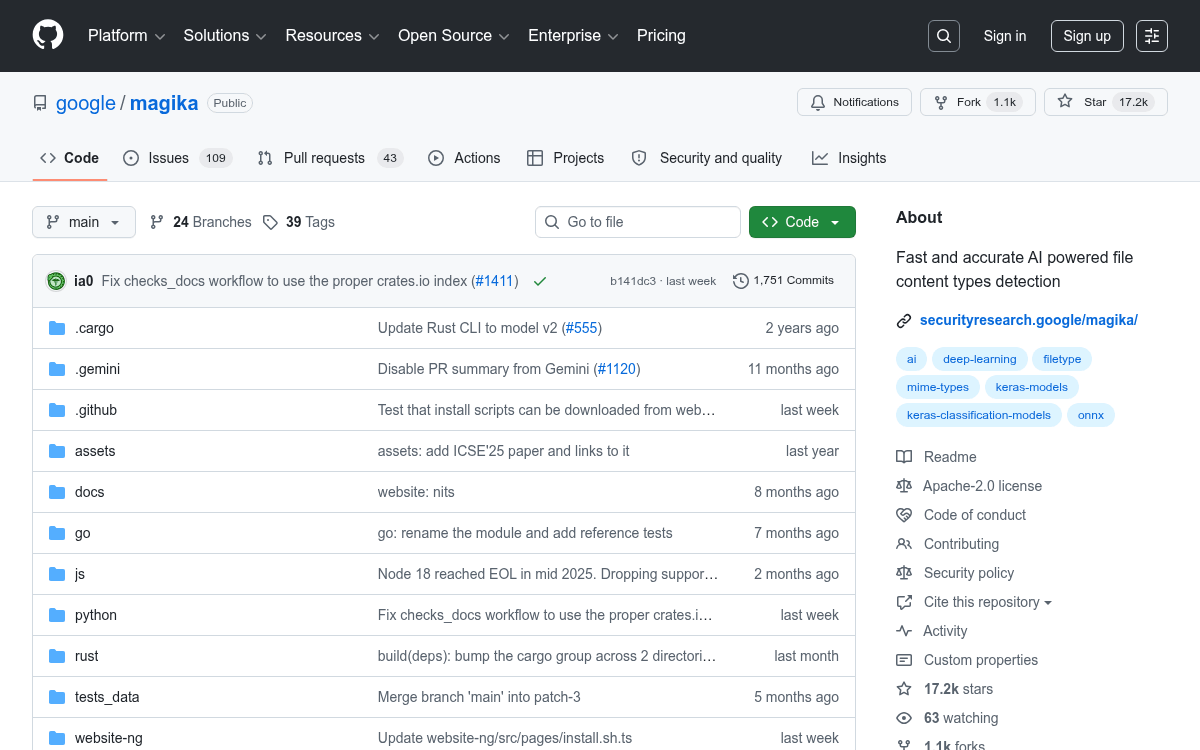
- What it is: Google's open-source AI tool that detects 200+ file content types in ~5ms with ~99% accuracy, using a ~3MB deep learning model.
- Scale: Already processing hundreds of billions of files per week inside Gmail, Google Drive, and Safe Browsing.
- How it works: Reads only up to 2KB of file bytes, runs a custom neural net, and applies per-type confidence thresholds to avoid false positives.
- Key advantage: 12% F1 gain over best existing tools on text/code files -- exactly where magic-byte heuristics fail most.
- Limitations: Does not handle polyglot files and is potentially susceptible to adversarial byte-level perturbations.
- Free & multi-language: Apache 2.0, available via GitHub with Python, Rust, JavaScript, and Go bindings -- plus a browser demo.
File type detection sounds boring until you realize that getting it wrong is how malware slips past security scanners. For decades, the industry leaned on libmagic and the Unix file command -- hand-written pattern matching against "magic bytes" at the start of a file. Linux's libmagic and the file utility have served as the de facto standard for file type identification for over 50 years, and today web browsers, code editors, and countless other software rely on file-type detection to decide how to properly render a file. Google decided that wasn't good enough, and built Magika -- an AI-powered replacement that is now open source and production-battle-tested at a scale most teams will never encounter.
The problem with magic bytes
Traditional detection has three weak points that attackers know well:
- File extensions can be renamed in seconds
- MIME types come from the client and are frequently wrong
- Magic numbers work for common formats but struggle with proprietary or polyglot files
This manual approach is both time consuming and error prone, as it is hard for humans to create generalized rules by hand. For security applications in particular, creating dependable detection is especially challenging as attackers are constantly attempting to confuse detection with adversarially-crafted payloads. The consequences are real: a PE binary misidentified as a text file skips the malware sandbox. A JavaScript file disguised with a .png extension sails past the image scanner.
A 3MB model doing the work of 50 years of heuristics
Magika is a novel AI-powered file type detection tool that relies on recent advances in deep learning to provide accurate detection. Under the hood, it employs a custom, highly optimized model that only weighs about a few MBs, enabling precise file identification within milliseconds, even when running on a single CPU. Magika has been trained and evaluated on a dataset of ~100M samples across 200+ content types, and it achieves an average ~99% accuracy on its test set.
This story is for Pro members
You've reached the end of the free preview. Upgrade to AlphaSignal Pro to read the full article - and everything else behind the paywall.
Comments
