

Google's GlucoFM Beats Every Rival at Predicting Diabetes From Wearable Data
Google Research unveils a self-supervised model that splits glucose data into slow trends and short spikes, beating prior baselines by 5.8 PR-AUC points.
- Google Research released GlucoFM, a self-supervised foundation model for continuous glucose monitoring data.
- Dual-stream design separates slow glycemic baselines from short-term spikes before recombining representations.
- Pre-trained on 109,066 hours of unlabeled CGM across 477 participant sessions using JEPA-style latent prediction.
- Beats strongest baseline by 4.1 PR-AUC points across 14 cohort-task evaluations, roughly 7.5% relative gain.
- Wins 11 of 12 cross-dataset transfer evaluations and stays best under one-shot and 1% data regimes.
- Full paper on arXiv; no code or API released yet.
Continuous glucose monitors (CGMs) generate a firehose of data, a reading every few minutes from a sensor under the skin, but turning those traces into useful clinical predictions is hard when labeled outcomes like insulin resistance or beta-cell dysfunction are scarce. Google Research just released GlucoFM, a self-supervised foundation model that learns transferable representations from raw CGM streams and posts new state-of-the-art numbers across a wide battery of metabolic prediction tasks.
Existing CGM foundation models like CGMformer, GluFormer, and CGM-JEPA process glucose through a single representation stream. CGM recordings actually contain two intertwined dynamics: relatively slow baseline patterns punctuated by short-term deviations that may reflect meals, activity, or sensor artifacts. GlucoFM explicitly splits those two dynamics into separate streams before recombining them, and the ablations suggest that split is where most of the gains come from.
The dual-stream trick
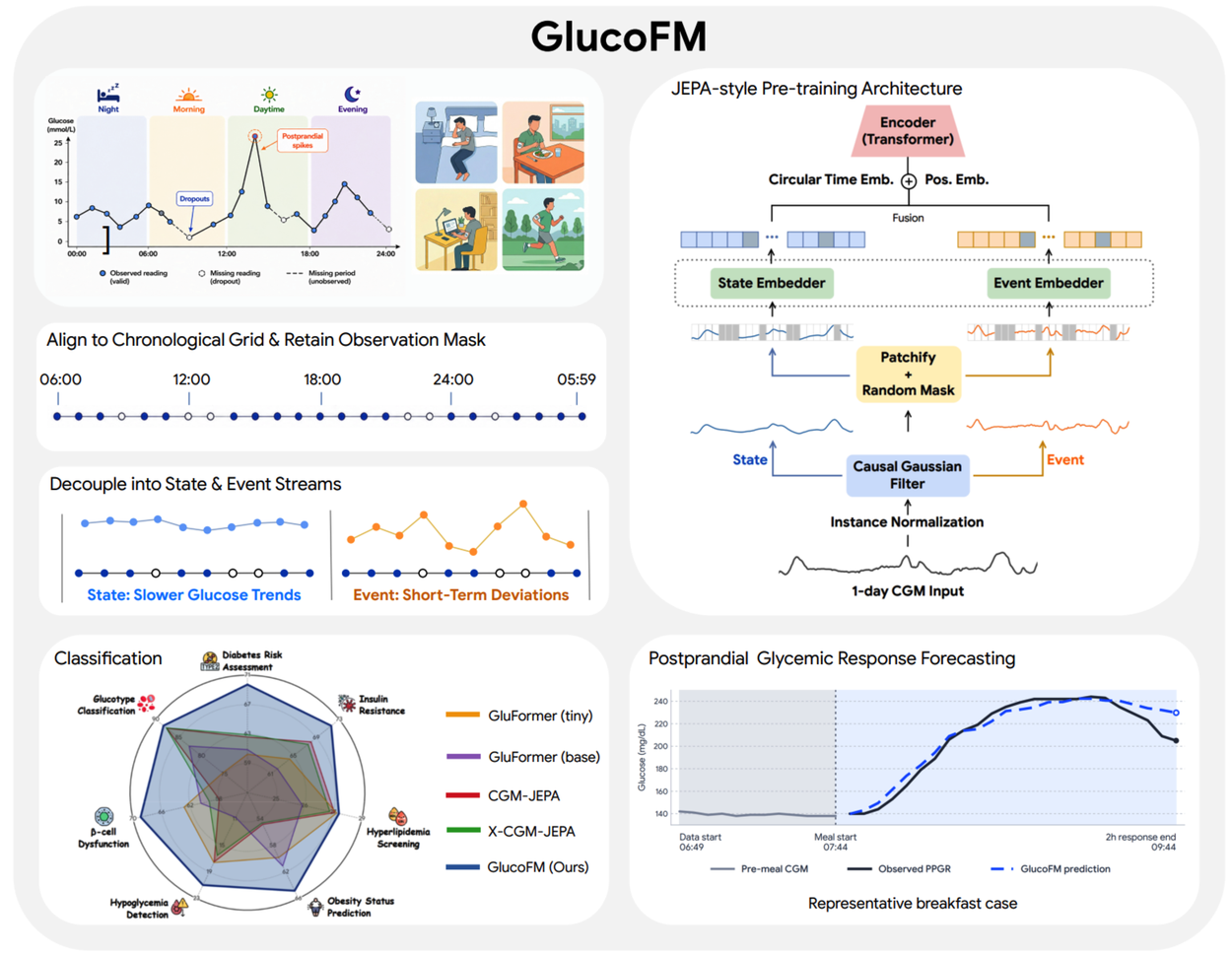
Before any learning happens, GlucoFM normalizes the messy reality of CGM recordings. It aligns each recording to a 24-hour, five-minute grid and retains an observation mask, keeping measured and unobserved positions distinct. That preserves both the time-of-day structure and the pattern of missingness, which itself carries information about sensor behavior.
A dual-stream encoder then separates a lower-frequency state component, representing slower glycemic trends, from a residual event component capturing short-term deviations that may arise from physiology, behavior, or sensing artifacts. Rather than trying to predict the exact glucose values, which are noisy, the model uses a JEPA-style latent prediction objective with two complementary tasks:
- Contextual prediction: mask parts of a day and predict the latent representations of the hidden segments from the surrounding context.
- Temporal dynamics: predict how the steady baseline and short-term deviations will evolve from one hour to the next, teaching continuity rather than snapshot behavior.
CGM-aware augmentations introduce baseline drift, compression-like drops, sparser sampling, and short disconnections, exposing the model to variation and missingness encountered in real recordings. This matters in deployment, where sensors fall off and calibration drifts.
A modest but focused pre-training corpus
Pre-training used 109,066 hours of unlabeled CGM data from Wear-CGM and four published datasets, totaling 477 participant/session records. That is small by LLM standards but reasonable for a physiological signal domain where diverse labeled cohorts are the real bottleneck. Evaluation spanned four cohorts (CGMacros, Stanford, Hall, ShanghaiT2DM) and seven clinical prediction tasks including diabetes risk, insulin resistance, beta-cell dysfunction, hyperlipidemia, hypoglycemia, obesity, and glucotype.
How it performs against the field
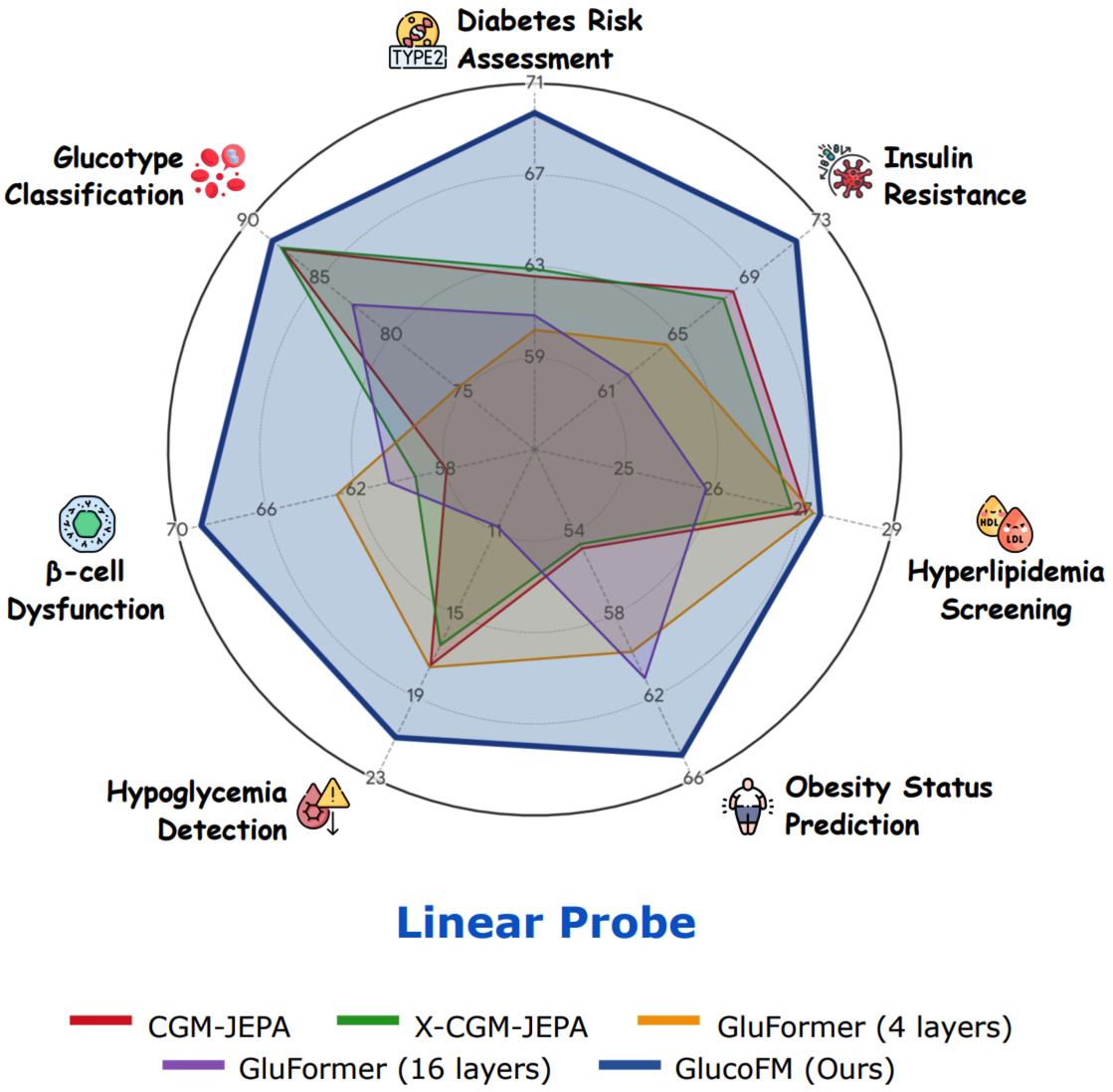
The headline number is the linear probing result: freeze the encoder, train a small linear classifier on top, and measure PR-AUC. Across 14 cohort-task evaluations, GlucoFM increased average PR-AUC from 54.7 for the strongest CGM-specific baseline retrained on the same data to 58.8, an absolute gain of 4.1 points, or roughly 7.5% relative to that baseline. It achieved the highest PR-AUC in all diabetes-risk and beta-cell-dysfunction evaluations, and in three of four insulin-resistance evaluations.
On the dynamic postprandial glycemic response (PPGR) task, where the model has to predict a full two-hour glucose trajectory after a meal, adding progressive context (pre-meal CGM, meal nutrition, fasting glucose, BMI, diabetes status) yielded the lowest mean MAE among the evaluated models: 21.88 mg/dL, compared with 22.90 mg/dL for the best baseline and 27.69 mg/dL for the train-fold mean baseline.
Two results stand out for practitioners thinking about generalization and label efficiency:
- Cross-cohort transfer: GlucoFM led in 11 of 12 evaluations by 0.5 to 8.6 PR-AUC points and trailed once by 0.6 points. Training a diabetes-risk classifier on one cohort still worked on patients from a totally different study.
- Few-shot adaptation: GlucoFM stayed on top even at one labeled subject per class and 1% of per-subject observations, useful when running a small pilot study.
Why the split earns its keep
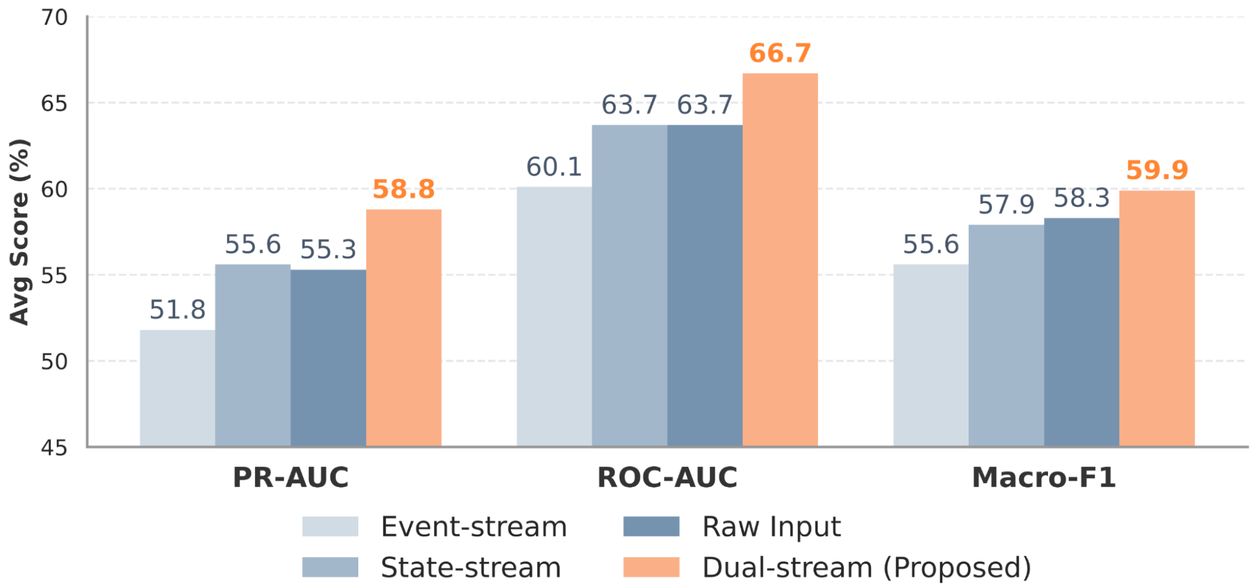
The ablation is worth pausing on. The event-only version was the weakest, showing that transient fluctuations alone do not support a stable metabolic picture. The raw-input and state-only versions were competitive, but the full dual-stream model consistently came out on top. Separating and then recombining slow baselines from transient spikes beats letting a single encoder untangle them implicitly. This mirrors what has been useful in speech and video, and it may generalize to other multiscale biosignals like heart rate variability or accelerometry.
What is now practical
Because the frozen representations transfer across cohorts and adapt with a few labeled examples, teams building CGM analytics can skip the usual pattern of collecting a large custom labeled dataset per new task. Practical implications include:
- Smaller clinical trials can bootstrap phenotype classifiers (diabetes risk, insulin resistance) with a handful of subjects.
- PPGR forecasting pipelines can plug in GlucoFM embeddings as historical context alongside meal macros and demographics.
- Subject-level predictions improve simply by averaging frozen daily representations across multiple days without retraining.
Limitations and open questions
The team is candid that the pre-training population is modest and each 24-hour window is processed independently, which caps how well the model captures trends unfolding over weeks or months. There is no public code drop or hosted API in the announcement; this is a research release, with the paper on arXiv as the primary artifact. The strongest baselines here, including GluFormer and CGM-JEPA, were retrained on the same corpus for a fair comparison, so the reported gains reflect architecture rather than a data advantage.
For anyone working on wearables, digital health, or biosignal foundation models, the takeaway is less about the specific numbers and more about the design pattern: decompose the signal along its natural timescales, predict in latent space rather than reconstructing noisy raw values, and preserve the mask. That recipe made a meaningful dent in a benchmark where single-stream transformers had been the default.
Comments
