

- Google announced 14 new MCP-powered app connections for Gemini, including Ticketmaster, Zocdoc, Otter.ai, Pandora, and Zoho.
- Connections span four categories: productivity/creativity, local/entertainment, music, and home/health/lifestyle.
- Gemini crossed 1 billion monthly active users, becoming Google's fastest-growing product ever -- tripling its user base in under a year.
- All 14 integrations use the Model Context Protocol (MCP), an open standard that lets AI assistants connect to external apps without custom per-integration engineering.
- Gemini Spark, Google's agentic tier, will soon be able to use these connections to take autonomous actions; custom MCP servers are also supported for Spark users.
- The move intensifies competition with ChatGPT's plugin ecosystem, with Google leveraging its 1 billion-user base and deep Workspace integration as key differentiators.
Google just announced 14 new third-party app connections coming to the Gemini app, spanning everything from restaurant bookings and concert tickets to doctor appointments and meeting transcriptions. The announcement dropped at Made by Google alongside a milestone that puts the stakes in sharp relief: Gemini has surpassed 1 billion monthly users as of August 2026, making it the fastest-growing product in the company's history.
The timing is deliberate. Google is using that momentum to push Gemini from a capable chatbot into something closer to a universal action layer -- one that can reach into the apps you already use and do things on your behalf.
14 new apps, four categories
The new connections cover a wide surface area of daily life. Google is rolling out integrations across productivity and creativity (Granola, Otter.ai, Wix), local and entertainment (Fever, Get Your Guide, Localiza, OpenTable UK, Ticketmaster), music (iHeartRadio, Pandora), and home, health, and lifestyle (Angi, Thumbtack, Zocdoc).
- Ticketmaster -- find live event tickets by natural language query
- OpenTable -- book restaurant reservations directly from chat
- iHeartRadio & Pandora -- stream music and podcasts on command
- Wix -- build or edit a website by describing what you want
- Fever & GetYourGuide -- discover and book local experiences and tours
- Otter.ai & Granola -- summarize and search across meeting transcripts
- Angi & Thumbtack -- find and compare local home service professionals
- Zocdoc -- schedule doctor appointments by location and specialty
- Localiza -- rent a car in Brazil
- Zoho -- query your CRM deals and pipeline
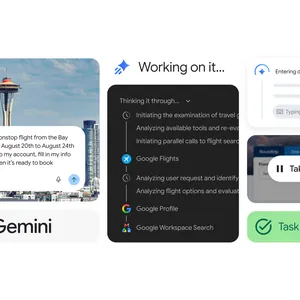
These connections are rolling out over the next few weeks. You enable them by linking your accounts in Gemini's settings, after which you can trigger any of them through plain-language requests.
Why MCP is the key detail here
Google is calling these "MCP connections," and that label matters. MCP -- Model Context Protocol -- is an open standard originally introduced by Anthropic in late 2024. It is a standardized way for AI applications to connect to external systems -- think of it as a universal adapter that lets AI assistants plug into the tools you already use.
Before MCP, every AI-to-app connection required a bespoke integration. Instead of an N×M problem where every AI tool needs a connector for every platform, MCP creates a 1×N solution where each platform implements MCP once, and every compatible AI tool can connect. Anthropic introduced it in late 2024 and donated it to the Linux Foundation's Agentic AI Foundation in 2025, with backing from OpenAI, Google, Microsoft, AWS, Cloudflare, and Bloomberg.
In practice, what this means for Gemini users is that these integrations are not one-off hacks. They follow a shared protocol, which makes them more reliable and easier to expand. Google had already expanded its MCP connections with Canva, OpenTable, and Instacart earlier this year, and this latest batch of 14 is a continuation of that strategy.
The bigger picture: 1 billion users and an agentic pivot
Gmail took roughly 14 years to build an audience of 1 billion, while Gemini managed to triple its user base in under a year. Google reported 400 million monthly active users at its developer conference in May 2025, climbing to 650 million in October 2025, 750 million in February 2026, and 950 million at Q2 earnings before crossing the billion mark.
The 1 billion figure applies strictly to the standalone Gemini app on mobile and desktop -- it excludes users accessing AI features embedded inside other Google products. That means the actual reach of Gemini's underlying models across Search, Workspace, and Android is considerably larger.
How people are using it is also telling. 63% of users now talk directly to Gemini, including more voice-only users, and busy parents are 43% more likely to use voice for everyday tasks. One in five Gemini Live interactions go beyond voice, with people using live camera feeds and screen sharing for real-time problem-solving.
The important shift is this: Gemini is becoming less like a chatbot you ask random questions and more like a personalized assistant that can research, create, organize, act, and improve alongside your existing workflow. The 14 new app connections are the clearest expression of that direction yet.
Who wins, who loses
For end users, the value is obvious: fewer app switches, more tasks completed in one place. The meeting transcription integrations (Otter.ai, Granola) are particularly interesting for teams -- being able to ask Gemini to summarize a specific call or extract action items across multiple recordings is a meaningful workflow upgrade.
For the app partners, being in Gemini's connected apps directory is a distribution play. Gemini's popularity is driven by features like conversational AI, multimodal input, real-time problem-solving via voice and camera, and robust integrations with over 40 popular apps -- and that list is growing fast. Getting in front of a billion users through natural language queries is a new kind of search placement.
The competitive pressure on ChatGPT and Claude is real. ChatGPT has the deepest third-party integration ecosystem, with plugins, the GPT Store, Zapier connections, and a long history of developer adoption. But Gemini is unbeatable if you live in Google's world -- native integration into Gmail, Docs, Sheets, Slides, and Meet means it can see and act on your actual work rather than just generating new content in a separate window.
What to watch next
In the coming weeks, Gemini Spark -- Google's agentic tier -- will be able to use these MCP connections to get things done autonomously. Google is also adding new abilities including texting and emailing Spark, creating custom sub-agents, and operating your local browser. Custom MCP connections, meanwhile, allow users to point Gemini at their own MCP server, though this capability is currently limited to users with Gemini Spark access.
The rollout of 14 new apps is a significant update on its own. But the more important story is what it signals: Google is treating MCP as the connective tissue for turning Gemini into a platform, not just a product. For anyone building tools or services that want to be where users are, implementing an MCP server is quickly becoming table stakes.
Comments
