

Google's Gemini 3.6 Flash Hits GitHub Copilot Faster and 17% Cheaper
Google's Gemini 3.6 Flash lands in GitHub Copilot with better coding benchmarks, 17% fewer output tokens, and a lower price than its predecessor
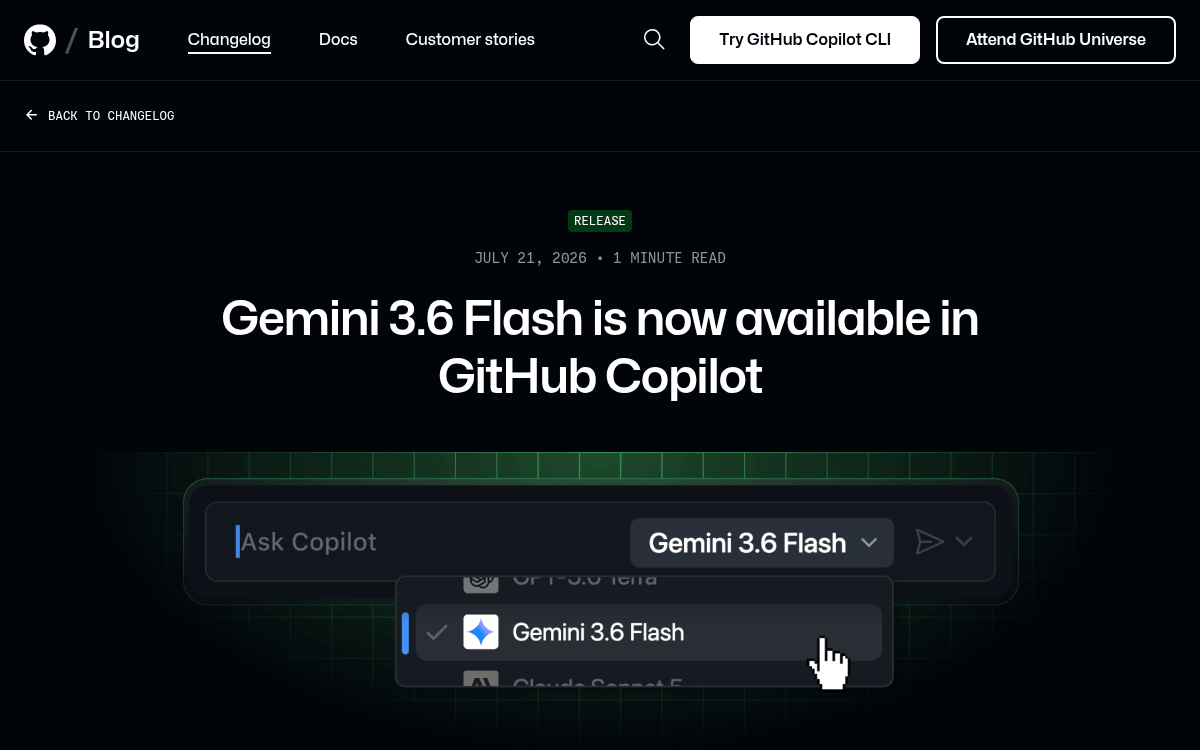
- Gemini 3.6 Flash is now rolling out in GitHub Copilot for Pro, Pro+, Max, Business, and Enterprise users.
- Coding benchmark scores jump significantly: DeepSWE goes from 37% to 49%, MLE Bench from 49.7% to 63.9% vs. 3.5 Flash.
- 17% fewer output tokens than 3.5 Flash on average, up to 65% fewer on some benchmarks -- directly cutting agentic task costs.
- Priced at $1.50/1M input and $7.50/1M output tokens -- cheaper than 3.5 Flash's $9 output price despite better performance.
- Features configurable reasoning effort, parallel tool use, 1M token context window, and built-in computer use.
- Enterprise/Business admins must enable the Gemini 3.6 Flash Preview policy in Copilot settings before users can access it.
Google's Gemini 3.6 Flash is now rolling out in GitHub Copilot. It's the latest in Google's Flash line, tuned for the balance between raw intelligence and the speed and cost that production workloads demand. The pitch: better code, fewer tokens burned, and a lower price than the model it replaces.
What changed from 3.5 Flash
3.6 Flash delivers higher-precision code edits with fewer unnecessary changes and tighter execution loops. On DeepSWE, which measures an agent's ability to resolve real software engineering tasks end-to-end, it scores 49% versus 37% for 3.5 Flash. On MLE Bench, which tests autonomous ML research capabilities, it jumps from 49.7% to 63.9%.
The gains extend beyond coding. On OSWorld-Verified, a computer-use benchmark that scores models on controlling desktop interfaces autonomously, 3.6 Flash posts 83.0% against 78.4% for its predecessor, and that score leads every other model in Google's published comparison, including GPT 5.6 Luna and Grok 4.5. On GDPval-AA v2, an agentic benchmark that scores models on real-world economically valuable tasks using an Elo rating system, it scores 1421 versus 1349.
Long-context retrieval is another standout. On GDM-MRCR v2 at 1M tokens, 3.6 Flash scores 54.0%, while both Gemini 3.5 Flash and Gemini 3.1 Pro stay below 27%.
Efficiency is the real story
Raw benchmark scores only tell part of the story. According to the Artificial Analysis Index, 3.6 Flash reduces output token usage by 17% compared to 3.5 Flash, and on some benchmarks like DeepSWE the reduction reaches 65%. Fewer output tokens means shorter agent loops, lower latency, and smaller bills, especially relevant in multi-step agentic workflows where token costs compound across many tool calls. On average, it completes tasks 12% faster than its predecessor.
Real-world users back this up. Figma found it faster for exploring and iterating on prototypes without sacrificing design quality. The model also executes code migrations using multi-agent orchestration with lower latency and higher output quality than 3.5 Flash.
What it can do in Copilot
3.6 Flash supports text, image, speech, and video input with a 1M token context window. It includes configurable reasoning effort, meaning you can trade response quality for speed and cost depending on the task, and it supports parallel tool use across complex workflows.
- Coding: Higher-precision edits with fewer unnecessary changes and tighter execution loops
- Agentic workflows: Parallel tool use and multi-step task completion with reduced token overhead
- Long-context tasks: 1M token context window across text, image, speech, and video
- Knowledge work: Customers like Hebbia and Harvey report strong results on document parsing, chart and data analysis, and report drafting
- Computer use: Built-in client-side tool for controlling desktop interfaces autonomously
Where other models still lead
3.6 Flash outpaces its own predecessor and Gemini 3.1 Pro across every benchmark Google has published, but GPT 5.6 Luna still leads on DeepSWE (67%) and Terminal-bench (84.7%). If raw coding agent performance on those specific benchmarks is your priority, stronger options exist in the Copilot model picker. The knowledge cutoff also advances from January 2025 to March 2026, a notable improvement but still a few months behind the current date.
Pricing and availability
Google lists 3.6 Flash at $1.50 per million input tokens and $7.50 per million output tokens, undercutting Gemini 3.5 Flash's $9 output price despite scoring higher across the board. For agentic use cases where output token costs dominate, that difference adds up.
The model is available to Copilot Pro, Pro+, Max, Business, and Enterprise users across VS Code, Visual Studio, Copilot CLI, the GitHub Copilot cloud agent, the GitHub Copilot app, JetBrains, Xcode, and Eclipse. Rollout is gradual, so check the model picker if you don't see it yet.
Copilot Enterprise and Business administrators must enable the Gemini 3.6 Flash Preview policy in Copilot settings before anyone in their organization can select it. Individual plan users can switch directly from the model picker in their IDE or the GitHub Copilot app.
One piece of broader context: Google had promised Gemini 3.5 Pro for a June arrival after I/O, and that deadline has slipped with no new date given. Two Flash-tier updates have shipped in its place, both cheaper than what they replaced. For Copilot users, that means a genuinely better model at a lower cost available now, while the more powerful Pro-tier option remains on the horizon.
Comments
