

Google's Gemini 3.6 Flash Hits 91.2% on the World's Hardest Reasoning Test
Google's Gemini 3.6 Flash hits 60.4% on ARC-AGI-2 at just $0.61 per task, while Flash-Lite offers a budget-friendly 10.3% at $0.14
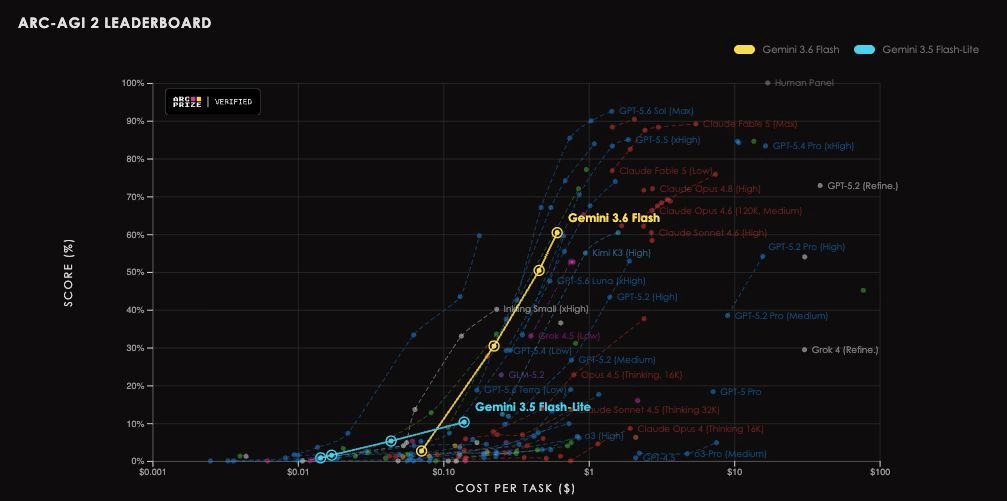
- Gemini 3.6 Flash scores 60.4% on ARC-AGI-2 at $0.61/task and 91.2% on ARC-AGI-1 at $0.34/task (verified).
- Gemini 3.5 Flash-Lite scores 10.3% on ARC-AGI-2 at $0.14/task — nearly 4x cheaper but far weaker on hard reasoning.
- Both models tested at 4 reasoning effort levels; Gemini 3.6 Flash drops from 60.4% to 2.6% on ARC-AGI-2 between High and Minimal effort.
- ARC-AGI-2 leaderboard leaders: GPT-5.6 Sol (92.5%), Claude Opus 5 (90.4%), GPT-5.5 (85%) — Gemini 3.6 Flash sits in the competitive mid-tier.
- Full per-task pass/fail results are public on arcprize.org for both models.
- ARC-AGI-2 grand prize threshold is >85%; human individual average is 66%, human panel is 100%.
Google has submitted two models to the ARC Prize verified leaderboard: Gemini 3.6 Flash and Gemini 3.5 Flash-Lite. Both have been officially tested across ARC-AGI-1 and ARC-AGI-2, with results that reveal a sharp cost-performance tradeoff in AI reasoning.
What ARC-AGI actually tests
ARC-AGI measures fluid intelligence: the ability to infer rules from a handful of examples and apply them to a completely novel problem. Each task presents a few input-output grid pairs made of colored squares. The model must identify the transformation rule and apply it to a new input. Answers must match the ground-truth output exactly, no partial credit, and models get at most three attempts per task.
The benchmark is deliberately resistant to memorization. Most benchmarks reward knowledge; ARC-AGI-2 rewards adaptability. Average individual human performance sits at 66% on ARC-AGI-1, the human panel completion rate is 100%, and the grand prize threshold is above 85% on ARC-AGI-2.
Flash vs. Flash-Lite: the numbers
ARC Prize tests each model at four reasoning effort levels: High, Medium, Low, and Minimal. These correspond to how much compute the model can spend before answering. All headline scores below are at the High effort setting.
| Model | ARC-AGI-1 (High) | ARC-AGI-2 (High) | Cost/task (ARC-AGI-2) |
|---|---|---|---|
| Gemini 3.6 Flash | 91.2% | 60.4% | $0.61 |
| Gemini 3.5 Flash-Lite | 53.5% | 10.3% | $0.14 |
On ARC-AGI-1, Gemini 3.6 Flash costs $0.34 per task at High effort. On ARC-AGI-2, that rises to $0.61. Flash-Lite runs at $0.09 per task on ARC-AGI-1 and $0.14 on ARC-AGI-2.
Reasoning budget drives everything
The effort breakdown shows how dramatically compute shapes performance. For Gemini 3.6 Flash on ARC-AGI-2:
- High: 60.4%
- Medium: 50.4%
- Low: 30.4%
- Minimal: 2.6%
That is a 23x gap between minimal and high effort on the harder benchmark. Flash-Lite follows the same pattern, dropping from 10.3% at high effort to 0.8% at minimal. More thinking time buys dramatically better generalization on novel tasks, and the data makes that concrete.
Where 60.4% sits on the leaderboard
As of late July 2026, GPT-5.6 Sol leads ARC-AGI-2 with 92.5%, followed by Claude Opus 5 at 90.4% and GPT-5.5 at 85%. Gemini 3.6 Flash's 60.4% places it in the competitive mid-tier, below the 85% grand prize threshold but ahead of most cheaper alternatives.
The drop from ARC-AGI-1 to ARC-AGI-2 scores is steep for both models. Gemini 3.6 Flash falls from 91.2% to 60.4%; Flash-Lite falls from 53.5% to 10.3%. ARC-AGI-2 was designed specifically to prevent brute-force approaches and benchmark leakage from inflating scores, so that gap is expected and intentional. A model that looks near-solved on ARC-AGI-1 can still struggle on ARC-AGI-2, and that gap is where the real frontier work is happening.
Cost is the deciding factor for most builders
For developers building reasoning-heavy pipelines, the cost-per-task metric is the most actionable number here. Gemini 3.6 Flash at $0.61/task for 60.4% ARC-AGI-2 accuracy is a meaningful data point. Flash-Lite at $0.14/task is nearly 4x cheaper, but its 10.3% ARC-AGI-2 score limits it to tasks that do not require deep novel reasoning.
A practical breakdown:
- Gemini 3.6 Flash at High effort: Use when you need strong novel reasoning and can afford roughly $0.61/task. Its 91.2% on ARC-AGI-1 means it handles most structured reasoning tasks reliably.
- Gemini 3.5 Flash-Lite at High effort: Use for high-volume, lower-complexity tasks where cost is the primary constraint. At $0.09/task on ARC-AGI-1, it is one of the cheapest verified reasoning options on the leaderboard.
- Minimal effort for either model: Both collapse on ARC-AGI-2 at minimal effort (2.6% and 0.8%). Avoid minimal reasoning budgets for anything requiring genuine generalization.
Both models are available via the Google AI API. Full per-task pass/fail breakdowns are on the Gemini 3.6 Flash results page and the Gemini 3.5 Flash-Lite results page, where you can inspect which of the 120 ARC-AGI-2 public eval tasks each reasoning level passed or failed.
Comments
