

Google's Biomarker Discovery Framework Finds 66 Health Signals Wearables Always Missed
Google's new multi-agent system turns messy wearable sensor streams into statistically vetted biomarker candidates through adversarial validation and human review.
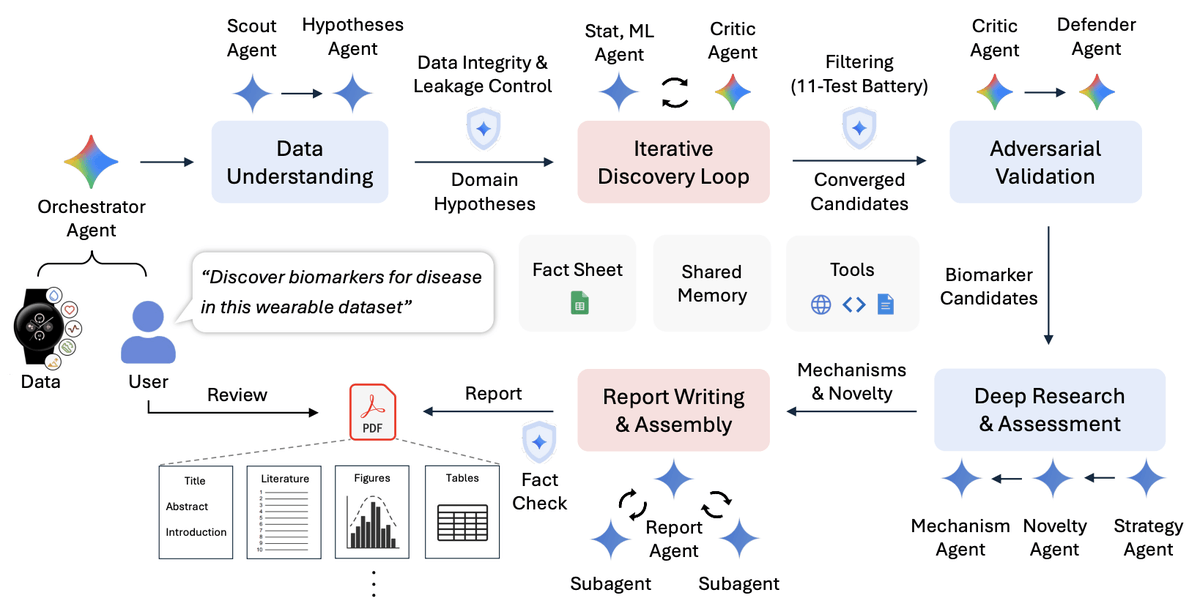
- Google Research unveiled the Biomarker Discovery Framework, a multi-agent system for wearable sensor biomarker discovery.
- Six-phase pipeline uses Scout, Critic, Defender, and Mechanism agents with an 11-check adversarial validation battery.
- Separates deterministic statistical computation from generative reasoning to prevent leakage, overfitting, and spurious correlations.
- Identified 41 mental health and 25 metabolic biomarker candidates across 9,279 participant-observations in three cohorts.
- Beat AI co-scientist, Biomni, and ADK Data Science Agent in a blinded 15-expert human evaluation.
- Reviewers kept 56.9% of its manuscript content on average versus 18.8-30.4% for baselines.
Wearable devices produce a firehose of physiological data, but most of it never turns into anything a clinician can trust. Google Research just introduced the Biomarker Discovery Framework, a multi-agent system that treats candidate biomarker discovery as an iterative research loop with hypothesis generation, statistical testing, adversarial critique, and literature grounding, all under human supervision.
The motivation traces back to a familiar failure mode in agentic science tooling. Existing LLM-based agent systems automate parts of the scientific workflow, but often break down on physiological time-series data. They optimize for predictive performance while overlooking statistical validity, which produces spurious correlations, leakage, and brittle features. On noisy sensor data, that translates to confident nonsense.
How the pipeline is wired
The framework splits the work between deterministic code (for anything numerical) and generative reasoning (for hypothesis formation and interpretation). An Orchestrator agent decomposes natural-language research directives into execution plans and guides specialized agents through a six-phase process. A shared fact sheet and common tools keep every claim traceable back to the data that produced it.

The six phases roughly mirror how a human research team would work through a biomarker question:
- Scout agents map the schema, missingness, temporal structure, and clinical endpoint, while leakage controls keep target labels separate from feature construction.
- Literature and Hypotheses agents retrieve and verify prior evidence, then propose physiologically plausible features and composite measures.
- Statistical and ML agents execute deterministic code to construct features, estimate associations, adjust for multiple testing, and evaluate predictive signals. A Critic agent identifies weak assumptions and unresolved gaps, prompting further analysis when needed.
- Critic and Defender agents stress-test candidates for target leakage, overfitting, confounding sensitivity, construct overlap, instability, and physiological implausibility.
- Mechanism, Novelty, and Strategy agents evaluate biological plausibility, prior literature, and potential translational relevance without treating an association as causal evidence.
- Report agents verify numerical claims against the fact sheet and compile the analyses, figures, literature, and limitations into a draft for expert review.
Adversarial validation is the piece worth studying for anyone who has tried to ship an agentic data science pipeline. A structured 11-check internal battery assigns explicit reporting labels including screened, conditional, exploratory, rejected, and unstable. Candidates that fail leakage or stability checks get flagged rather than silently promoted, which is where most autoML-style pipelines quietly go off the rails.
What it actually found
The team ran the framework across three independent cohorts. The pipeline autonomously identified 41 candidate digital biomarkers for mental health and 25 for metabolic outcomes. Rather than picking pre-existing columns, it built composite features. In the metabolic domain, it derived a cardiovascular fitness index (steps divided by resting heart rate) as a non-invasive correlate of insulin resistance, linking it to prior work on glucose regulation and cardiometabolic fitness.
On depression, the two mental health cohorts converged on a related idea from different angles. In DWB, sleep-duration variability was associated with PHQ-8 severity (ρ = 0.252, p < 0.001). In GLOBEM, sleep-onset variability emerged as an exploratory, low-signal association with PHQ-4 (ρ = 0.126, p < 0.001; CV AUC = 0.535). The team frames this as construct-level convergence rather than direct replication.

Effect sizes are modest, which is honest for passive sensing. Integrating these framework-derived features alongside demographic variables improved predictive performance (ΔR² = 0.040 for depression, 0.021 for insulin resistance).
The blinded expert bake-off
The more revealing evaluation pits the framework against other agentic science systems. Fifteen experts in medicine, biomedical data science, machine learning, bioinformatics, and digital health reviewed blinded reports from the Biomarker Discovery Framework and three contemporary AI research systems: Google DeepMind's AI co-scientist, Biomni, and Google ADK's Data Science Agent.
The framework received the highest mean scores across all seven quality dimensions. Under the study's simulated editorial rubric, it was the only system to earn any "Accept" or "Minor Revision" recommendations: 2 Accept, 8 Minor Revision, 8 Major Revision, and 3 Reject. Reviewers estimated they would retain 56.9% of framework-generated manuscript content on average, compared with 18.8%–30.4% for the baselines, and ranked it first in 9 of 13 four-system ranking sessions.
Rigor as architecture, not prompt
The real contribution here is architectural. Most agent frameworks let a single LLM chain tools and reasoning together, which works fine for well-posed tasks but collapses when the correctness of intermediate steps depends on statistical assumptions. By splitting deterministic computation from generative reasoning, forcing a Critic-Defender debate, and gating outputs behind explicit reporting labels, the system encodes scientific rigor as a structural property rather than a prompt.
For anyone building agentic workflows on messy real-world data, whether wearables, EHRs, financial time series, or industrial telemetry, the pattern is worth studying. Full details are in the accompanying paper, and the cohorts used (DWB and GLOBEM) are public benchmarks worth knowing if you work in digital phenotyping.
Comments
