

Google's ADK Hits 20K Stars as 2.0 Ships Multi-Agent Workflows
Google's Agent Development Kit hits 20K stars as ADK Python 2.0 goes GA with graph workflows, Kotlin support, and on-device Android agents
 PRO
PRO- ADK Python 2.0 goes GA with graph-based workflows, collaborative agents, and dynamic branching logic for production multi-agent systems.
- ADK for Kotlin and Android launched (v0.1.0), enabling on-device AI agents with local LLMs directly inside Android apps.
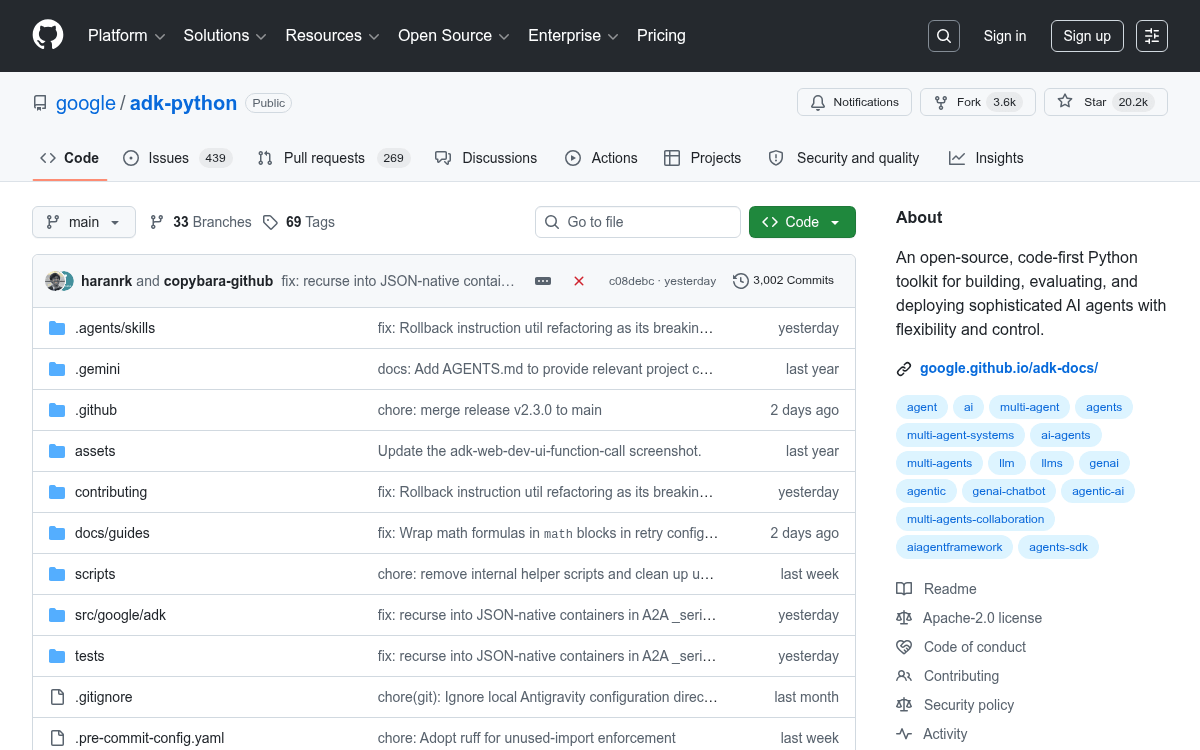
- 20K GitHub stars, 3.5K forks on google/adk-python, reflecting rapid community adoption since the April 2025 launch.
- New Python features include session rewind, a Vertex AI Code Execution Sandbox executor, and custom service registration for FastAPI.
- Five languages now supported: Python, TypeScript, Go, Java, and Kotlin, with deployment to Cloud Run, GKE, or Vertex AI Agent Engine.
- ADK 2.0 storage is not backwards-compatible with 1.0 session/memory data; do not mix storage systems across versions in production.
Google's Agent Development Kit (ADK) just crossed 20,000 GitHub stars and 3,500 forks, a milestone that reflects genuine adoption rather than hype. The timing is not accidental: ADK Python 2.0 recently shipped as a general availability release, ADK for Kotlin and Android landed, and the framework has been shipping new features on a roughly bi-weekly cadence. This is a good moment to take stock of what the framework actually is, what changed, and whether it belongs in your stack.
What ADK actually is
ADK is an open-source agent development framework that lets you build, debug, and deploy reliable AI agents at enterprise scale, supporting everything from personal AI assistants to mission-critical business workflows. The core design philosophy is code-first: you define agent logic, tools, and orchestration directly in Python rather than through configuration files or drag-and-drop UIs. It is designed to make agent development feel like software development, offering tools for creating, evaluating, and deploying agentic architectures ranging from simple tasks to complex workflows.
Users can leverage flexible orchestration to define predictable pipelines using workflow agents or rely on agent-coordinated dynamic routing for more adaptive behavior. ADK natively supports multi-agent architectures, allowing developers to compose specialized teams of agents that can collaborate and delegate tasks, and features a rich tool ecosystem for integrating third-party applications and custom code.
ADK 2.0 goes GA
The v2.0.0 release establishes production-grade foundations for multi-agent workflows and advanced dynamic agent collaboration. The three headline additions in 2.0 are:
- Graph-based workflows: Build deterministic agent workflows with more control over how tasks are routed and executed. Think of this as replacing free-form LLM routing with an explicit directed graph where you define the edges.
This story is for Pro members
You've reached the end of the free preview. Upgrade to AlphaSignal Pro to read the full article - and everything else behind the paywall.
Comments
