

Google Research Fixes Broken AI Audits With Three-Sample Unlearning Test
Google Research's new statistical framework catches privacy leaks and unlearning failures with far fewer samples than existing methods
- Google Research released Regularized f-Divergence Kernel Tests, a new framework for auditing machine unlearning and differential privacy, presented at AISTATS 2026.
- Standard two-sample tests are fundamentally flawed for unlearning audits -- they flag safely retrained models as failures due to benign training variance.
- The new three-sample relative test asks whether an unlearned model is closer to a safe retrained model or the original compromised one, eliminating false positives.
- The hockey-stick divergence tester detected privacy violations using thousands of samples where prior tools like DP-Auditorium needed millions.
- Of popular approximate unlearning methods tested (finetuning, pruning, SSD, random label), only random label passed the new evaluation.
- Code is open-sourced on GitHub and the full paper includes theoretical guarantees on false positive control.
When a user invokes their "right to be forgotten" under GDPR, a company must prove their AI model has actually erased that person's data influence. But how do you verify that a model has truly forgotten something? That question has quietly become one of the hardest problems in responsible AI, and the tools we've been using to answer it are fundamentally broken. Google Research just published a framework that fixes the core flaw.
The new approach, called Regularized f-Divergence Kernel Tests, was presented at AISTATS 2026 and is designed to make auditing ML models much more sensitive, flexible, and accurate. The code is publicly available on GitHub.
The broken audit
The standard approach to verifying machine unlearning relies on two-sample testing -- a statistical method that checks whether outputs from two models come from different underlying distributions. The logic seems sound: compare a model that supposedly forgot a record against one retrained from scratch without it. If their outputs look statistically different, unlearning failed.
The problem is that this test is too sensitive in the wrong direction. Exact unlearning mechanisms that retrain from scratch without access to the forget data are safe by definition. However, two-sample tests incorrectly flag them as unsafe due to distributional differences with the reference model. The three-sample test overcomes this issue.
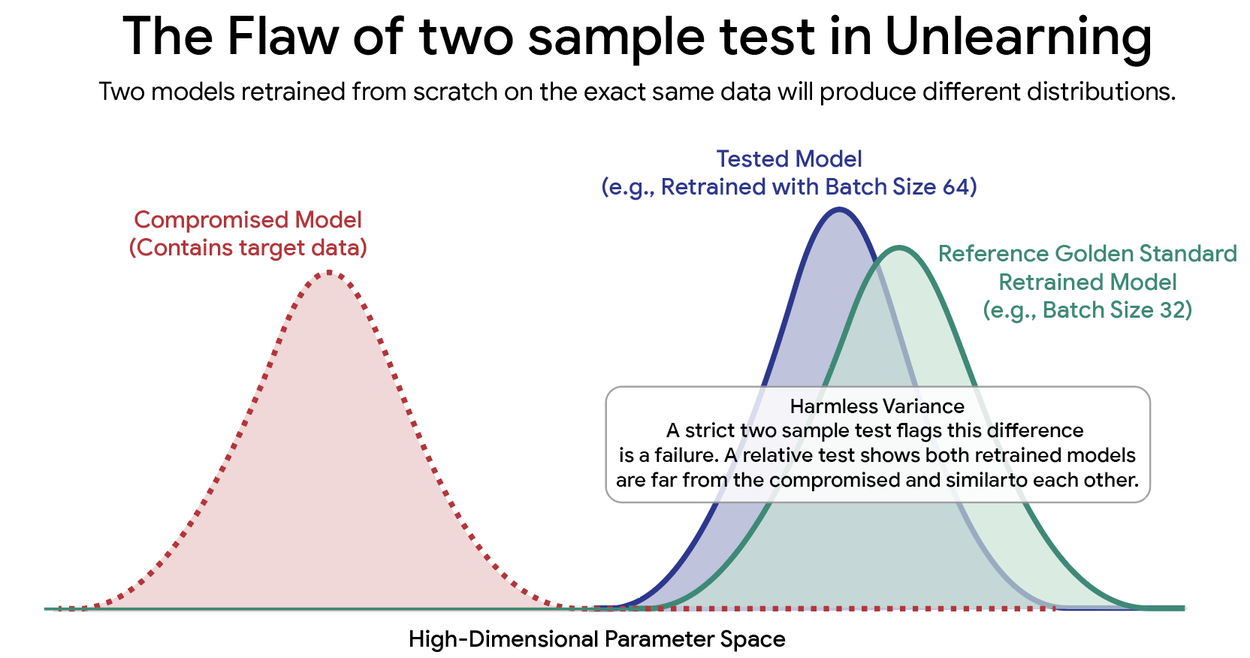
There's also a theoretical ceiling. Recent work shows that an AI model can never perfectly "forget" data just by tweaking its current settings; unless it re-traces every step of its original training, it will always leave behind a permanent footprint of the information it was supposed to delete. This means a sensitive enough two-sample test will always flag approximate unlearning as a failure, even when it's working correctly.
Beyond the false-positive problem, existing tools like Maximum Mean Discrepancy (MMD) -- a popular way to measure how different two distributions are -- have a sensitivity gap. MMD excels at detecting broad, global shifts across data, such as a model systematically generating brighter images than its counterpart, but often lacks the necessary specificity to capture complex anomalies. If a forgotten person's data only causes a highly specific, localized outlier in the model's outputs, MMD can miss it entirely.
The three-sample fix
The core innovation is reframing the unlearning audit as a relative distance problem rather than an absolute one. Instead of asking "is the unlearned model identical to a retrained model?", the new framework asks: "is the unlearned model closer to the safely retrained model, or closer to the original compromised model?"
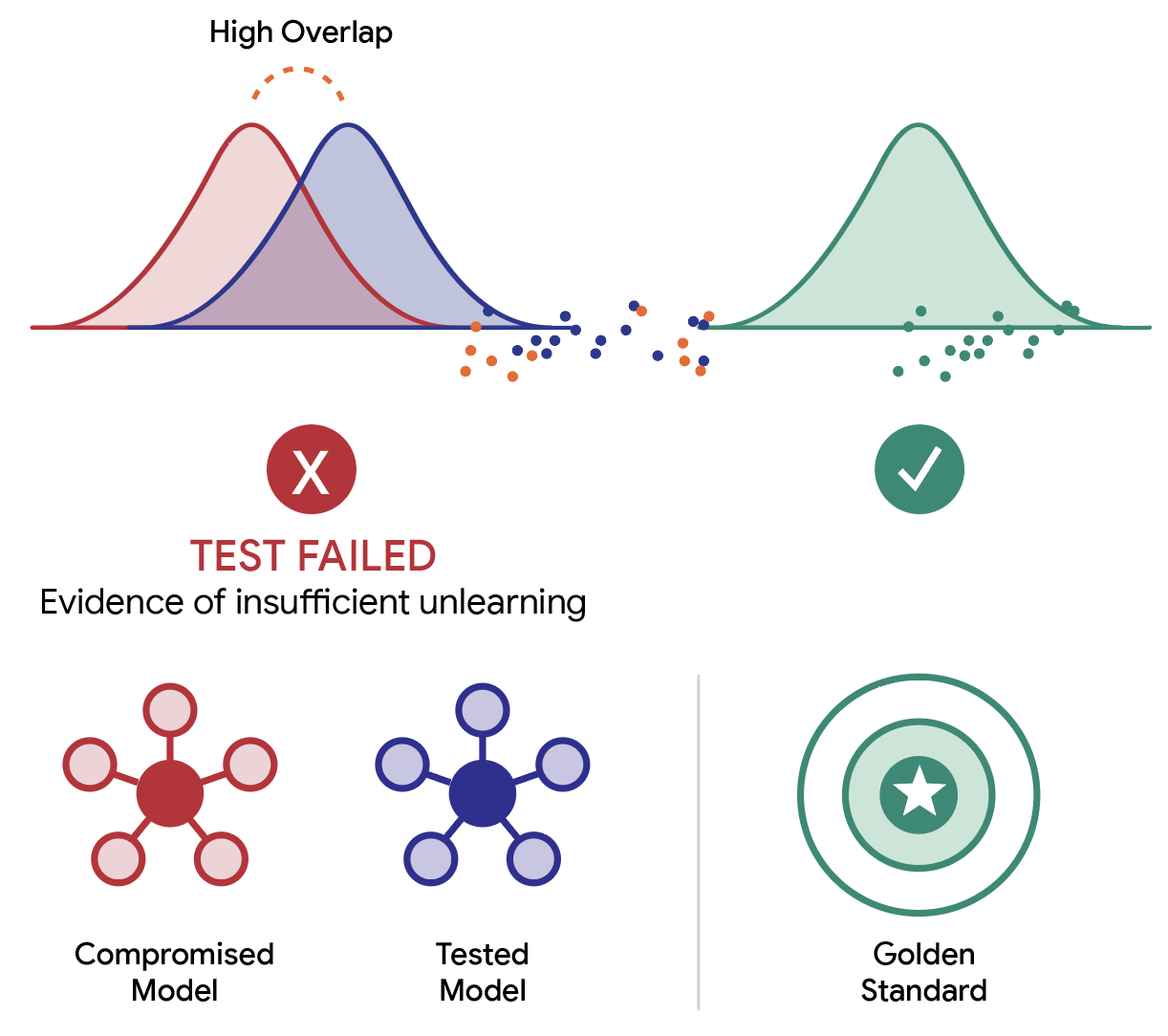
This three-sample test is robust to benign distributional differences introduced by retraining with different hyperparameters (like batch size), while still catching genuine unlearning failures. The test correctly identifies all retrained-from-scratch models as safe, regardless of minor training variations.
The framework is built on f-divergences -- a broad family of statistical distance measures, each sensitive to different types of data shifts. Think of them as specialized sensors:
- Chi-squared and KL divergences: Effective for identifying smooth and localized differences, such as outliers in physical models.
- Hockey-stick divergence: Specially captures definitions for privacy and unlearning. It operates with a parameter that controls the degree of statistical indistinguishability, effectively establishing an acceptable threshold and only triggering an alert when a meaningful privacy breach occurs.
- f-Agg: An aggregated test that combines multiple divergences to catch a wide range of anomalies automatically.
Calculating these divergences on high-dimensional, real-world data is notoriously difficult. To make these complex optimization problems tractable without requiring massive amounts of compute, the framework uses kernel regularization methods to estimate the differences efficiently. The adaptive testing approach automatically selects the best divergence and the optimal hyperparameter configurations to maximize reliability, entirely eliminating the need for sample splitting.
Sample efficiency that matters in practice
The most immediately practical result is the dramatic reduction in samples needed to catch privacy violations. In one notable instance, the framework detected violations in a specific sparse vector technique mechanism using only a few thousand samples, while previously studied techniques like DP-Auditorium required millions of samples to approximate the same violation detection rate.
That's not a minor improvement -- it's the difference between an audit that's computationally feasible and one that isn't. For privacy auditing, the hockey-stick divergence test proved especially powerful because it directly aligns with the mathematical definition of differential privacy (DP). DP is a formal privacy guarantee that bounds how much any single person's data can influence a model's outputs; the hockey-stick divergence measures exactly that type of bounded influence.
What it found about popular unlearning methods
The framework was tested against several widely-used unlearning algorithms on CIFAR-10, including Selective Synaptic Dampening (SSD), pruning, random label, and finetuning. The results are sobering:
- Finetuning: Failed -- the unlearned model remained closer to the original compromised model.
- Pruning: Failed -- same result.
- Selective Synaptic Dampening (SSD): Failed -- despite being a popular method, it left detectable traces of the forgotten data.
- Random label: Passed -- the only approximate method that cleared the three-sample test.
- Retrained from scratch: Correctly identified as safe in all configurations.
The authors are careful to note these were simplified implementations, and more rigorous setups may produce different rankings. But the result still signals that the field may be over-relying on unlearning methods that don't actually meet the bar for true data removal.
What needs to change
The deeper implication here is a redefinition of what "successful unlearning" even means. The newly proposed framework provides a much more precise, adaptable, and mathematically sound lens for examining ML behavior. By leveraging regularized f-Divergence kernel tests, researchers and auditors can now statistically prove whether a model is behaving unsafely or leaking data across a massive class of problems and complex distributional shifts.
For teams building GDPR-compliant systems or working on privacy-preserving ML, this framework offers a concrete path to more credible audits. The shift from two-sample to three-sample testing isn't just a technical detail -- it's the difference between a test that reliably catches real failures and one that cries wolf on safe models while potentially missing subtle leaks.
The full paper includes theoretical guarantees on false positive control and convergence rates, along with the complete experimental setup for reproducing results on physics datasets, differential privacy mechanisms, and unlearning benchmarks.
Comments
