

Google Rebuilds Gemini to Kill the Chat Box With 900M Users
Google's Neural Expressive overhauls the Gemini app with animated, multimedia-first responses and a new agentic layer for 900M+ users
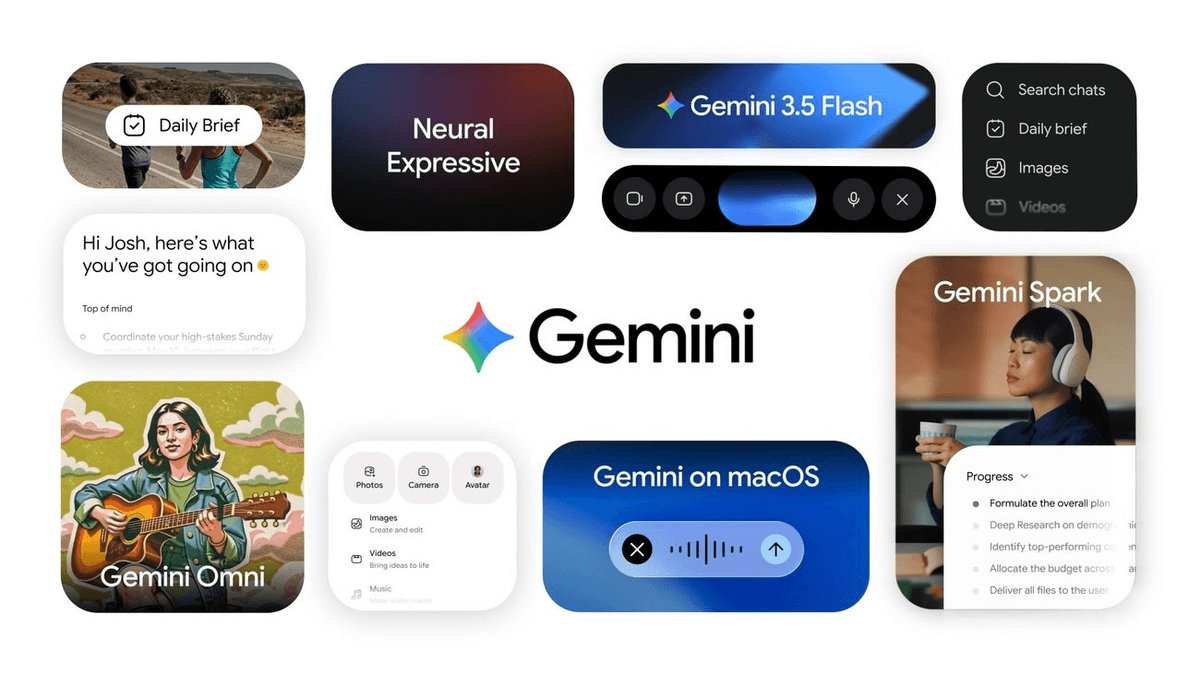
- Neural Expressive is Google's new Gemini design language: fluid animations, haptic feedback, vibrant colors, and multimedia-first AI responses -- live now on web, Android, and iOS for free.
- Responses are no longer plain text -- Gemini now generates inline images, interactive timelines, narrated videos, and dynamic graphics tailored to each query in real time.
- Gemini Spark, a 24/7 background AI agent built on Gemini 3.5 Flash, can run tasks while your phone is locked and connects to Gmail, Docs, Canva, OpenTable, and Instacart via MCP.
- Daily Brief is a new morning digest agent that scans Gmail and Calendar to surface urgent updates and next steps -- available to Plus, Pro, and Ultra subscribers in the U.S.
- Gemini's monthly active user base more than doubled year-over-year, from 400M to 900M users across 230 countries.
- Early hands-on reviews praise the visuals but flag discoverability issues for power users, as tools and attachments are now buried under a single
+menu.
Google just declared the chat log era over. At Google I/O 2026, the company unveiled a sweeping overhaul of the Gemini app anchored by a new design language called Neural Expressive, and it ships with something far more consequential than a fresh coat of paint: a rethinking of what an AI response is supposed to be.
The end of the wall of text
Neural Expressive does something no Gemini update has attempted before: it treats the AI response itself as a designed object, not a text output. The practical result is that instead of static replies, Gemini can now generate more interactive responses that include images, timelines, graphics, narrated videos, and adaptive layouts tailored to different types of queries.
Before Neural Expressive, Gemini responses arrived in undifferentiated blocks -- the same visual weight whether the answer was three words or three thousand. The redesign inverts that logic: the most critical information surfaces at the top, bolded and isolated, with additional depth scrollable below.
The visual overhaul goes deeper than layout. Colors and glow are at the forefront, with a blue-and-white gradient on the homepage. The greeting is larger and centered, with the colorful Gemini logo above it. The suggestion chips are gone, and Neural Expressive detaches the text field from your Android keyboard, letting it float in a pill-shaped UI element. While the model is thinking, the entire top half of the app starts glowing in a gradient that cycles through the Gemini icon's colors -- a different way of letting the user know the model is working.
Animations that mean something
The motion design here is not decorative. The fluid transitions and haptic feedback are communicating state. When a model is processing, retrieving, or switching modes, the interface moves in ways that correspond to cognitive load. Most AI tools either freeze or spin; Gemini now breathes.
Google has also integrated Gemini Live directly into the main chat interface, allowing users to switch more seamlessly between typing and real-time voice conversations without opening a separate screen. Previously, switching to voice meant losing your place in the conversation. Now it's a single tap. Google also re-engineered the mic so you can talk through a complex idea at your own pace without getting cut off mid-thought, and regional dialects are coming soon.
Availability and pricing
The Gemini app's Neural Expressive redesign started rolling out globally across Android, iOS, and the web. It's free for all users -- no subscription required. The broader package of updates announced alongside it, however, is tiered:
- Neural Expressive redesign: Free, available to all users on web, Android, and iOS
- Gemini Omni (cinematic video generation): Google AI Plus, Pro, and Ultra subscribers
- Daily Brief (personalized morning digest agent): Plus, Pro, and Ultra subscribers, starting in the U.S.
- Gemini Spark (24/7 agentic assistant): Beta rolling out to U.S. Google AI Ultra subscribers first
The bigger picture: Gemini goes agentic
Neural Expressive is the visible surface of a much deeper shift. Last year at Google I/O, Gemini was serving 400 million users. Today, more than 900 million people across 230 countries and more than 70 languages turn to Gemini for help every month. With that scale, Google is pushing Gemini from reactive assistant to proactive agent.
The most ambitious piece is Gemini Spark, a 24/7 background agent running on Gemini 3.5 Flash. It stays active even when you close your phone or laptop, and it is deeply integrated with Gmail, Docs, Slides, and Calendar. Here is what it can do out of the box:
- Recurring triggers: Automatically parse monthly credit card statements to flag hidden subscription fees
- Teachable skills: Monitor your inbox for school updates, extract deadlines, and send a consolidated digest to you and your partner
- Full workflows: Synthesize meeting notes across emails and chats, create polished Google Docs, and draft the follow-up email to kick off a project
Spark also connects to external services via MCP (Model Context Protocol -- a standard that lets AI agents talk to third-party apps). New MCP connections to Canva, OpenTable, and Instacart are launching now, with more partners integrating. Critically, Spark is designed to ask before performing high-stakes actions like sending emails or spending money.
What the hands-on reviews are saying
Early hands-on coverage is split. Android Authority's reviewer noted that the app is rebuilt from the ground up and called it "the best the Gemini app has ever looked." But the same reviewer flagged real usability concerns: the app is certainly more inviting, but it's not just a visual change -- and not all of those changes are improvements.
The core complaint is discoverability. Tools and attachments are now consolidated under a single + button, which power users find counterintuitive. The sidebar is also more crowded than before. A reader poll on Android Authority showed 60% of respondents were fans of the new design, while 21% specifically called out the buried controls as a dealbreaker. Google has already made one fix in response to early feedback -- the model picker now shows the active model name instead of just a chevron icon.
What this means for the industry
The Neural Expressive approach reflects a broader shift in the AI industry, where companies are increasingly focusing not only on model performance but also on how AI systems feel during everyday use. Smooth transitions, tactile feedback, and visually adaptive interfaces are becoming part of efforts to make AI interactions appear more conversational and immersive.
The chat log era of artificial intelligence is coming to an end. Google has just released a new version of its AI assistant that radically rethinks the prompt-and-response interface that has been a mainstay of the first few years of widely available generative AI. The implicit challenge to every other AI product team is clear: a plain text response box is no longer a neutral design choice -- it's a statement that you haven't kept up.
For builders integrating Gemini into their own products, the agentic layer via MCP is the part worth watching most closely. The combination of a background-running agent, a growing partner ecosystem, and a model (Gemini 3.5 Flash) that reportedly surpasses Gemini 3.1 Pro on coding and agentic benchmarks sets up Gemini as a platform, not just a chatbot. The design overhaul is what users see. The agent infrastructure is what developers will build on.
Comments
