
Google Opens GNM, a Free 3D Human Head Model With 636 Controls
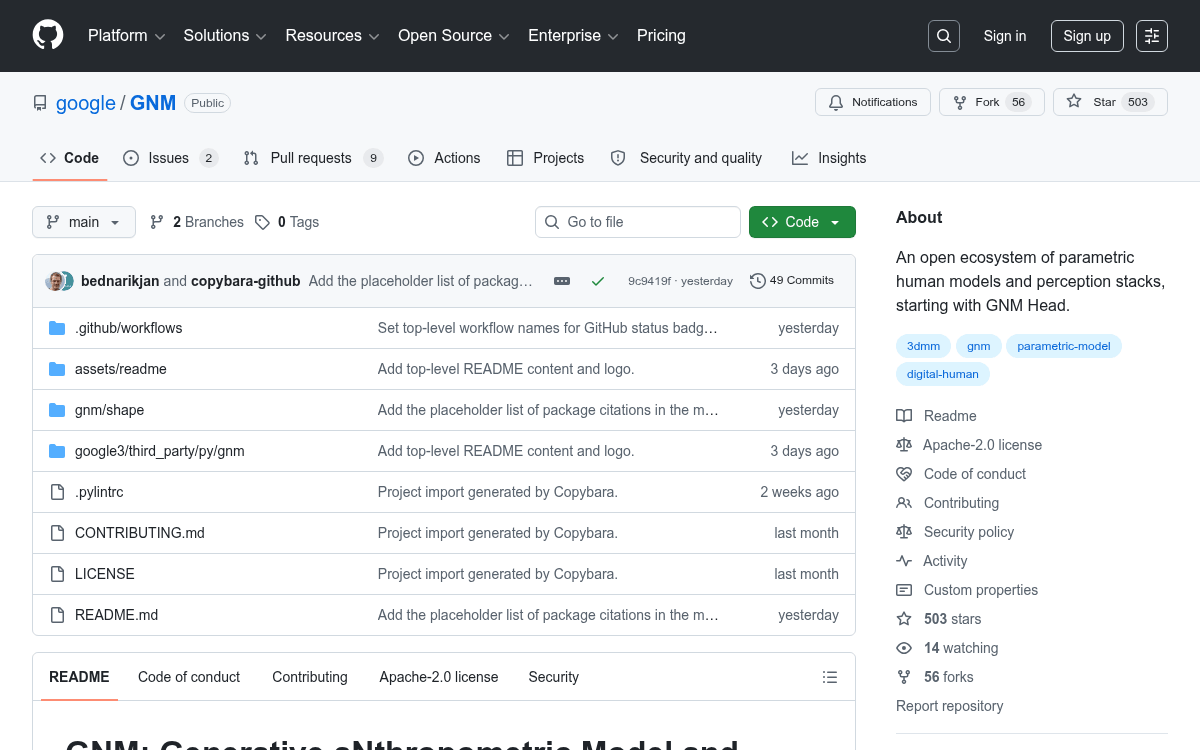
Google open-sources GNM Head, a scan-based parametric 3D head model with 636 controls for identity, expression, and anatomy — free for commercial use.
 Pro
Takeaways
- Google open-sources GNM Head, a parametric 3D statistical head model learned from large-scale 3D scan data.
- 636 total parameters: 253 for identity (head, teeth, eyeballs) and 383 for expressions (eyes, face, tongue, iris).
- Full anatomy included: the mesh covers skin, eyeballs, teeth, and tongue with disentangled controls for each.
- Multi-framework: native backends for NumPy, JAX, PyTorch, and TensorFlow; Apache 2.0 license allows commercial use.
- Semantic samplers let you generate faces and expressions from text labels like "happy" or "Asian female" without touching raw parameters.
- Community add-ons already live: a free Blender add-on and a Houdini HDA appeared within hours of the release.
Google has open-sourced GNM (Generative aNthropometric Model, pronounced "genome"), a state-of-the-art parametric 3D statistical model of the human head. The first release in what Google plans to be a full ecosystem of human body models, GNM Head gives researchers and developers a high-fidelity, fully controllable 3D head model that is free for both commercial and non-commercial use.
3D Morphable Models (3DMMs) are widely used across computer vision, computer graphics, and generative AI for representing human geometry and appearance. The field has had open models before, but nothing at this level of anatomical detail and control from a major tech company, under a fully permissive license.
Not a neural mesh generator -- a statistical model
It is worth being precise about what GNM is. GNM Head is a linear parametric model (a 3D Morphable Model): a template mesh deformed by an identity basis and an expression blendshape basis, learned from a large dataset of 3D scans -- not a diffusion model or neural network that hallucinates geometry. Every output is a deterministic, differentiable mesh you can plug into any pipeline. GNM strives to be the most accurate and complete 3D parametric human model.
It generates a dense 3D face mesh comprised of the skin, the eyes, the teeth, and the tongue, with separate parameters for identity (subject-specific facial features), expression (a rich set of blendshapes), and head pose (rotation of the neck and eyeballs).

636 knobs, all labeled
The parameter space is unusually granular. On the identity side:
- 253 identity parameters control the basic shape of the head mesh: 170 for the head itself, 80 for teeth, and 3 for eyeballs.
- 383 expression parameters cover the full face: 100 each for the left and right eyes, 150 for the lower face, 32 for the tongue, and 1 for the irises.
All parameters operate in a typical range of -3 to +3. Beyond raw numeric control, GNM includes pre-trained models to generate identity and expression parameters from semantic labels -- for example, an ExpressionSampler can generate expressions like "happy" or "surprise", or blend them. There is also an IdentitySampler that generates faces conditioned on attributes like gender and ethnicity.
Getting started in five lines
The package contains core NumPy, JAX, PyTorch, and TensorFlow based GNM shape model implementations, along with tools for visualization and semantic sampling of parameters. You can load the model and export a mesh with minimal boilerplate:
from gnm.shape import gnm_numpy
import trimesh
gnm = gnm_numpy.GNM.from_local(version=gnm_numpy.GNMMajorVersion.V3,
                                 variant=gnm_numpy.GNMVariant.HEAD)
mesh = trimesh.Trimesh(vertices=gnm.template_vertex_positions,
                       faces=gnm.triangles, process=False)
mesh.export("template_face.obj")
Install only the backends you need: pip install -e ".[jax]" or pip install -e ".[pytorch]". The model data (gnm_head.npz) ships inside the repo, so there are no separate downloads.
The community moved fast
The speed of the community response tells you something about the pent-up demand. Google is beginning the open-source release with GNM Head, and the ecosystem is released under a permissive license suitable for both non-commercial and commercial applications. Within hours of the announcement, artists had already built integrations for two major DCC tools:
- Blender: A free Blender add-on lets you import GNM Head as an interactive viewport tool, with sliders for ethnicity, gender, expressions, and more.
- Houdini: The Global Head of 3D at VFX firm Zoic Studios wrapped GNM into an HDA node, though it is not yet publicly available.
What it is good at -- and where it falls short
In its current form, GNM Head is more for researchers and software developers than CG artists: a resource from which to build artist tools, rather than an artist tool in its own right. It produces geometry only -- no textures, no hair, no shading. The model data ships as .npz files, so integration into a production pipeline requires engineering work.
There are also representation limitations to be aware of. The model was trained on datasets using binary gender categories and four broad demographic groups based on conventions in 3DMM literature and data availability. These categories do not fully represent the spectrum of human gender identities or the full diversity of the global population. Google has said a more detailed technical report on the training data is coming.
Where this fits and what comes next
The practical use-cases are broad. The model is a natural fit for:
- Face reconstruction from images or video -- fitting GNM parameters to 2D observations
- Synthetic data generation for training face detection, landmark, or expression classifiers
- Avatar and character pipelines in games, VFX, and XR applications
- Facial animation research, where a differentiable mesh model is a prerequisite
Google's roadmap includes releasing a comprehensive suite of statistical models complemented by perception and analysis technology. The repository structure already hints at a GNM Body package. A senior Google research scientist confirmed on LinkedIn that future releases are planned, though no timeline has been given. The formal model definition PDF is already in the repo, and a citable paper is listed as "coming soon."
This project is licensed under the Apache License, Version 2.0 -- meaning you can use it in closed-source commercial products without restriction. For a scan-derived, anatomically detailed 3D head model from a major lab, that is a genuinely unusual offer.