

Google Kills MusicFX to Go All-In on Flow Music
Google shuts down MusicFX and MusicFX DJ on July 31, consolidating its AI music experiments into the more capable Google Flow Music platform.

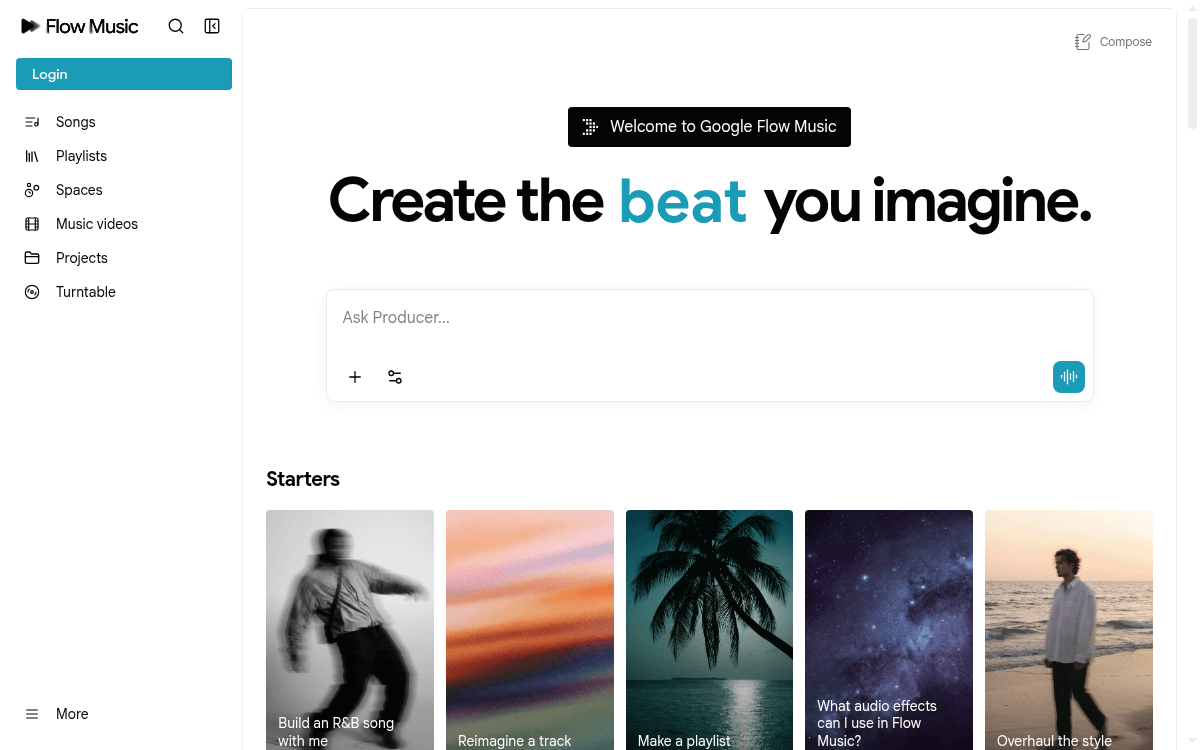
- MusicFX and MusicFX DJ shut down July 31, 2026 as Google consolidates all AI music efforts into Google Flow Music.
- Flow Music is built on Lyria 3 Pro, Google's most advanced music model, generating full songs up to 3 minutes with intros, verses, choruses, and bridges.
- Key new features include section-level editing, AI cover generation, Gemini Omni-powered music video creation, and a vibe-code mode for building custom audio plugins.
- Flow Music is trained on licensed data, giving it a legal advantage over Suno and Udio, which both faced major label copyright lawsuits.
- Suno dominates the market with $2.45B valuation and $300M ARR, but Google's YouTube integration and free access give Flow Music a structural edge for content creators.
- Google also partnered with Believe and TuneCore to bring Flow Music directly to artists and producers, signaling a push beyond casual consumers.
Google Labs just announced the end of two of its most beloved AI music experiments. MusicFX and MusicFX DJ will shut down on July 31, 2026, as Google focuses its resources on Google Flow Music -- a full-featured AI music studio the company is betting on as its long-term home for creative music projects.
This is not a quiet sunset. MusicFX was one of the most technically interesting consumer AI tools Google ever shipped, and MusicFX DJ had a devoted following among producers and hobbyists who used it to run real-time AI-powered jam sessions. Letting them go signals a clear strategic shift: Google is done running parallel music experiments and wants everything under one roof.
From Lab Experiments to a Real Product
MusicFX launched as part of Google's AI Test Kitchen, a way for users to interact with the MusicLM AI model. It was always framed as an experiment -- a place to poke at what AI could do with music, not a product you'd build a workflow around. MusicFX DJ, developed by Google DeepMind in partnership with Google Labs, functioned like a generative mixing deck where users could input multiple text prompts like "funky bassline" or "ethereal synth pads" and layer them simultaneously.
Google collaborated with Jacob Collier, a six-time Grammy award-winning singer, songwriter, and multi-instrumentalist, who spent a year working with Google DeepMind and Google Labs to help shape MusicFX DJ. The real-time interactivity and high-quality 48 kHz stereo output differentiated it from earlier static generation tools. But it was still, at its core, a research demo.
What Flow Music Actually Is
Google Flow Music is a different beast entirely. Google launched Flow Music on April 18, 2026, rebranding ProducerAI into a standalone AI music studio powered by Lyria 3. The platform runs on Lyria 3, Google's latest music generation model, and is the rebrand of ProducerAI, the startup Google acquired and brought into Google Labs in February.
Google Flow Music sits inside the broader Google Flow AI ecosystem alongside image generation (Imagen 3), video generation (Veo 3.1), and image remixing -- making it the first time Google has unified creative AI for sound, image, and video in one platform. That integration is the key differentiator. This is not just a music generator; it's a creative studio with a coherent model stack underneath it.
Here is what the platform can do today:
- Precisely edit any section of a song -- highlight a part and rewrite lyrics, restyle the beat drop, and more, without altering the rest of the track.
- Reimagine full tracks with covers: transform the style of a song while keeping the original melody and structure -- for instance, creating a lo-fi version of a playlist.
- Create music videos by feeding a song into Gemini Omni with instructions for the desired type of video, and it will take your direction to create the final product.
- Build browser-based custom audio plugins and mini-DAWs directly on the Lyria 3 API using natural language -- no audio engineering background required.
- Mobile apps are now live: the Flow Music app is available on iOS (Android coming soon), while the web version remains the primary platform for full capabilities.
The Model Underneath
Lyria 3 is Google's most advanced AI music generation tool yet, developed with input from producers and musicians so it understands musicality -- from rhythm to arrangement. Lyria 3 Pro creates songs up to 3 minutes long, with intros, verses, choruses, and bridges. That is a significant jump from MusicFX, which generated 30-second clips.
On the copyright front, Google has been careful. Lyria 3 Pro is trained on licensed data -- unlike Suno and Udio, which both faced copyright lawsuits from major music labels. All tracks created using Lyria 3 and Lyria 3 Pro are marked with SynthID to denote that AI was used to make them. For teams doing commercial work, that legal clarity matters.
A Crowded and Contentious Market
Google is stepping into a space already occupied by well-funded competitors. Suno leads the market with a $2.45B valuation, $300M ARR, and roughly 2 million paid subscribers as of early 2026. Udio is the cleaner choice for artists who need a clean licensing story, since Universal Music Group settled with Udio in October 2025 and a jointly licensed UMG x Udio platform is scheduled for 2026.
But Google's position is structurally different from either. Unlike those tools, Flow Music launches with the advantages of Google's distribution reach, Lyria 3, and tight integration with YouTube. An experimental export path sends AI-generated tracks directly into YouTube Shorts, meaning creators can score short-form videos without leaving the Google ecosystem or worrying about DMCA claims on their own AI-generated music. That YouTube pipeline alone is a moat neither Suno nor Udio can easily replicate.
ProducerAI had already reached 1 million users before the acquisition. With Google's infrastructure and free entry-level access, Flow Music has the reach to rapidly become the default for creators who want quick, royalty-free music for their content.
Who Wins, Who Loses
The clearest winners here are creators who were already using MusicFX DJ as a performance or ideation tool and were frustrated by its experimental limitations. Flow Music gives them a production-grade successor with section-level editing, full-length song generation, and music video creation in one place.
The losers are users who loved MusicFX DJ precisely because it was a low-friction, real-time performance tool. Unlike other AI music tools, Google's DJ Mode felt more like a performance tool than full song creation. That specific use case -- live, improvisational AI music -- does not have a clear equivalent in Flow Music yet.
For the broader AI music market, Google's consolidation move adds serious pressure to Suno and Udio. Google is also teaming up with the global artist development company Believe to bring Flow Music and Lyria 3 Pro directly to artists -- a partnership that signals Google is building an industry-facing distribution channel, not just a consumer toy.
What Happens Next
MusicFX and MusicFX DJ go dark on July 31, 2026. If you have sessions or projects saved there, now is the time to export anything you want to keep. Google Flow Music is a generative AI platform for creating, remixing, and sharing studio-quality songs -- you can direct music videos, vibe-code new instruments, create playlists, and publish songs. It is free to start with no credit card required.
Millions of creatives across a wide range of disciplines have brought their ideas to life using Google Flow and Google Flow Music in the last year. The shutdown of MusicFX is not a retreat from AI music -- it is Google placing a much larger bet on a single, more capable platform. Whether Flow Music can hold its own against Suno's 2 million paying subscribers is the real question to watch.
Comments
