

Google Expands Gemini Spark's 24/7 Background Agent to More Countries
Google's always-on AI agent Gemini Spark expands internationally with four new productivity upgrades including Google Docs editing and parallel source retrieval
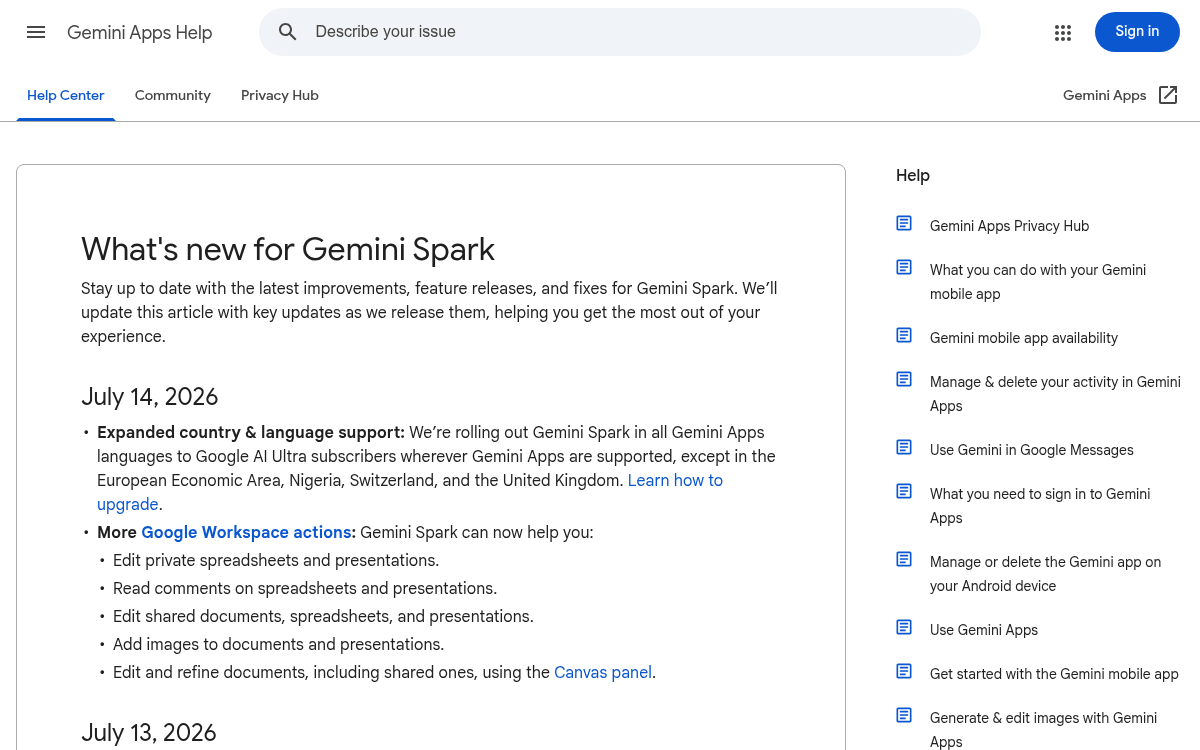
- International expansion: Gemini Spark is now rolling out to Google AI Ultra subscribers in more countries and languages beyond the initial US launch.
- Four new upgrades: Google Docs editing, Sheets/Slides comment reading, speed improvements, and parallel source retrieval are all starting to roll out today.
- Still excluded: Australia, Canada, the EU, Hong Kong, India, Japan, Nigeria, South Korea, Switzerland, and the UK remain blocked -- EU/UK pending AI Act review.
- Pricing gate: Spark requires Google AI Ultra at $100/month minimum; no standalone purchase option exists.
- Competitive context: At $100/month, Google AI Ultra is the only plan in that tier to include a persistent 24/7 cloud agent, vs. OpenAI and Anthropic's per-task models.
- Architecture: Spark runs on isolated ephemeral VMs on Google Cloud via the Antigravity harness, continuing to execute tasks even when your device is off.
Gemini Spark, Google's 24/7 background AI agent, is now rolling out to Google AI Ultra subscribers in more countries and languages -- and it's shipping four meaningful capability upgrades alongside the expansion. This is not a soft announcement. It's the clearest signal yet that Google is treating Spark as the centerpiece of its AI subscription strategy.
From chatbot to agent: what Spark actually is
Spark represents a big shift for Gemini, transforming it from an assistant that can answer your questions into an active partner that does real work on your behalf and under your direction. The key architectural difference from a regular chatbot: because it is a cloud-based agent, Spark keeps working in the background even when you close your laptop or lock your phone.
Gemini Spark runs 24/7 on dedicated virtual machines in Google Cloud, powered by Gemini 3.5 and the Antigravity harness -- an agentic framework that allows it to perform long-horizon tasks in the background. Think of Antigravity as the scaffolding that lets Spark plan, execute, and recover from multi-step workflows without you babysitting it.
The agent operates on a three-layer model: Tasks (what you want done), Schedules (when or how often), and Skills (reusable personal work patterns you teach it). Spark proactively sends critical updates and requires explicit approval for high-risk actions like sending emails. The more you use it, the better it learns your unique preferences to become a more accurate, helpful extension of your work style.
What's new in today's update
Google is pushing four improvements alongside the international rollout:
- Google Docs editing: You can now directly open and edit Google Docs files inside Spark -- not just read them.
- Deeper Workspace integration: Spark can now read comments in Google Sheets and Slides, giving it more context when working on collaborative documents.
- Speed improvements: Long-running tasks are completing faster across the board.
- Parallel source retrieval: For complex tasks that pull from multiple sources, Spark can now fetch and review those sources simultaneously rather than sequentially -- a meaningful throughput gain for research-heavy workflows.
These updates follow a steady cadence of improvements since launch. Earlier milestones included third-party connected apps like Canva, Instacart, and OpenTable, plus improved topic monitoring across news, finance, sports, and local events. Spark also landed in the Gemini app for Mac with Schedules and Skills, and gained connections to Google Keep and Google Tasks.
The subscription math
Spark requires a Google AI Ultra subscription, which starts at $100/month after Google's I/O 2026 pricing restructure; the top Ultra tier is $200/month (down from $250). The plan also includes five times the usage limits of the $20 AI Pro tier, 20 terabytes of Google One cloud storage, and YouTube Premium. There is no way to purchase Spark as a standalone product.
One important distinction for anyone outside the US: Google AI Ultra itself is available in many countries, but that does not mean Gemini Spark is available everywhere. Meeting the subscription requirement alone is not enough -- you must also be in a supported country.
Where it's available -- and where it isn't
Gemini Spark is rolling out everywhere Gemini Apps are supported, except in Australia, Canada, the European Economic Area, Hong Kong, India, Japan, Nigeria, South Korea, Switzerland, and the United Kingdom. That's a significant carve-out. The EU and UK exclusions are widely attributed to regulatory compliance work around the AI Act. EU and UK availability is pending AI Act compliance review, with a Q3 2026 timeline expected by analysts.
The international expansion is also picking up momentum in specific regions. Following its initial launch in English, Google is rolling out Gemini Spark in local languages to Gemini Advanced (Ultra) subscribers in Southeast Asia. According to Google's first-ever Gemini Southeast Asia Report, Southeast Asians are adopting Gemini at a record-breaking pace -- faster than they've adopted any other Google app -- with active users more than doubling in the region in a year.
Google's structural advantage -- and the tradeoff
Where Google believes it can differentiate is depth of integration. Because it controls the operating system, the browser, the email client, and the cloud infrastructure, Spark can operate across all of those layers without the friction that standalone agents face when stitching together disparate tools.
The competitive field is real. The launch follows a wave of competing agentic products. OpenAI recently merged ChatGPT and Codex into a single agentic platform, while Anthropic's Claude Cowork lets users hand off tasks that the AI then completes by controlling a desktop computer. At the $100 price point, Google, Anthropic, and OpenAI now all offer a premium AI tier at roughly the same price -- but Google AI Ultra is the only one in that range to include a persistent cloud agent.
The tradeoff is trust. A cloud agent with standing access to a user's inbox, calendar, and third-party purchasing accounts is a meaningfully different consent model than a chatbot that operates session-by-session. On the enterprise side, Spark operates in a fully managed, secure runtime on Google Cloud, with every task executing in a fresh, strictly isolated, ephemeral VM to ensure data never overlaps between sessions.
What to watch next
The real test is availability and trust. Many of the most ambitious features are limited to subscribers, trusted testers, US betas, or summer rollouts -- so what shipped on stage was a model and a direction more than a finished product. The EU and UK remain the biggest unlocked markets, and Google will need to satisfy regulators before it can bring Spark to hundreds of millions of additional users. For now, if you're an Ultra subscriber in a supported country, the official changelog is the fastest way to track what's live.
Comments
