

Google DeepMind Ships Gemini Omni Flash to Turn Images Into Editable Videos
Google ships Nano Banana 2 Lite for 4-second image generation at $0.034/image, and opens Gemini Omni Flash video editing to API developers for the first time

- Nano Banana 2 Lite (
gemini-3.1-flash-lite-image) generates images in 4 seconds at $0.034 per 1K-resolution image, the fastest and cheapest in the family. - Gemini Omni Flash (
gemini-omni-flash-preview) is now available via the Gemini API and AI Studio for the first time, priced at $0.10/second of video output. - Both models can be chained via the Interactions API, supporting up to 3 sequential edits with maintained session history.
- Omni Flash currently caps video generation at 10 seconds; audio references and scene extension are not yet supported in the API.
- Nano Banana 2 Lite is Google's recommended drop-in replacement for
gemini-2.5-flash-imageusers. - Both models ship with SynthID watermarking; the original Nano Banana family has generated over 50 billion images to date.
Google DeepMind is shipping two generative media models today that together cover the full image-to-video pipeline: Nano Banana 2 Lite, the fastest and cheapest image model in the Nano Banana family, and Gemini Omni Flash, which brings conversational video generation and editing to the Gemini API for the first time. The two models are designed to be chained together, and the release marks a meaningful step in making high-throughput multimedia pipelines practical at scale.
The fastest image model Google has shipped
Nano Banana 2 Lite (gemini-3.1-flash-lite-image) is designed for rapid ideation and high-velocity developer pipelines where speed and cost are the primary constraints. The headline number is hard to ignore: it delivers text-to-image outputs in 4 seconds, making it the fastest model in the family. At $0.034 per 1,000-resolution image, it is also the cheapest.
It is Google's recommended replacement for developers currently using the first version of Nano Banana (gemini-2.5-flash-image), and you can swap it out now for immediate benefits across key performance dimensions. Despite the speed focus, the model retains reliable prompt adherence, strong character consistency, and legible in-image text rendering.

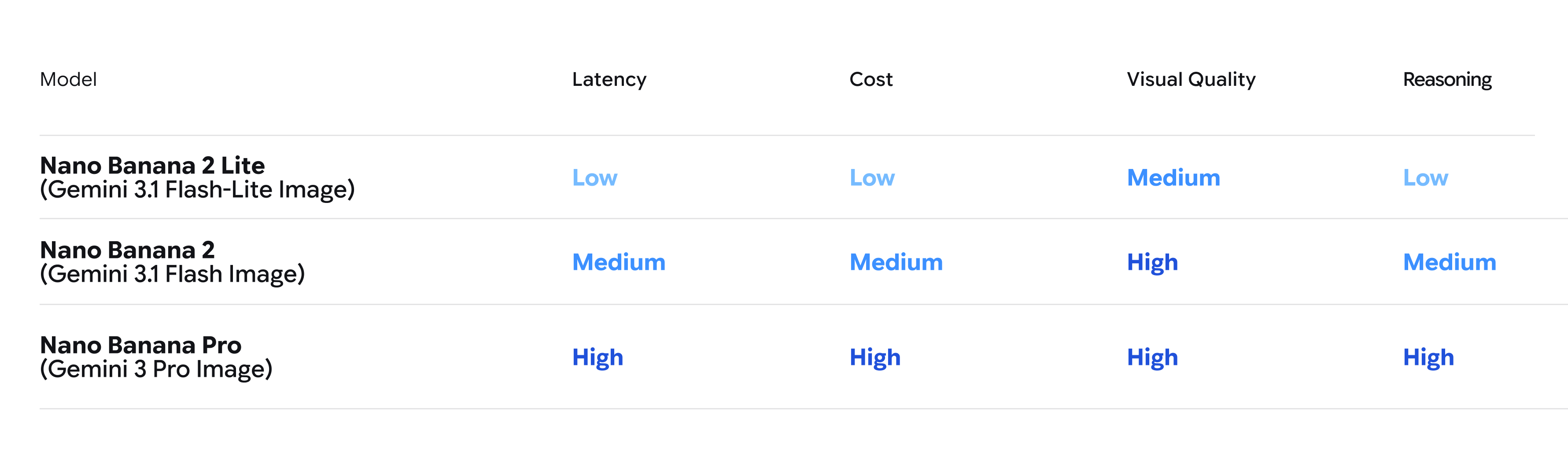
To understand where Nano Banana 2 Lite fits, it helps to see the full family:
- Nano Banana 2 Lite (Gemini 3.1 Flash Lite Image): Built for speed. Optimized for near-real-time, high-volume workflows where ultra-low latency is critical.
- Nano Banana 2 (Gemini 3.1 Flash Image): The generalist workhorse. Best balance of performance and cost.
- Nano Banana Pro (Gemini 3 Pro Image): Optimized for complex, professional use cases where accuracy matters more than speed.
- Nano Banana (Gemini 2.5 Flash Image): The legacy model. Google recommends upgrading to Nano Banana 2 Lite.
Gemini Omni Flash finally hits the API
Introduced at Google I/O, Gemini Omni Flash is the model where Gemini's multimodal reasoning meets video generation and editing. Today, gemini-omni-flash-preview is rolling to developers via the Gemini API and Google AI Studio, natively supporting high-quality video generation and conversational editing from a combination of text, image, and video inputs. This is the first time the model is available to developers programmatically.
The model is priced at $0.10 per second of video output, matching Veo 3.1 Fast. What makes Omni Flash distinct is its editing paradigm: rather than generating video from scratch each time, you can refine a clip through natural language in a conversation. Google notes that Omni has an intuitive understanding of physics, and its creations are grounded in Gemini's knowledge about history, science, and cultural context to improve photorealism and storytelling.
Omni Flash's key strengths:
- Conversational editing: Refine and edit videos using natural language across multiple turns.
- Multimodal referencing: Combine images, text, and video in a single prompt to maintain scene consistency.
- Real-world knowledge: Draws on Gemini's knowledge base for context-aware video construction.
- Text and action sync: Connect text and graphics directly to video actions through simple prompting.
There are real limitations to know about going in:
- Video generation is currently capped at 10 seconds. Google describes this as a compute deployment choice, not a model limit, and says longer durations are in the pipeline.
- Uploading audio references and scene extension are not yet supported in the API.
- Video references up to 3 seconds are accepted by the API schema but are not correctly processed by the model at this time.
- Character consistency when changing scenes or during panning movements has some limitations.
- The safety filter has a notable rate of false positives on video input. Clips that pass any reasonable bar for general audiences are getting blocked. Google has acknowledged similar over-cautious behavior on Nano Banana at launch and tuned it down later, so this will likely improve.
The real unlock: chaining image and video together
Building with generative media is often about creative iteration. With these two models, developers can build comprehensive, end-to-end multimedia experiences that connect rapid image generation with video creation and editing. The key mechanism is the Interactions API, which maintains session history so you can stack up to three sequential edits across both models in a single context.
A typical pipeline looks like this:
- Generate a draft image with Nano Banana 2 Lite in ~4 seconds.
- Pass that image as a reference to Gemini Omni Flash.
- Animate it into a video clip with a natural language prompt.
- Iterate with follow-up edits, maintaining session context throughout.
Google has shipped three demo apps to illustrate this: Anywhere (transport yourself to landmarks via selfie, then animate the scene), Space Lift (interior design reimagining with cinematic video output), and Omni Product Studio (static product images turned into e-commerce video). All three are remixable in AI Studio.
Where to use each model
Nano Banana 2 Lite is the right choice when:
- You need high-volume image generation at low cost (drafting, ideation, ad creative pipelines).
- Latency is a hard constraint, such as in interactive or real-time workflows.
- You are currently on
gemini-2.5-flash-imageand want a drop-in upgrade.
Gemini Omni Flash is the right choice when:
- You need conversational, multi-turn video editing without re-generating from scratch.
- Your pipeline combines multiple input types (text + image + video reference).
- You want Gemini's world knowledge baked into video generation for context-accurate outputs.
Availability and access
Nano Banana 2 Lite is available today in Google AI Studio, the Gemini API, and the Gemini Enterprise Agent Platform. It is also rolling out today in Google consumer surfaces including AI Mode in Search, the Gemini app, and many other products. Consumer surfaces include NotebookLM, Google Photos, Stitch, Google Flow, and Google Ads.
Gemini Omni Flash is available in public preview via the Gemini API and Google AI Studio starting today. Both models are built on Google's secure infrastructure and use SynthID watermarking, with verification available through the Gemini app, Chrome, and Search.
The Nano Banana family has already proven it can move at consumer scale. According to Google, the original Nano Banana helped attract over 10 million new users to the Gemini app and facilitated more than 200 million image edits within weeks of launch. The image generation model has generated over 50 billion images to date. Nano Banana 2 Lite is positioned to accelerate that throughput further, while Omni Flash extends the same conversational paradigm into video for the first time at the API level.
Comments
