

Google DeepMind Ships Gemini Image Models to Production, Killing Imagen for Good
Google's Nano Banana image models hit general availability, bringing 4K output, real-time search grounding, and video-to-image generation to production APIs
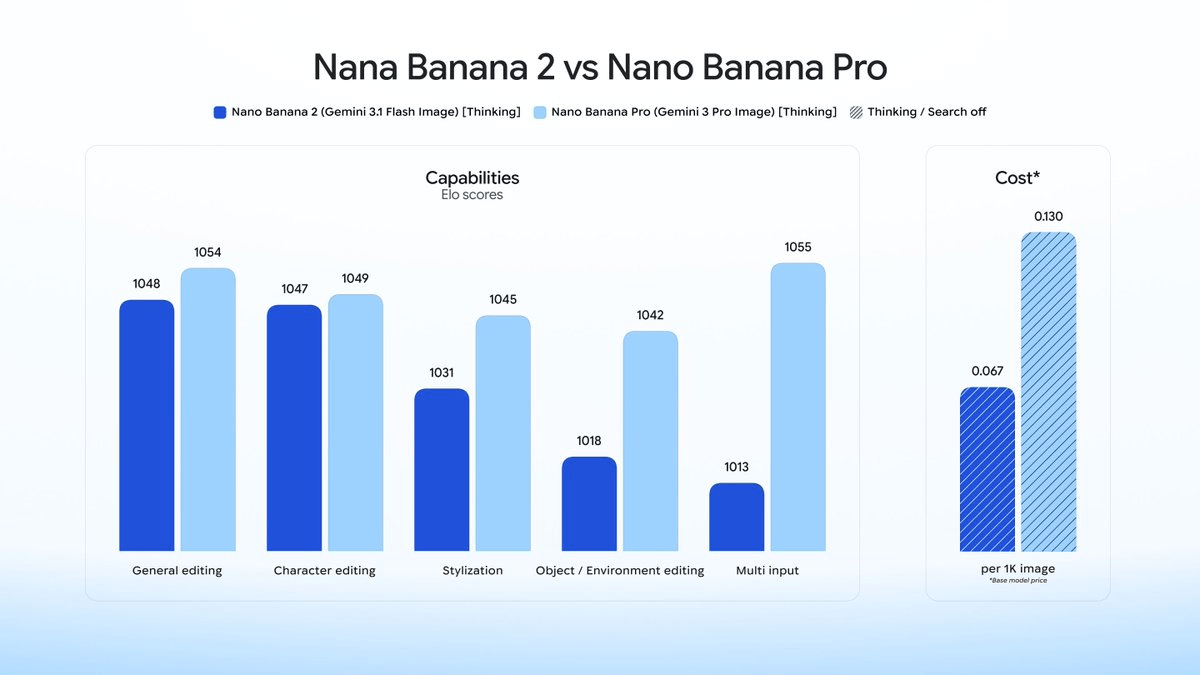
- GA release: Nano Banana Pro (gemini-3-pro-image) and Nano Banana 2 (gemini-3.1-flash-image) are now production-ready; preview model IDs shut down June 25, 2026.
- Video-to-image: gemini-3.1-flash-image now accepts YouTube URLs or uploaded videos as context to generate thumbnails, posters, and infographics.
- 4K output & thinking mode: Both models support up to 4K resolution and use a built-in reasoning process to refine composition before final output.
- Pricing: Flash costs $0.067/image at 1K; Pro costs $0.134/image at 1K or 2K; both offer 50% off via the Batch API — no free tier.
- Imagen deprecated: Imagen 4 shuts down August 17, 2026; Google is consolidating all image generation into the Nano Banana / Gemini API family.
- Flash-only extras: Image Search grounding, 512px output, extreme aspect ratios (1:8, 8:1), and adjustable thinking levels are exclusive to the Flash model.
Google's two flagship native image generation models, Nano Banana Pro and Nano Banana 2, are now generally available for production use via the Gemini API. The models, codenamed internally and known publicly by their playful banana branding, map to gemini-3-pro-image and gemini-3.1-flash-image respectively. If you were using the -preview suffix versions, you now have a stable production target , and a deadline to migrate.
On May 28, Google DeepMind officially promoted both gemini-3.1-flash-image-preview and gemini-3-pro-image-preview to General Availability (GA), corresponding to Nano Banana 2 and Nano Banana Pro respectively. The preview model IDs are now deprecated and will be shut down on June 25, 2026 , giving teams roughly a month to update their model strings.
Two models, two lanes
The Nano Banana family covers two distinct production models: Nano Banana 2 (gemini-3.1-flash-image), optimized for speed and high-volume developer use cases, and Nano Banana Pro (gemini-3-pro-image), designed for professional asset production, utilizing advanced reasoning to follow complex instructions and render high-fidelity text.
Think of it as a two-lane highway. Flash is your workhorse for real-time apps and high-throughput pipelines. Pro is where you go when quality, text accuracy, or complex multi-step editing is non-negotiable.
What these models can actually do
Both models share a core set of capabilities that go well beyond simple text-to-image generation:
- Native conversational editing: Gemini can generate and process images conversationally with text, images, video, or a combination, letting you create, edit, and iterate on visuals with unprecedented control.
- High-resolution output: Both Gemini 3.1 Flash Image and Gemini 3 Pro Image support 4K image outputs.
- Up to 14 reference images: You can feed in up to 14 reference images in a single call to control character consistency, brand fidelity, or object placement.
- Grounding with Google Search: The model can use Google Search as a tool to verify facts and generate imagery based on real-time data, such as current weather maps, stock charts, and recent events.
- Thinking mode: Thinking mode enables the AI to reason through complex prompts, generating interim thought images that refine the composition before producing the final high-quality output.
- SynthID watermarking: All generated images include an invisible SynthID watermark for provenance tracking.
The new thing: video-to-image
On the same day as the GA announcement, gemini-3.1-flash-image gained a brand-new video-to-image capability. This is exclusive to the Flash model and lets you pass a video file , or a public YouTube URL , as context alongside a text prompt.
You can now pass a video file via direct upload or as a public YouTube URL as multimodal context alongside a text prompt to generate high-quality thumbnails, cinematic movie posters, or summary infographics. The model analyzes frames up to its 131K token context limit, extracts visual themes and key events, then synthesizes an image from those signals plus your prompt. Here's the minimal Python call:
from google import genai
from google.genai import types
client = genai.Client()
response = client.models.generate_content(
    model="gemini-3.1-flash-image",
    contents=[
        types.Part(
            file_data=types.FileData(
                file_uri="https://www.youtube.com/watch?v=YOUR_VIDEO"
            ),
            video_metadata=types.VideoMetadata(fps=0.5)
        ),
        "Generate a poster image that captures the key themes of this video."
    ],
    config=types.GenerateContentConfig(
        response_modalities=["TEXT", "IMAGE"]
    )
)
Flash-only extras
Beyond video-to-image, Nano Banana 2 (Flash) ships with a few capabilities not available on the Pro model:
- Image Search grounding: Flash can use Google Image Search , not just web search , as a visual reference during generation. Useful for generating accurate depictions of real-world subjects like animals, landmarks, or products.
- Smaller resolutions: Flash adds a 512px (0.5K) output option, useful for thumbnails or low-bandwidth applications.
- More extreme aspect ratios: Flash supports 1:4, 4:1, 1:8, and 8:1 ratios , handy for banners, strips, or vertical mobile formats.
- Adjustable thinking level: Flash lets you tune between
minimalandhighthinking to trade latency for quality. Pro always thinks at full depth.
What it's good at , and where it struggles
Nano Banana Pro is an astonishingly capable image generation model. Community examples highlighted in the launch thread show strong performance on:
- Subject consistency across multi-turn sessions
- Advanced world knowledge (generating factually grounded infographics from a 9-word prompt)
- Text rendering , logos, menus, magazine covers with legible, stylized fonts
- Style transfer , mixing photorealism with anime or claymation in a single scene
The limitations are real though. The official docs note that the model won't always follow an exact number of image outputs, and best performance is limited to about 15 languages. Video inputs are Flash-only, and image search grounding cannot be used to search for real-world images of people. The model also can't generate transparent backgrounds , if you need a PNG with alpha, you'll need to post-process.
Pricing breakdown
Both models are paid-only with no free tier. Billing is token-based, but translates cleanly to per-image costs at standard resolutions:
| Model | 1K image | 2K image | 4K image | Batch discount |
|---|---|---|---|---|
| Nano Banana 2 (Flash) | $0.067 | $0.101 | $0.151 | 50% off |
| Nano Banana Pro | $0.134 | $0.134 | $0.240 | 50% off |
Grounding with Google Search on Gemini 3 models includes 5,000 free prompts per month shared across the Gemini 3 family, then costs $14 per 1,000 search queries. One request can trigger multiple search queries, so budget accordingly if you're using grounding heavily. The Batch API cuts image costs in half with up to a 24-hour turnaround , useful for offline asset pipelines.
The bigger picture
The real shift here isn't just resolution or speed. It's that image generation is now a first-class capability inside the same API you use for text, code, and reasoning , not a separate specialized endpoint. Rather than offering image creation through a separate model, this model integrates native image generation directly into the Gemini conversational architecture. That means you can build a single agent that reasons about a problem, fetches live data from the web, and produces a finished visual artifact , all in one API call.
It also signals the end of Imagen as Google's primary image API. Google's deprecations table shows gemini-2.5-flash-image is scheduled to shut down on October 2, 2026, and the official docs now explicitly recommend migrating all image generation tasks to the Nano Banana family. Imagen 4 models are deprecated and will be shut down on August 17, 2026. The consolidation is complete: Gemini is the image API now.
For teams building image-heavy products, the migration path is straightforward. Drop the -preview suffix before June 25. Use Flash for speed and volume, Pro when text accuracy or complex multi-step editing matters. And if you're on Imagen, start planning your migration now , the clock is ticking.
Comments
