

Google DeepMind's TacticAI Expands to Live Football With Palmeiras
Google DeepMind expands TacticAI to open-play football with Palmeiras, predicting field dynamics up to 8 seconds ahead using graph neural networks
- New deployment: Palmeiras becomes the first football club to extend TacticAI beyond set pieces into open-play dynamics.
- 8-second lookahead: The expanded system predicts field dynamics, ball trajectories, and player movements up to 8 seconds ahead in real time.
- Graph neural networks: All 22 players are modeled as nodes; geometric deep learning enforces pitch symmetries to compensate for scarce training data.
- Expert validation: Liverpool FC experts preferred TacticAI's tactical suggestions over real ones 90% of the time in blind evaluations.
- Liverpool precedent: Liverpool used TacticAI during the 2024/25 season and won the Premier League; Palmeiras is the first Latin American club to adopt it.
- Broader implications: DeepMind frames football as a testbed for partial-observability and multi-agent AI with direct applications to robotics and traffic systems.
Google DeepMind just made its first real-world football club deployment outside of Liverpool FC. TacticAI, the AI tactical assistant originally built for corner kick analysis, is being expanded to handle open-play dynamics, and Palmeiras is the first club in Latin America to build on it. The announcement came at the Google for Brazil 2026 event, timed with the FIFA World Cup kicking off in the country.
Unlike earlier versions of the technology that focused on set pieces like corners and penalties, the new application analyzes the continuous movement of all 22 players during live play. The tool has been refined to process player positioning data and predict how plays will develop up to eight seconds in advance, projecting ball trajectories and player movements from real-time game dynamics.
From dead balls to live chaos
The original TacticAI, published in Nature Communications, was laser-focused on corner kicks. The reasoning was pragmatic: corner kicks are of particular importance because an improvement in their execution can substantially modify game outcomes, they occur frequently (around 10 per match on average), they are taken from a fixed position, and they offer an immediate opportunity for scoring. Set pieces gave the model a controlled environment to learn from.
Open play is a fundamentally harder problem. Existing methods remain constrained to static situations, leaving open-play scenarios that are pivotal to creating attacking advantages largely unexplored. Due to the highly dynamic and long-sequence nature of open play, the potential tactic space grows exponentially as the sequence progresses. The Palmeiras deployment is DeepMind's public signal that they believe the underlying architecture is ready to tackle it.
The graph that sees the pitch
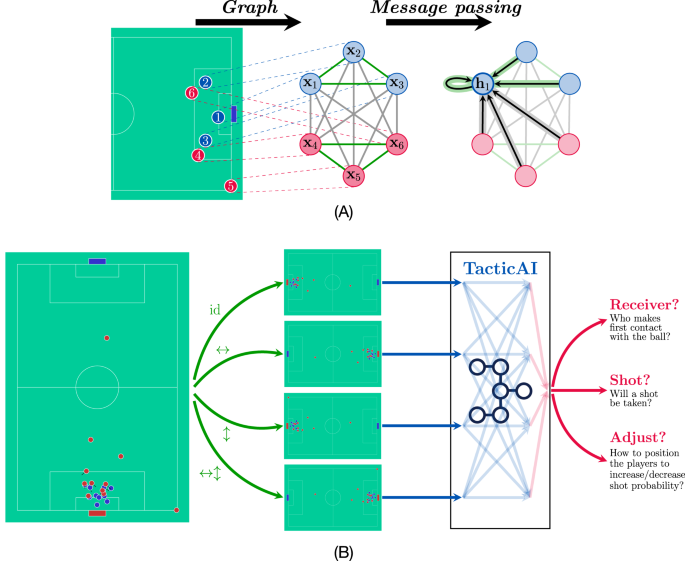
The core of TacticAI is a graph neural network (GNN) where every player on the pitch is a node, and the edges between them encode physical relationships like proximity and team membership. The model then runs message passing across this graph, meaning each player's representation gets updated by aggregating information from all other players they interact with. This is a natural fit for football, where relative positioning matters more than absolute coordinates.
But the team went further with a technique called geometric deep learning. The football pitch has natural symmetries: a corner kick from the left side is strategically equivalent to one from the right. Rather than learning these symmetries from data (which would require far more examples), TacticAI bakes them in mathematically using D2 group convolutions, which enforce that the model's outputs are identical under horizontal and vertical reflections of the pitch. This proves to be a valuable addition, as high-quality tracking data is often limited, with only a few hundred matches played each year in every league.
The model was trained on 7,176 corner kicks from the 2020 to 2021 Premier League seasons, using four data sources fused together: spatio-temporal tracking at 25 frames per second, event stream annotations, player profile data (height, weight), and pitch metadata. Critically, ball movement was deliberately excluded from the input features, forcing the model to reason purely from player positioning.
Three things TacticAI can do
The system has three distinct capabilities, each backed by a separate model head:
- Receiver prediction: Given a corner kick setup, predict which of the 22 players will make first contact with the ball. The best-performing model achieved 0.782 top-3 accuracy after 50,000 training steps, using a deep graph attention network (GATv2) with D2 group convolutions.
- Shot probability: Estimate whether a shot will result from the corner. Rather than predicting this directly (which only yielded an F1 of 0.52), the team decomposed it through the receiver predictor first. This two-phased approach yielded a final test F1 score of 0.71 for shot prediction.
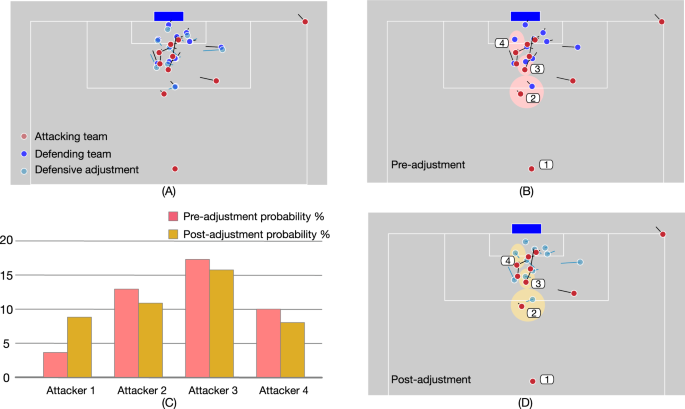
- Tactic generation: Suggest adjusted player positions and velocities that would increase or decrease shot probability. This uses a conditional variational autoencoder (CVAE), a generative model that learns to reconstruct player coordinates conditioned on a desired outcome (shot or no shot).
What the experts said
DeepMind didn't just run benchmarks. They ran a formal case study with five Liverpool FC experts: three data scientists, one video analyst, and one coaching assistant. The results were striking.
- TacticAI's model suggestions were not only indistinguishable from real tactics, but also favoured over existing tactics 90% of the time.
- Human raters could barely tell AI-generated setups from real ones, scoring only an average F1 of 0.60 on the classification task, barely above chance.
- TacticAI significantly outperformed a feature-space baseline as a method for mining similar corners, with an average recall of 0.59 versus 0.36 for the baseline.
The retrieval capability is particularly underrated. Coaches can pull up historical corners with similar tactical setups to the one they're planning, effectively turning TacticAI into a searchable database of strategic situations indexed by meaning rather than metadata.
Palmeiras and the open-play frontier
Palmeiras' data science department uses a drag-and-drop interface to virtually reposition players and observe how changes affect the collective behavior of the team and opponents. Currently used for pre- and post-game analysis, the tool is expected to eventually be used during the full 90 minutes of competitive matches.
Palmeiras is the first club in Latin America to adopt the technology, which was developed by Google DeepMind in collaboration with Liverpool. Liverpool used the system during the 2024/2025 season and won the Premier League that year. Correlation is not causation, but it's a data point clubs will notice.
The broader context matters too. Coaching staff currently spend around 70% of their time compiling spreadsheets with information scattered across medical reports, performance statistics, and technical observations. TacticAI is one piece of a larger Google push into football infrastructure, which also includes a two-year partnership with the Brazilian Football Confederation (CBF) to centralize and analyze national team data using generative AI.
Why this matters beyond the pitch
DeepMind is explicit that football is a research vehicle, not just a product. A live match is one of the most demanding environments for AI: 22 agents moving simultaneously, partial observability (you can't measure fatigue or psychology directly), multimodal data streams, and continuous spatial reasoning under time pressure.
Advances obtained in football can contribute to other areas including robotics, digital games, and traffic coordination systems. The model was also developed to operate in scenarios of partial observability, where not all factors involved can be measured directly, such as the psychological aspects of athletes.
The assumption that needs updating across the field: graph-based geometric deep learning is no longer just a protein-folding or molecular-dynamics trick. When you have multi-agent spatial data with known symmetries and scarce labels, this architecture family is now proven to extract signal that standard CNNs and MLPs miss. The football pitch is just the most visible proof of concept.
Comments
