
Google DeepMind's SURF Separates Audio Without Any Clean Training Data
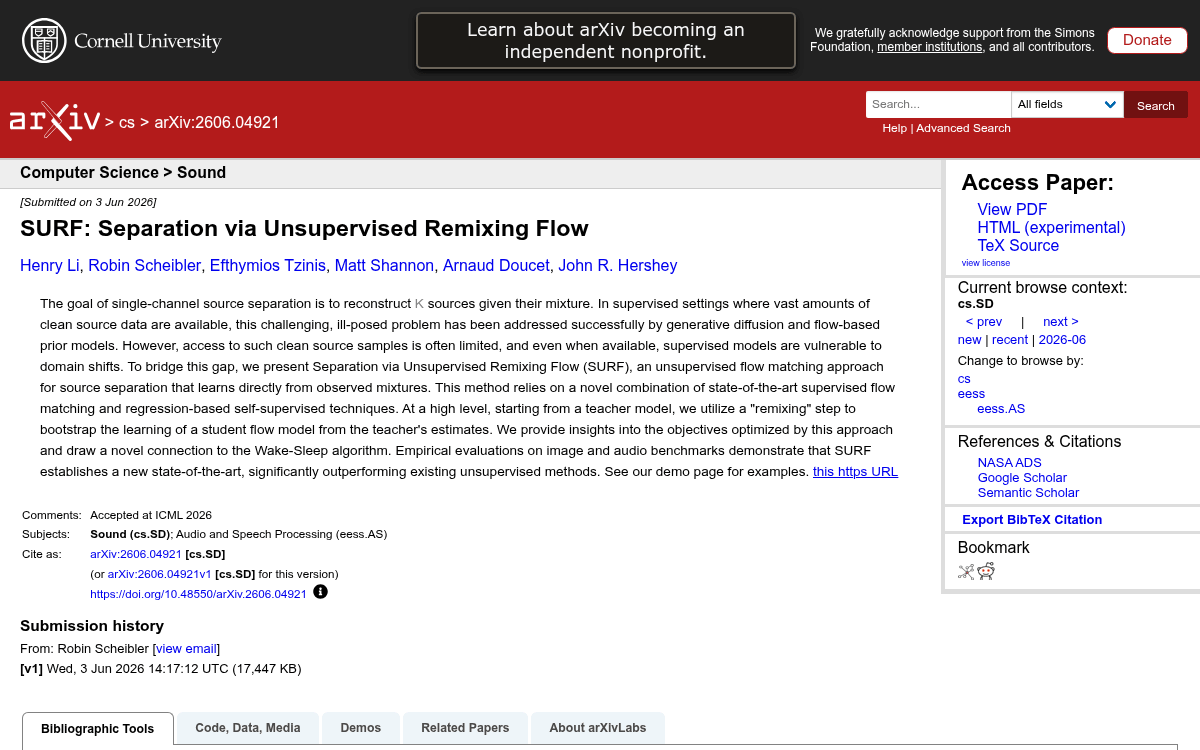
SURF trains a generative flow-matching model to separate audio and images using only raw mixtures, with no clean source data required, setting a new unsupervised state-of-the-art.
 Pro
Takeaways
- SURF is the first generative source separation model that trains entirely from raw mixtures, with no clean source data required.
- It combines flow matching with a teacher-student remixing loop: a teacher separates mixtures, estimates are shuffled and recombined, and a student flow model trains on these synthetic pairs.
- On MNIST image separation, SURF (ReMixIT) achieves PSNR 37.26 vs. 23.13 for the best prior unsupervised method, nearly matching supervised flow matching.
- On CIFAR-10, SURF achieves FID 12.50, outperforming BASIS (FID 22.12) which uses a supervised diffusion prior trained on clean images.
- On Libri2Mix speech separation, SURF reaches 16.28–16.54 dB SI-SDR vs. 12.39–13.60 dB for prior unsupervised methods, approaching the supervised ceiling of 17.89 dB.
- The paper draws a novel theoretical connection to the Wake-Sleep algorithm and was accepted to ICML; a demo page with audio examples is available.
Every time you've used a noise-canceling headset or watched a movie with clean dialogue pulled from a noisy set recording, source separation was doing the heavy lifting. The field has made enormous strides with supervised deep learning, but there's a stubborn bottleneck: you need large libraries of clean, isolated recordings to train these models. For many real-world domains, that data simply doesn't exist. A new paper from Google and Google DeepMind, SURF: Separation via Unsupervised Remixing Flow, proposes a way around this wall entirely.
The clean-data problem
Single-channel source separation is the task of taking one recording that contains multiple overlapping signals and recovering each individual source. Think of unmixing two speakers talking at once, or separating a voice from background noise. The challenge is deeply ill-posed: infinitely many combinations of sources could sum to the same mixture.
Modern generative approaches, particularly diffusion and flow-matching models, have tackled this by learning a strong prior over what clean signals look like, then using that prior to guide separation. The catch is that training these priors requires access to large datasets of clean, isolated sources. In many complex domains such as bio-acoustics, hyperspectral imaging, or gravitational wave detection, obtaining such clean, in-domain source data is practically impossible. And even when clean data exists, supervised models are vulnerable to domain shifts.
Prior unsupervised approaches like MixIT and ReMixIT addressed the data problem for regression-based models, but no one had successfully applied this idea to generative flow-matching models. That's the gap SURF fills.
Flow matching, briefly
Flow matching (FM) is a generative modeling technique that learns to transport samples from a simple noise distribution to a target data distribution by training a neural network to predict a "velocity field" , essentially, the direction and speed to move a noisy sample at each point in time to reach a clean sample. For source separation, the model starts from a noisy version of the mixture and flows toward the separated sources.
The key difficulty in going unsupervised is that flow matching normally requires pairs of (noisy, clean) training examples. SURF's core contribution is a way to generate those pairs synthetically, using only the raw mixtures themselves.
The remixing trick
SURF builds on a teacher-student framework that has proven effective in regression-based unsupervised separation. The core idea is called remixing:
- Bootstrap a teacher. A MixIT model is first trained on raw mixtures. MixIT works by creating "mixtures of mixtures" and training a model to separate them without ever seeing clean sources.
- Teacher estimates sources. Given a batch of real mixtures, the teacher produces imperfect but reasonable source estimates.
- Shuffle and remix. Those estimated sources are randomly shuffled across the batch and recombined into new synthetic mixtures. Now you have synthetic (mixture, estimated-sources) pairs with known pseudo-targets.
- Train the student flow model. A flow-matching student is trained to separate these synthetic mixtures, using the shuffled teacher estimates as training targets.
- EMA teacher update. After each student update, the teacher is slowly updated toward the student via an exponential moving average (EMA), gradually improving the quality of the pseudo-targets over time.

The non-trivial part is adapting this remixing idea to flow matching. Regression models directly predict source estimates, but flow models predict a velocity field. SURF bridges this by exploiting a mathematical relationship: the expected clean source estimate from a flow model at time t can be expressed as a function of the velocity field at that point. This lets the paper translate the ReMixIT and Self-Remixing regression objectives directly into flow-matching losses.
Two variants, one key insight
SURF comes in two flavors, corresponding to two established regression-based methods:
- SURF (ReMixIT): The student is trained to predict the shuffled teacher estimates directly. The loss penalizes how far the student's velocity field is from pointing toward those pseudo-targets.
- SURF (Self-Remixing): Instead of regressing to teacher estimates (which contain teacher errors), the student is trained so that its separated outputs, when re-summed, match the original observed mixture. This avoids propagating teacher errors into the training signal.
The paper also draws a novel theoretical connection: an instance of SURF can be reinterpreted as a Wake-Sleep algorithm, a classical method for training latent-variable generative models. In the "sleep" phase, the student learns to separate synthetic mixtures generated by the teacher. In the "wake" phase, the teacher is updated to match the student's aggregate posterior. This framing gives a principled probabilistic interpretation to what otherwise looks like a heuristic bootstrapping procedure.
What the numbers say
SURF was evaluated on four benchmarks spanning image and audio separation. For images, the team used MNIST and CIFAR-10, following the same protocol as the BASIS paper. For audio, they used Libri2Mix (clean speech separation) and AudioSet (731 hours of in-the-wild YouTube audio with no ground truth sources available).

On MNIST image separation, both variants of SURF excel in separation quality, both in terms of distance-based metrics (PSNR and SSIM) and in terms of perceptual quality metrics (LPIPS and FID), and are only surpassed by the supervised FM baseline. The gap over prior unsupervised methods is dramatic: SURF (ReMixIT) achieves a PSNR of 37.26 on MNIST versus 23.13 for the best prior unsupervised method (Self-Remixing regression).
On CIFAR-10, SURF achieves an FID of 12.50–12.98, compared to 28.44–30.55 for regression-based unsupervised baselines and 22.12 for BASIS, which uses a supervised diffusion prior trained on clean images. In other words, SURF without any clean data beats a method that was explicitly given clean source data for prior training.
On Libri2Mix speech separation, SURF achieves an SI-SDR of 16.28–16.54 dB versus 12.39–13.60 dB for prior unsupervised methods, approaching the supervised flow matching ceiling of 17.89 dB. On AudioSet, where no clean sources exist at all, SURF significantly improves the "Equal" separation metric, indicating it is better at estimating the correct number of sources in a mixture.
Where it struggles
SURF is not uniformly dominant. On the FUSS dataset, SURF largely outperforms the other methods on 1 and 2 sources, but does slightly worse on 3 and 4 sources. The paper hypothesizes this is because the MixIT teacher used to initialize training was trained on mixtures containing double the average number of sources, which biases the teacher toward over-separating. This initialization bias carries forward into SURF's training.
More broadly, SURF inherits the limitations of its teacher. If the initial MixIT model produces very poor estimates, the quality of the pseudo-targets is low, and the student has little signal to improve from. The method also requires careful tuning of the EMA decay rate and a "hybrid teacher" schedule that gradually transitions from the frozen MixIT baseline to the dynamically updated teacher , ablations show that getting this wrong significantly degrades performance.
Who should care
SURF is most compelling for anyone working with audio or signal data where clean isolated recordings are hard or impossible to obtain:
- Bioacoustics and wildlife monitoring: Field recordings of animal sounds are always mixtures. There are no isolated animal calls to train on.
- Medical audio: Separating heart sounds from lung sounds in clinical recordings, where clean reference signals don't exist.
- In-the-wild speech enhancement: Building models that generalize to real deployment conditions without requiring studio-quality training data.
- Hyperspectral imaging: Unmixing spectral signals in satellite imagery where ground truth pure-material spectra are unavailable.
For teams already working with supervised separation models, SURF also offers a path to domain adaptation: rather than collecting new clean data for a new domain, you can fine-tune using only the raw mixtures from that domain.
Code and demos
No code repository has been released with the paper, but the team has published a demo page with audio examples comparing SURF against baselines on Libri2Mix, LibriSpeech+FUSS, and the FUSS universal separation benchmark. The paper PDF includes full algorithmic details and a PyTorch pseudocode implementation of the training loop. The work was accepted to ICML.
The core insight , that you can bootstrap a generative model from its own imperfect estimates by remixing them , is simple enough to implement on top of any existing flow-matching separation framework. For teams already using supervised flow models, the path to an unsupervised variant is now much clearer.