

Google DeepMind's Gemma 4 12B Runs Multimodal AI on Your Laptop for Free
Google's Gemma 4 12B ditches multimodal encoders entirely, bringing near-26B performance to a 16GB laptop under Apache 2.0
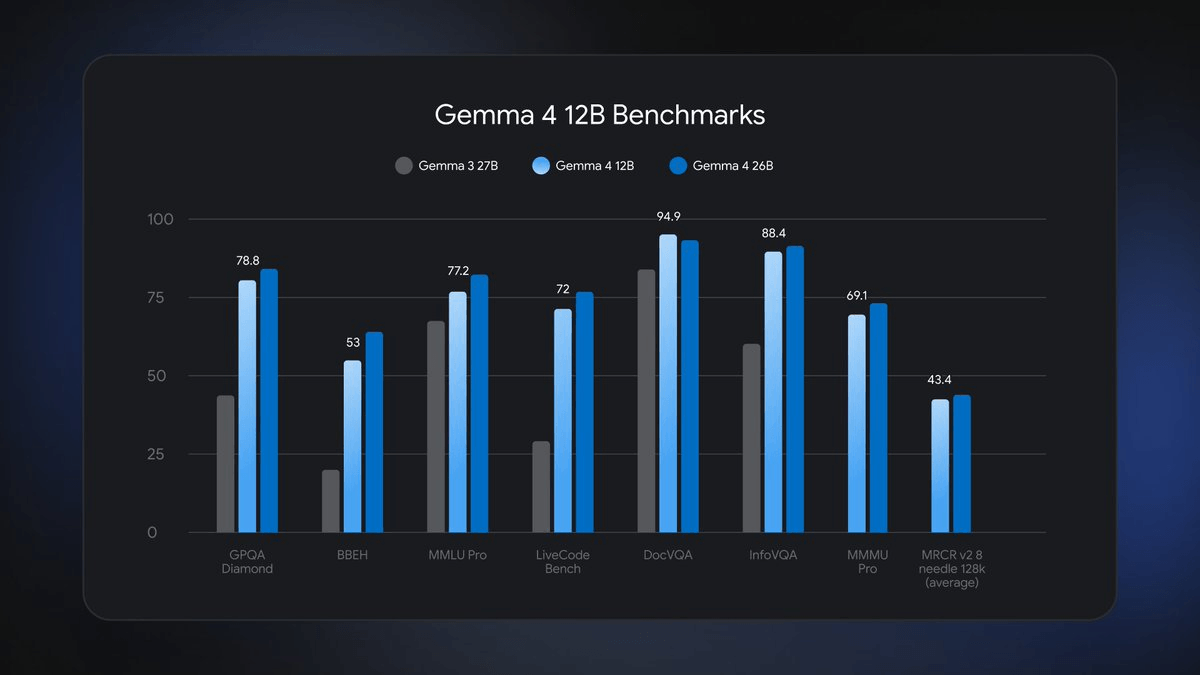
- Gemma 4 12B launched: Google DeepMind released a 12B multimodal model that runs on a 16GB VRAM laptop under Apache 2.0.
- Encoder-free architecture: Vision and audio inputs flow directly into the LLM backbone, replacing 550M+ parameter encoder stacks with a 35M embedder.
- Near-26B performance: Scores 77.2% on MMLU Pro, beating Gemma 3 27B (67.6%), and matches the 26B model on most benchmarks at half the memory.
- First mid-sized Gemma with native audio: Processes raw 16kHz audio directly; audio capped at 30s, video at 60s at 1 FPS.
- Context bug warning: Many community GGUFs on Hugging Face have a broken 131K context limit due to a bad initial config.json -- fixable via gguf-set-metadata.
- Available now on Hugging Face and Kaggle; compatible with Ollama, llama.cpp, vLLM, MLX, LM Studio, and Unsloth.
Google DeepMind just dropped Gemma 4 12B, and the headline is deceptively simple: a 12-billion-parameter model that runs on your laptop and handles text, images, audio, and video natively. What's actually interesting is how they pulled it off. The model throws out the multimodal encoder playbook entirely, and the results are hard to ignore.
Gemma 4 12B is designed to bring agentic multimodal intelligence directly to laptops, bridging the gap between the edge-friendly E4B and the more advanced 26B Mixture of Experts model, while also being the first mid-sized model in the Gemma family to feature native audio inputs. It ships right now, free, under an Apache 2.0 license, which allows free use, modification, and commercial deployment -- a change from Gemma 3 and earlier, which used Google's source-available Gemma Terms of Use rather than a fully open-source license.
The architecture bet that changes everything
Most multimodal models work by bolting separate specialist networks onto a language model. You have a vision encoder (think CLIP or a Vision Transformer), sometimes an audio encoder, and the language model sits downstream waiting for their outputs. Previous multimodal models, including earlier Gemma generations, attached a separate vision tower -- a SigLIP-style encoder of roughly 550M parameters -- and an audio encoder onto the language model. Those encoders had to finish processing an image or audio clip before the language model could even begin.
Gemma 4 12B cuts all of that out. Google trained it with an encoder-free architecture to integrate audio and vision input directly. For vision, they replaced Gemma 4's vision encoder with a lightweight embedding module consisting of a single matrix multiplication, positional embedding, and normalizations -- allowing the LLM backbone to take over visual processing. For audio, they eliminated the separate audio encoder entirely, slicing raw 16 kHz audio signals into 40ms frames and projecting them linearly to the LLM input space.
The practical result: a small (~35M) embedder replaces the 550M vision encoder, and image patches and audio frames are projected directly into the language model, where the shared decoder processes everything together. That's where the memory savings come from.
Numbers that don't add up (in a good way)
The benchmark story is the kind that makes you double-check the axes. Gemma 4 12B scores 77.2% on MMLU Pro, beating last year's Gemma 3 27B (67.6%), and runs in roughly 6.6 GB VRAM at Q4KM, fitting an 8GB GPU. On harder reasoning tasks, the gap is even more dramatic: on GPQA Diamond (graduate-level reasoning), Gemma 4 12B scores 78.8 -- well above where a 12B model has any right to be, sitting close to the 26B variant. On BBEH, a broad suite of hard reasoning tasks, the 12B scores 53, a steep jump from Gemma 3 27B's ~18.
The standout quality is that it performs nearly as well as Gemma 4 26B -- but at less than half the total memory footprint. A look at the benchmarks shows 12B neck and neck with 26B's performance, even pushing past the older model on DocVQA (Document Visual Question Answering). Community testing reported roughly 21 tokens per second on an RTX 4060 via llama.cpp and smooth performance on MacBook Pro via MLX.
What you can actually build with it
The encoder-free design has a downstream benefit that matters a lot for teams building specialized models: because vision, audio, and text inputs share the exact same weights, you no longer need to co-tune separate frozen encoders. Downstream adapter fine-tuning (such as LoRA) or full fine-tuning naturally updates the entire multimodal token loop in a single pass -- a significant simplification for teams building domain-specific multimodal models.
Practical use cases where this shines:
- Document intelligence: strong DocVQA performance makes it well suited to reading invoices, forms, and scanned documents -- locally, privately, without a hosted API.
- Audio understanding: process spoken input directly, useful for transcription-adjacent tasks, voice notes, and audio Q&A without a separate speech model.
- Long-context work: the 256K context window handles large documents and multi-file context in one pass.
- Agentic workflows: multi-step reasoning pipelines that previously needed a server can now run entirely on a developer's machine.
- Video analysis: the developer guide demonstrates processing 5 minutes of video at 1 FPS with audio, reasoning across both modalities simultaneously.
Known rough edges
The launch wasn't without friction. If you see a max context limit of 131,072 when loading Gemma 4 12B models, it's because the initial config.json released by Google contained bad metadata. Google and Unsloth have corrected their upstream files , but this bad metadata was permanently baked into the GGUFs of hundreds of downstream fine-tunes, adapters, and quantizations during a 12-24 hour window -- resulting in a large number of permanently broken Gemma 4 GGUFs currently circulating on Hugging Face. The fix is a one-liner with the gguf Python package.
There are also hard limits on media inputs: audio supports a maximum of 30 seconds, and video supports a maximum of 60 seconds assuming 1 frame per second processing. For longer audio or video, you'll need to chunk your inputs manually.
Getting it running
About 16 GB of memory -- either a 16 GB VRAM GPU or a Mac with 16 GB of unified memory -- running a quantized build (Q4 is the practical default) is all you need. The weights are available on Hugging Face and Kaggle. The ecosystem support at launch is unusually broad:
- Inference: llama.cpp, MLX, vLLM, SGLang, Hugging Face Transformers
- Local UIs: LM Studio, Ollama
- Fine-tuning: Unsloth (with LoRA support out of the box)
- On-device: Google AI Edge Gallery (now on macOS desktop) and LiteRT-LM CLI
- Cloud: Google Cloud Run, GKE, and Gemini Enterprise Agent Platform
Google also released a new Gemma Skills repository -- a library of pre-built agent capabilities designed specifically for Gemma models, making it easier to wire the model into existing agentic frameworks like OpenCode.
For teams that want to run it as a local API server, the new litert-lm serve command spins up an OpenAI-compatible endpoint with stateless prefix caching, so tools like Continue, Aider, or Hermes can point at it with no code changes. The bigger picture here is that a model with near-frontier multimodal reasoning, native audio, a 256K context window, and commercial-friendly licensing now fits on hardware most developers already own. That's a meaningful shift in what's possible without a cloud bill.
Comments
