


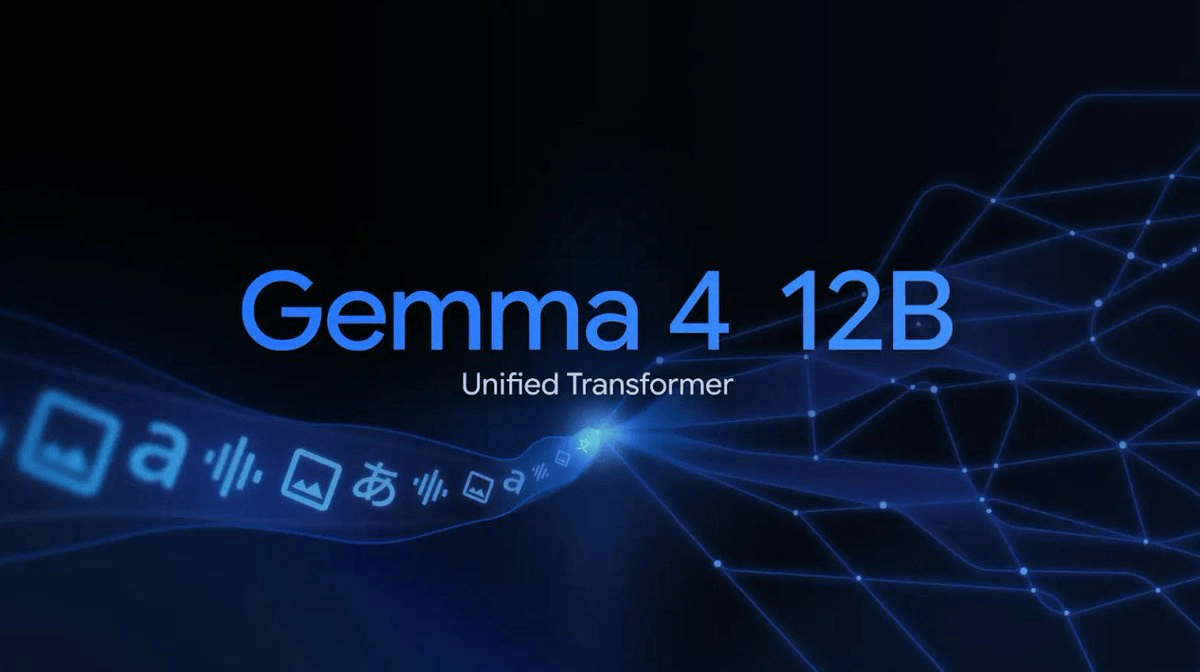
Google DeepMind has released Gemma 4 12B, a dense multimodal model that rethinks how vision and audio get processed. Instead of bolting on separate encoder models for each modality, everything flows through a single decoder-only transformer. The result is a 12-billion-parameter model that handles text, images, audio, and video natively, fits on a 16GB VRAM laptop, and ships free under Apache 2.0.
The encoder problem it solves
Most multimodal models today work by chaining together specialized components: a vision encoder (like a ViT) processes the image, a projection layer translates it into the language model's embedding space, and then the LLM takes over. Audio gets its own separate encoder on top of that. A vision encoder processes the image, a projection layer translates it into the language model's embedding space, and then the LM does its thing. This pipeline adds memory overhead, increases latency, and makes fine-tuning painful because you have to coordinate updates across separately frozen components.
Gemma 4 12B bypasses heavy multi-stage vision and audio encoders entirely, feeding multimodal data straight into the LLM backbone, reducing multimodal latency. This is the core architectural bet, and it has real downstream consequences for anyone who wants to fine-tune or deploy locally.
How the architecture actually works
The encoder-free design is not magic -- it replaces heavy encoders with two lightweight projections:
- Vision embedder (35M parameters): Raw 48x48 pixel patches are projected to the LLM hidden dimension with a single matrix multiplication. A factorized coordinate lookup attaches spatial location information directly to the input, replacing the 27 vision transformer layers used in other medium-sized Gemma 4 models.
- Audio wave projection: Raw 16 kHz audio signals are sliced into 40ms frames (640 floats each) and projected linearly into the LLM input space, eliminating the 12 conformer layers used in the edge Gemma models.


Don't miss what's next in AI
Join 300,000+ engineers and researchers who get the signal, not the noise.
- Full access to in-depth AI research breakdowns
- Be the first to know what's trending before it hits mainstream
- Daily curated papers, repos, and industry moves