

Google DeepMind's Gemini Robotics 2 Gives Humanoids Full-Body AI Control
Google DeepMind launches Gemini Robotics 2, bringing full-body humanoid control, multi-finger dexterity, and cross-robot collaboration to physical AI

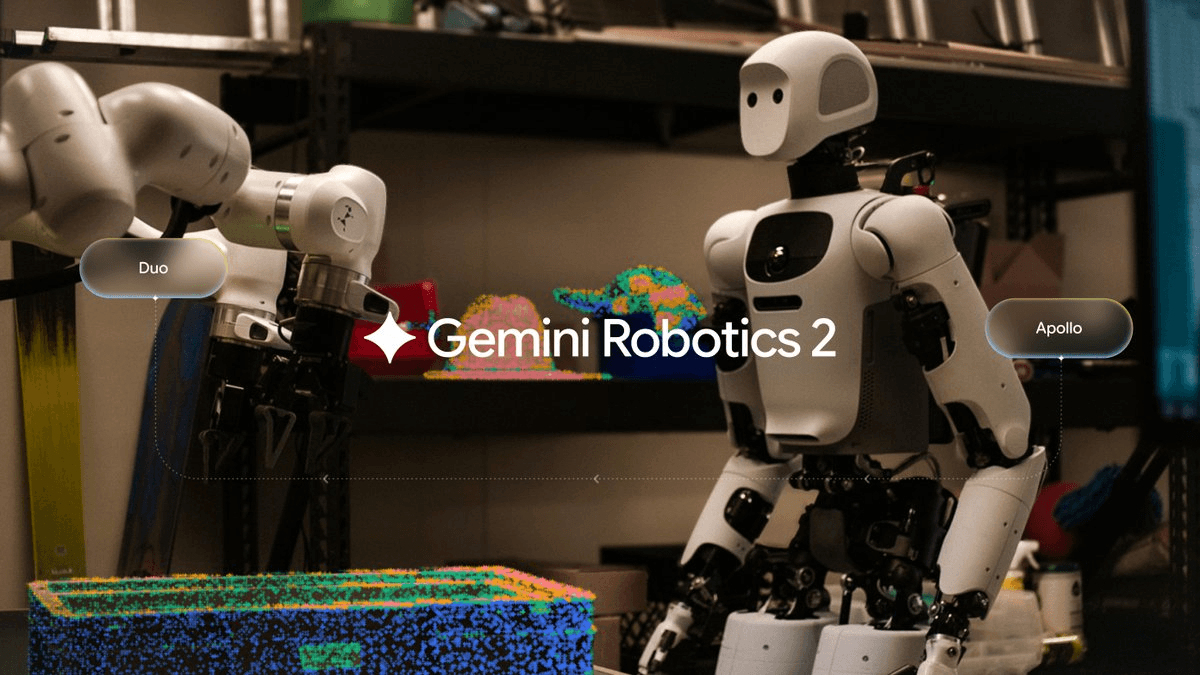
- Three new models: Gemini Robotics 2 (full-body VLA), Gemini Robotics ER 2 (reasoning brain), and On-Device 2 (local, fast adaptation).
- Whole-body humanoid control: For the first time, a single model controls a humanoid from feet to fingertips, not just tabletop arms.
- Multi-robot collaboration: Different robot types (e.g., humanoid + arm) can now communicate and divide tasks via a shared semantic layer.
- ER 2 is publicly available via Google AI Studio and the Gemini API; VLA models require early-access sign-up.
- Fast hardware adaptation: On-Device 2 can adapt to a brand-new robot body in a few hours with fewer than 200 demonstration examples.
- Honest benchmarks: Multi-finger dexterity success rates range from 32-92%, with screwing in a lightbulb at only 36%, showing real frontier challenges remain.
For years, the most capable robot demos shared a common limitation: a single arm, a tabletop, and a narrow set of pre-programmed tasks. Google DeepMind's Gemini Robotics 2 breaks that pattern. The new release introduces whole-body humanoid control, advanced multi-finger dexterity, and the ability for different robot platforms to collaborate on a shared task, all powered by a single AI model.
One brain, three models
Gemini Robotics 2 is a family of three distinct models, each targeting a different layer of the robotics stack:
- Gemini Robotics 2: A vision-language-action (VLA) model that takes camera input and natural language instructions and outputs direct motor commands. This is the model that physically moves the robot, and it now controls full humanoids from feet to fingertips, not just tabletop arms.
- Gemini Robotics ER 2: The "embodied reasoning" model, acting as the high-level planner. It watches video feeds, plans multi-step tasks, calls external tools like Google Search, and hands off execution to the VLA model.
- Gemini Robotics On-Device 2: An efficient VLA optimized to run locally on robot hardware with no network dependency, capable of adapting to a new robot body in just a few hours.
Gemini Robotics ER 2 is publicly available via the Gemini API and Google AI Studio, and in private preview on the Gemini Enterprise Agent Platform. The VLA and On-Device models are available to early-access partners.
From tabletop to whole-body
Previous models controlled a humanoid's upper body for tabletop tasks. Gemini Robotics 2 extends that to full-body motion. In the demo, Apptronik's Apollo 2 humanoid receives a single natural language prompt, walks to a table, picks up a watering can, navigates to a shelf, and places it in the correct bin. Movement speed still has room to improve, but coordinating locomotion with manipulation in a single model is a meaningful step toward robots that can operate in unstructured environments.

Dexterity: honest numbers
The model controls the five-fingered, 22 degree-of-freedom SharpaWave hand on the Apollo 2 to perform tasks like tying knots or sealing a ziplock bag. It also operates standard two-fingered parallel grippers on a Franka Duo platform for tight packing and precise insertion.
The published benchmarks are worth reading carefully. On whole-body manipulation with Apollo 2, success rates range from 45.7% (picking from the floor) to 76.3% (picking from a shelf). Gripper-based precise insertion hits 89.6%. Multi-finger dexterity is the hardest frontier: unscrewing a lightbulb reaches 92%, screwing one in lands at 36%, and tying a trash bag at 44%. The team published these numbers anyway, which tells you something about how they want to be evaluated.
The reasoning layer: ER 2 in depth
Gemini Robotics ER 2 upgrades the previous ER 1.6 with what the team calls temporal intelligence: the ability to track task progress through a continuous video feed, adapt when something goes wrong, and know when a step is actually complete. That last part is harder than it sounds. Knowing a cup is full enough to stop pouring requires understanding context, not just detecting motion.
Two sub-capabilities drive this:
- Progress classification: The model assigns each video frame to one of five completion buckets (0–20%, 20–40%, and so on), giving the robot real-time situational awareness. ER 2 achieves 57.4% accuracy on this task, outperforming both the previous generation and competing frontier models.
- Moment-finding: The model identifies the exact frame where a critical event occurs. ER 2 hits 91.3% accuracy with a 0.96-second mean absolute distance, at a fraction of the compute cost and 4x the execution speed of larger model categories.
ER 2 integrates with the Gemini Live API via a bidirectional streaming endpoint tuned for low latency, which keeps orchestration fluid rather than stop-and-start. The developer blog includes a working demo of Boston Dynamics' Spot fetching objects on natural language commands, with code on GitHub.
Multi-robot coordination and on-device adaptation
Different robot form factors have different strengths. A wheeled rover can navigate a warehouse floor while a humanoid handles manipulation at a workstation. With ER 2 as a shared semantic layer, they can coordinate tasks that neither could complete alone, without requiring a custom integration between platforms.
Gemini Robotics On-Device 2 handles the constraints of real deployments: no internet, limited compute, and hardware that varies widely in shape and sensors. It inherits motion transfer techniques from Gemini Robotics 1.5 and can adapt to a new bi-arm robot body in a few hours, typically with fewer than 200 demonstration examples.
Safety baked in, not bolted on
As robots gain physical autonomy, safety becomes a harder engineering problem. Gemini Robotics 2 introduces ASIMOV-Agentic, a benchmark that measures whether the embodied reasoning agent can refuse unsafe tool calls from a VLA, predict whether a task is feasible, and request human intervention when uncertain.
In practice, ER 2 halts a humanoid when a person enters its workspace and resumes only once the area is clear. Human-proximity awareness is a baseline requirement for any robot in a shared space, and it is now part of the model's evaluation criteria rather than a post-hoc rule.
Where this fits
The Gemini Robotics family launched in March 2025 with two models built on Gemini 2.0. It has expanded three times since, moving from a single cloud model to a lineup covering local execution and advanced embodied reasoning. Version 2 is the largest architectural step yet, extending control from arm-only to full-body humanoid coordination.
Physical AI is one of the most contested areas in the field right now, with Figure, Physical Intelligence, and Boston Dynamics all working on similar problems. DeepMind's approach is to build a single general-purpose model grounded in Gemini's multimodal reasoning and adaptable to any hardware via motion transfer, rather than training task-specific policies from scratch for each robot. The on-device adaptation story, going from zero to a working policy on a new robot body with under 200 demos and a few hours of compute, is the clearest expression of that bet.
The ER 2 model is live in Google AI Studio now. For the full VLA stack on physical hardware, the early-access program is open for sign-ups.
Comments
