

Google DeepMind's Gemini Omni 1.1 Flash Stretches AI Video to 40 Seconds
Google DeepMind's video model update brings 40-second scene extensions, keyframe control, 4K upscaling, and cheap 360p drafts through the Gemini API.

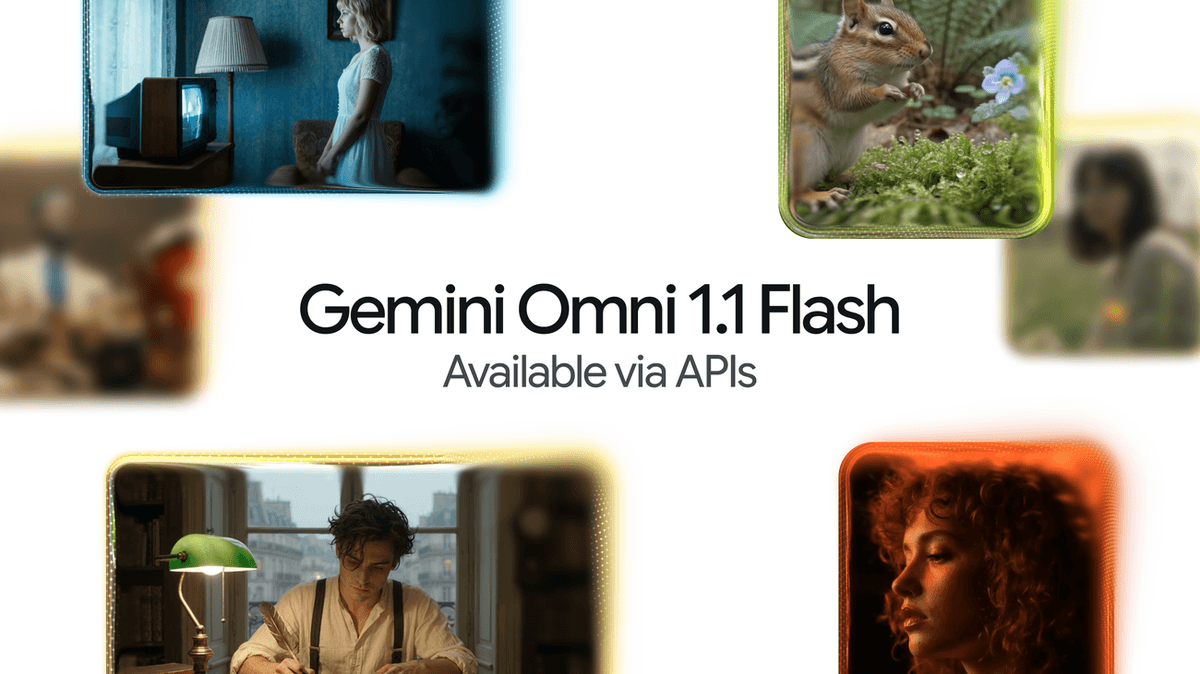
- Google DeepMind released Gemini Omni 1.1 Flash, a production-ready video generation model update.
- Scene extension now analyzes 10 seconds of prior context and reaches 40 seconds cumulative length.
- First-and-last-frame control enables continuous camera moves like orbits, dolly zooms, and seamless loops.
- New 360p draft mode is 60% faster and one-third the cost of 720p for rapid prototyping.
- Outputs upscale to 1080p or 4K, though not natively generated at those resolutions.
- Available via Google AI Studio, Enterprise Agent Platform, Flow, and Gemini app.
Google DeepMind rolled out Gemini Omni 1.1 Flash, a production-ready refresh of its generative video model aimed at the workflows people actually ship. The pitch centers less on a bigger model and more on giving builders the levers they need to control shot length, camera motion, and output quality without burning through GPU budgets on every iteration.
The core update tackles a familiar frustration in AI video: continuity. Generated sequences can now run 40 seconds, up from 10, and the model reads up to 10 seconds of prior footage before adding a fixed increment, rather than only the final one second. That expanded awareness sharpens visual consistency and narrative adherence across longer runs. Characters stop mutating between clips, and camera motion carries through cuts.
What actually shipped
Beyond scene extension, Omni 1.1 adds a handful of controls that push it closer to a real production tool:
- First and last frame control: Developers can set start and end frames to create camera movements between keyframes, useful for orbits, dolly zooms, and seamless loops.
- Video references: You can upload up to three seconds of external footage as a style reference to carry over characters or motion patterns.
- 360p draft mode: Runs up to 60 percent faster at a third of the cost of 720p, designed for storyboard iteration.
- High-res output: Videos can be upscaled to 1080p or 4K. Per Google's Gemini API documentation, both resolutions are upscaled rather than generated natively, with the default remaining 720p.
Pricing that rewards iteration
Per-second pricing lands at $0.03 for 360p, $0.10 for 720p, $0.15 for 1080p, and $0.30 for 4K. A 10-second 360p test costs 30 cents, so you can generate several variants, pick the winner, then upscale only the keeper. For anyone who has watched the meter spin while regenerating a shot that just needed a different camera angle, that math changes the workflow.
How to call it
The extension API chains off a previous generation by ID:
from google import genai
client = genai.Client()
interaction = client.interactions.create(
    model="gemini-omni-1.1-flash",
    previous_interaction_id=previous_video_interaction.id,
    input=[{"type": "text", "text": "Continue the scene."}],
    response_format={"resolution": "360p"},
)
Where you can use it
Gemini Omni 1.1 Flash is available through the Gemini API in Google AI Studio and Google's Gemini Enterprise Agent Platform. Omni 1.1 is also live globally in Flow for Google AI Plus, Pro, and Ultra subscribers, with scene extension exposed to those same subscribers in the Gemini app. The model card lists it as a Preview offering on the Enterprise Agent Platform, though customers can use it for production workloads.
Who is already shipping with it
Adobe, Figma, GMI Cloud, and Runway have embedded Omni Flash into their pipelines. Adobe wired it into Firefly, and Figma Weave uses it for reference-driven canvas generation. The recurring theme in partner quotes is temporal reliability rather than novelty. GMI Cloud specifically highlighted the model's fidelity for educational and explanatory content where getting facts visually correct actually matters.
The catch
Two things are worth flagging. Extensions cap at 40 seconds total, so this is not a tool for generating a full minute-plus scene in one pass. And the upscaling story matters if you care about fine detail. Native 720p with a post-hoc upscale differs from native 4K generation, and edges on complex textures can betray that. For social cuts, ad iterations, and previz, it is more than enough. For hero shots that need to hold up on a theater screen, plan around it.
The broader signal is Google converging on video as a first-class developer surface. Gemini Omni is where Gemini's reasoning meets its generation, and the result is a step forward in world understanding, multimodality, and editing. Whether the product story ends up too crowded, given the overlap with Veo, Flow, Vids, and the Gemini app, is a separate question. For anyone building creative tooling on top of an API, Omni 1.1 now offers the most useful set of knobs.
Comments
