

Google DeepMind's Gemini Flash Lite Passes the World's First Cheat-Proof AI Test
Google DeepMind's new cryptographic testing setup lets outside auditors evaluate Gemini without ever seeing model weights or leaking their prompts.
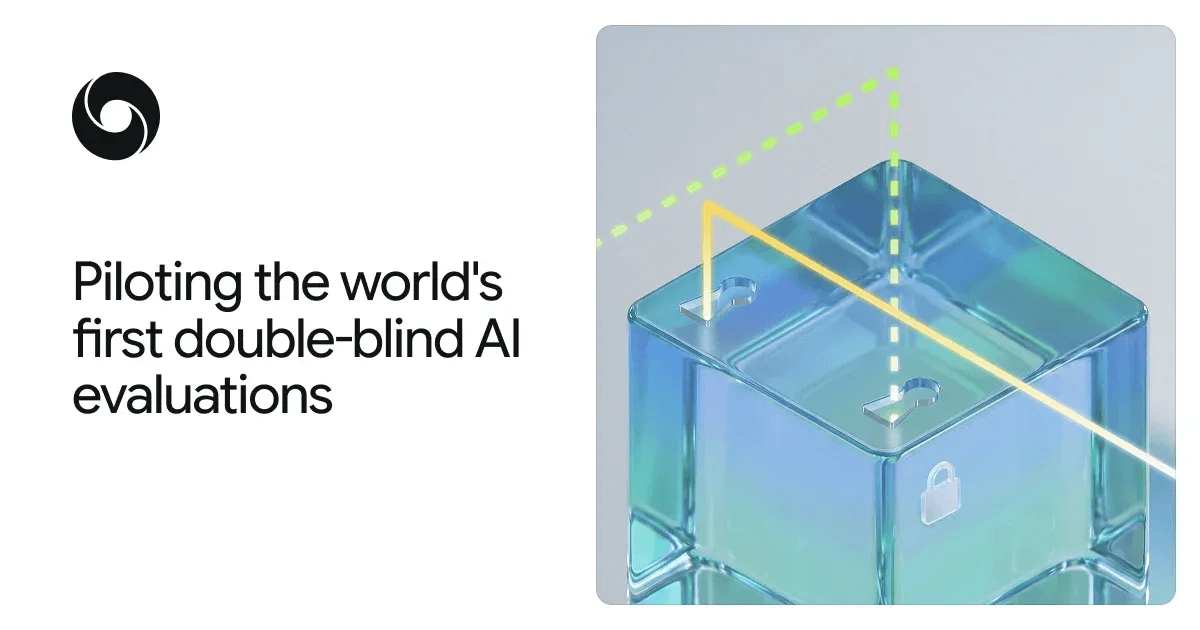
- Google DeepMind is piloting the first double-blind evaluation of a frontier proprietary model, Gemini Flash Lite.
- Neither Google sees the evaluator's test prompts nor the evaluator sees Gemini's weights.
- Built on Google Cloud Confidential Space, using hardware enclaves with cryptographic attestation.
- Partners include Singapore AI Safety Institute, MLCommons, OpenMined, and AVERI.
- Directly targets benchmark contamination, a major credibility problem for published model scores.
- Unlocks classified evaluations by governments without exposing prompts or model IP.
Benchmark contamination has quietly become one of the most awkward problems in frontier AI. If a model has been trained on the same questions used to grade it, its scores stop measuring capability and start measuring memorization. Google DeepMind is now piloting a fix that borrows a page from cryptography: a double-blind evaluation setup where neither the evaluator nor the model owner can see what the other is bringing to the table.
The pilot claims to be the world's first double-blind evaluation of a proprietary frontier-class AI model, keeping external test sets confined to a cryptographic box where they can't be scraped into later training runs. The partners include the Singapore AI Safety Institute, OpenMined, AVERI, and MLCommons, and the model under test is Gemini Flash Lite.
The peeking problem
External safety and capability evaluations have always run into a nasty tradeoff. High-stakes audits historically required evaluators to hand over their test prompts, risking the model provider seeing the questions in advance, or required the model provider to hand over its weights, risking its intellectual property.
Zero-logging protocols and rigorous contractual safeguards have long kept external prompts confidential, but layering in technical and cryptographic guarantees closes a gap that paperwork alone can't. The upshot for policymakers and enterprises: benchmark numbers become trustworthy because the model provably could not have seen the questions during training.
Inside the cryptographic box
The mechanism is built on Google Cloud's Confidential Computing stack, specifically the Confidential Space product. Both the external evaluation data and the proprietary model can be cryptographically verified to remain private to their respective owners, so the evaluator never sees the Gemini weights and Google never sees the test prompts.
Under the hood, this relies on a hardware-backed trusted execution environment (TEE). A GPU enclave loads both the model weights and the test prompts inside a sealed piece of silicon, runs the evaluation, and emits only the results. The enclave also produces attestations, essentially signed certificates, proving that only the agreed-upon evaluation code ran inside.
The pattern isn't brand new in concept. OpenMined, one of the partners, previously ran a similar trial with Anthropic and the UK AI Safety Institute. In that setup, a secure enclave hosted both the model and a biological dataset during the evaluation, produced certificates showing that only approved code executed, and completed the run in under two hours once deployed. What's new here is applying the machinery to a proprietary frontier model from a major lab at industry scale.
Why this matters for anyone shipping models
The obvious win is trust. For a CTO picking between frontier models, a benchmark score that's cryptographically guaranteed to be uncontaminated is worth substantially more than one that isn't. The less obvious win is jurisdictional. Independent organizations can now rigorously test advanced models without compromising data sovereignty or security, which matters for sensitive evaluations such as cybersecurity assessments or those run by government bodies.
Concretely, this opens up use cases including:
- National AI safety institutes running classified cyber or bioweapon uplift evaluations without exposing the prompts to any lab
- Regulators auditing model behavior with private datasets that can't legally leave their custody
- Enterprises stress-testing proprietary models against internal red-team suites without leaking those suites into future training data
- Third-party benchmark maintainers keeping test sets genuinely held out, even as they're used repeatedly
An industry drifting toward a credibility crisis
Evaluation has taken a beating. Contamination scandals, leaderboard gaming, and the gap between static benchmarks and messy real-world use have all chipped away at trust in published scores. MLCommons has been pushing hard on this front, recently announcing a collaboration with contributors from Anthropic, Google, Meta, Microsoft, OpenAI, and others to co-develop an open agent reliability evaluation standard for agentic deployments.
Double-blind evaluations slot into that broader push. They don't fix everything, since poorly designed benchmarks remain poorly designed benchmarks, but they remove one of the biggest reasons to distrust a headline number. The technical report details the methodology and findings from the Gemini Flash Lite pilot.
Who blinks next
The interesting question is whether other frontier labs follow. If OpenAI, Anthropic, xAI, and Meta agree to submit models to enclave-based evaluations, safety institutes and regulators gain a real audit tool. If they don't, this stays a one-lab commitment. Either way, the assumption that external evaluations require handing over either your weights or your prompts is now demonstrably wrong, and that shifts the default expectation for what a serious third-party audit should look like going forward.
Comments
