

Google DeepMind's Gemini 3.7 Flash Cuts Video Analysis Costs by 66%
Gemini's Flash models now dynamically scan videos across frames, audio, and transcripts, slashing token use by 88% and boosting accuracy by 7%.

- Google launched agentic video understanding for Gemini 3.7, 3.6 Flash and 3.5 Flash-Lite.
- Cuts token consumption by up to 88%, cost by up to 66%, boosts accuracy up to 7%.
- Model dynamically picks frames, audio or transcript instead of fixed 1 FPS sampling.
- Live via Gemini API in Google AI Studio, no extra feature fee.
- Enable it by setting the
processingfield to"agentic"on video inputs. - Coming soon to Gemini app and YouTube's Ask YouTube feature on watch pages.
Google DeepMind just flipped a switch on how Gemini watches video. Instead of feeding every frame into the model at a fixed rate, the newest Flash models can now decide for themselves what to look at, when to zoom in, and whether to check the audio or transcript instead. The result: agentic video understanding, which the team says cuts analysis costs by up to 66%, token consumption by up to 88%, and improves accuracy by up to 7%.
The feature is live today via the Gemini API in Google AI Studio and the Gemini Enterprise Agent Platform, and it works on both file uploads and YouTube URLs. It ships across Gemini 3.7 Flash, 3.6 Flash, and 3.5 Flash-Lite, using standard Gemini API token pricing with no additional feature fee. A rollout to the consumer Gemini app is coming soon, and it will also power YouTube's Ask YouTube feature on the watch page in the coming months.
Why static frame sampling breaks on long videos
Historically, Gemini processed video by sampling at a fixed rate, typically 1 frame per second. That works fine for a 30-second clip, but it forces a nasty tradeoff on longer content. Either you eat massive token bills to keep the full stream in context, or you drop the frame rate and lose critical moments. The efficiency problem gets worse the longer the video, which is exactly where developers most want to use these models: 10-minute how-to guides, 90-minute lectures, multi-hour recordings.
Agentic video understanding sidesteps this by turning ingestion into a tool call. The model reasons about the query, then invokes an internal tool to load only the segments it actually needs, at the frame rate it needs, from whichever modality it needs, whether that's the visual frames, the audio track, or the transcript.
How the loop actually works
Under the hood, this resembles the agentic vision pattern Google shipped for images, where the model pairs its native understanding with code execution to inspect targeted regions. For video, the pattern extends across three signals:
- Frames: the model can dynamically resample specific time windows at higher FPS to catch fast motion or subtle artifacts.
- Audio: it can pull the audio for a segment when sound is the discriminating signal.
- Transcript: it can scan text first to localize where in a long video the answer likely lives.
Turning it on is a single config change. Set processing to "agentic" on the video input and the rest of the API stays the same:
from google import genai
client = genai.Client()
interaction = client.interactions.create(
    model="gemini-3.7-flash",
    input=[
        {"type": "video",
         "uri": "https://youtu.be/7Z5Vy9JBANs",
         "processing": "agentic"},
        {"type": "text",
         "text": "What are the 3 most important announcements in this keynote?"},
    ],
)
print(interaction.output_text)
Where the numbers land
On standard video analysis benchmarks, Gemini 3.7 Flash with agentic understanding sits on the accuracy-to-cost pareto frontier, ahead of the tested competitors on the chart Google published.
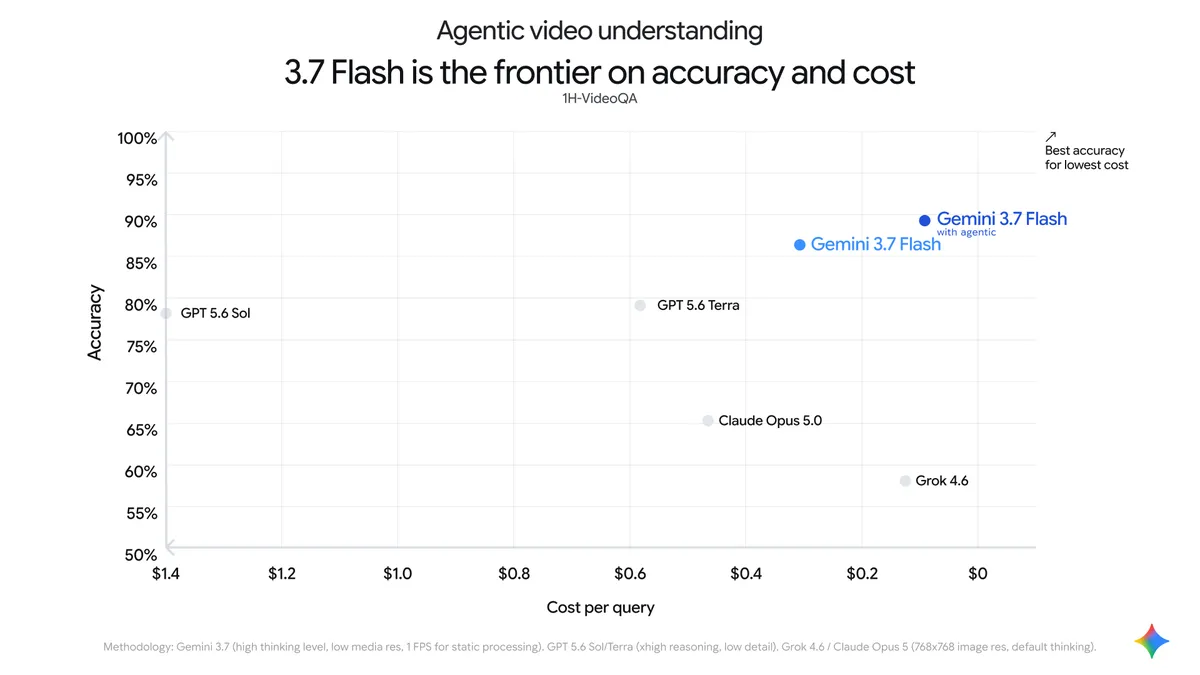
The efficiency win is most dramatic on long-form content evaluated with LongVideoBench, where static processing forces developers to either burn tokens or drop details. Google says the gains hold across all three Flash variants, though 3.7 Flash delivers the best overall quality and the best quality-to-cost ratio.
What it unlocks in practice
The capabilities Google is calling out map cleanly to real workloads that were painful or impossible with fixed-rate sampling:
- Sub-second moment retrieval: pinpointing split-second state changes and tight cut boundaries that vanish at 1 FPS, useful for automated editing pipelines.
- Needle-in-a-haystack search: answering complex queries across multi-hour videos without burning millions of tokens on frames that don't matter.
- Anomaly detection: resampling interesting time windows at higher FPS to inspect rapid motion or subtle visual artifacts.
- Counting actions and objects: tracking repeated physical movements or distinct objects reliably across long timelines.
The bigger shift
The headline number is efficiency, but the deeper change is architectural. Video has been the modality where naive tokenization scales worst, since a modest clip can dwarf an entire book in tokens. Letting the model itself decide what to load treats video less like a static blob flattened into a context window and more like a database it queries on demand. Developers could stitch this together manually before, deciding which segments to send, but doing it inside an agentic loop removes a lot of glue code and lets the model chase its own hunches when the query is ambiguous.
If you have any pipeline touching lectures, meetings, gameplay, sports, security footage, or long tutorials, this is worth trying with a single flag flip against your current prompts. See the Gemini API docs for the full parameter reference.
Comments
