

Google DeepMind's Gemini 3.6 Flash Beats Its Predecessor While Costing Less
Google ships Gemini 3.6 Flash, 3.5 Flash-Lite, and a restricted cybersecurity model — all cheaper and faster than what they replace
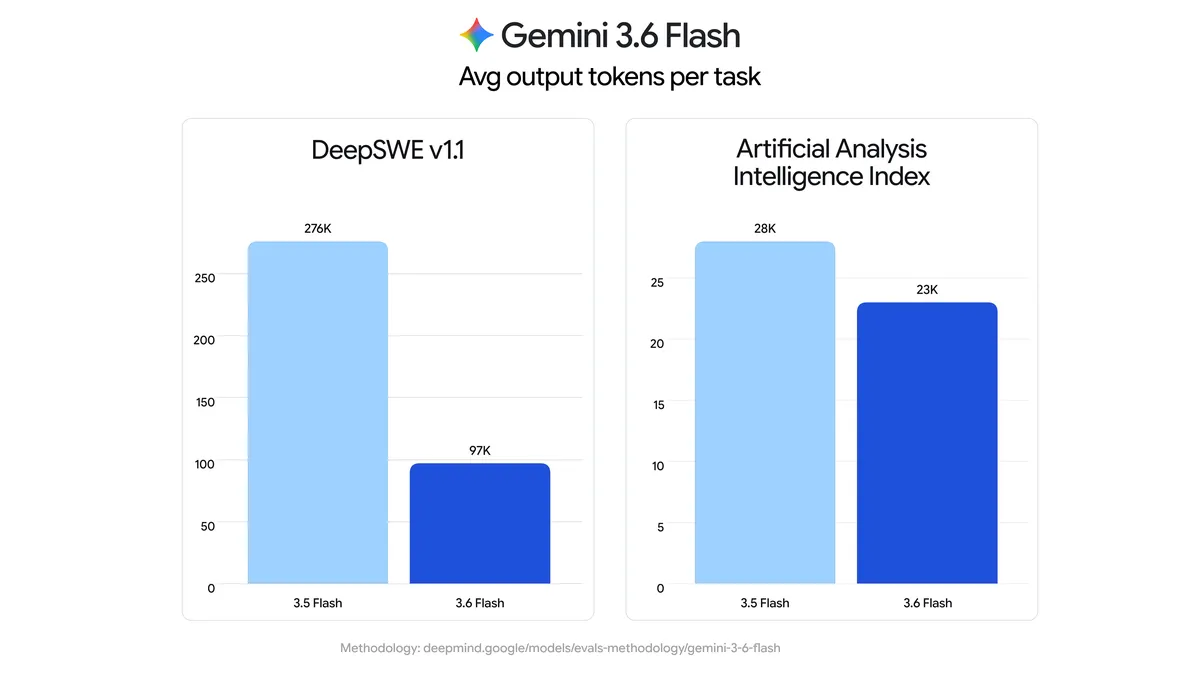
- Gemini 3.6 Flash is cheaper ($7.50/M output vs $9) and better than 3.5 Flash, using 17–65% fewer output tokens on agentic tasks.
- Gemini 3.5 Flash-Lite runs at 350 tokens/sec for $0.30/$2.50 per million tokens, beating 3 Flash on SWE-Bench Pro and OSWorld.
- Gemini 3.5 Flash Cyber is a security-specialized model that found 55 unique V8 vulnerabilities vs 47 for 3.5 Flash and 36 for Claude Opus 4.6.
- Flash Cyber is restricted to governments and trusted partners via CodeMender as a limited-access pilot.
- 3.6 Flash and 3.5 Flash-Lite are live now in Google AI Studio, Android Studio, and the Gemini app.
- Google confirmed Gemini 3.5 Pro is still in partner testing, and Gemini 4 pre-training has begun.
Google DeepMind released three new models aimed at production-scale AI agents: Gemini 3.6 Flash, 3.5 Flash-Lite, and 3.5 Flash Cyber. All three are simultaneously better and cheaper than what they replace, which is unusual enough to warrant a close look.
Three models, three jobs
Each model targets a distinct point on the cost-performance curve:
- Gemini 3.6 Flash: the workhorse upgrade. Better coding, knowledge work, and multimodal reasoning than 3.5 Flash, at a lower price per task.
- Gemini 3.5 Flash-Lite: the throughput specialist. Fastest in the 3.5 series, built for high-volume pipelines like document processing and agentic search.
- Gemini 3.5 Flash Cyber: a fine-tuned security model for finding and patching software vulnerabilities, available exclusively to governments and trusted partners via CodeMender.
3.6 Flash: fewer tokens, lower cost, better results
The core innovation in 3.6 Flash is token efficiency. According to the Artificial Analysis Index, 3.6 Flash reduces output token usage by 17% compared to 3.5 Flash. On the DeepSWE benchmark, that reduction reaches 65%. In agentic workflows where a model calls tools dozens of times per task, fewer tokens per step compounds into real cost savings.
The price reflects this: $1.50 per million input tokens and $7.50 per million output tokens, down from $9.00 per million output tokens for 3.5 Flash. A better model at a lower per-task cost.
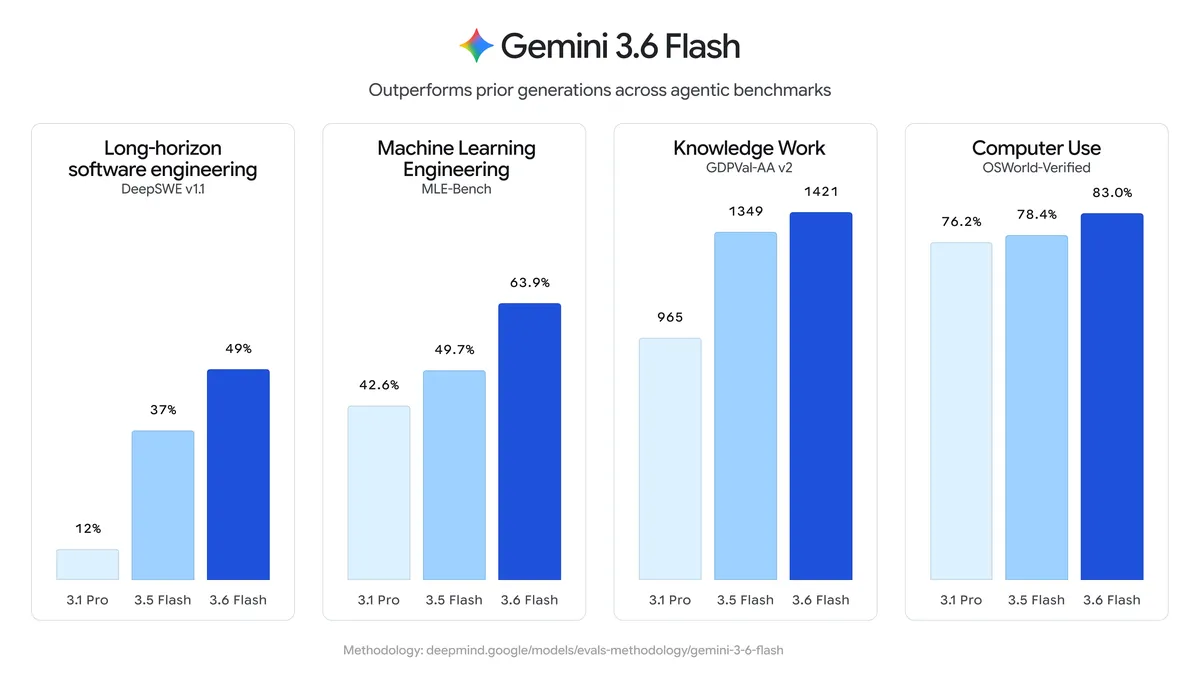
Benchmark gains are consistent across task types:
- DeepSWE (software engineering): 49% vs. 37% for 3.5 Flash, with fewer unwanted code edits and reduced execution loops.
- MLE Bench (ML research tasks): 63.9% vs. 49.7%.
- OSWorld-Verified (computer use): 83.0% vs. 78.4%. Computer use is now a built-in client-side tool via the Gemini API and Gemini Enterprise.
- Long context (GDM-MRCR v2 at 1M tokens): 54.0% vs. under 27% for 3.5 Flash.
On OSWorld-Verified, 3.6 Flash posts the highest score of any model in the comparison at 83.0%, ahead of GPT 5.6 Luna and Grok 4.5. The picture is competitive elsewhere: GPT 5.6 Luna leads on DeepSWE (67%) and Terminal-bench (84.7%), Grok 4.5 edges ahead on SWE-Bench Pro (64.7%), and Claude Sonnet 5 tops MLE-Bench (66.9%) and GDPVal-AA v2. No single model sweeps the board.
Early adopters back the numbers. Figma said 3.6 Flash "hits the sweet spot, offering a much faster way to explore and iterate on prototypes while upholding the quality of designs." Harvey reported it was "notably more efficient, completing tasks 12% faster on average."
3.5 Flash-Lite: the throughput tier gets a serious upgrade
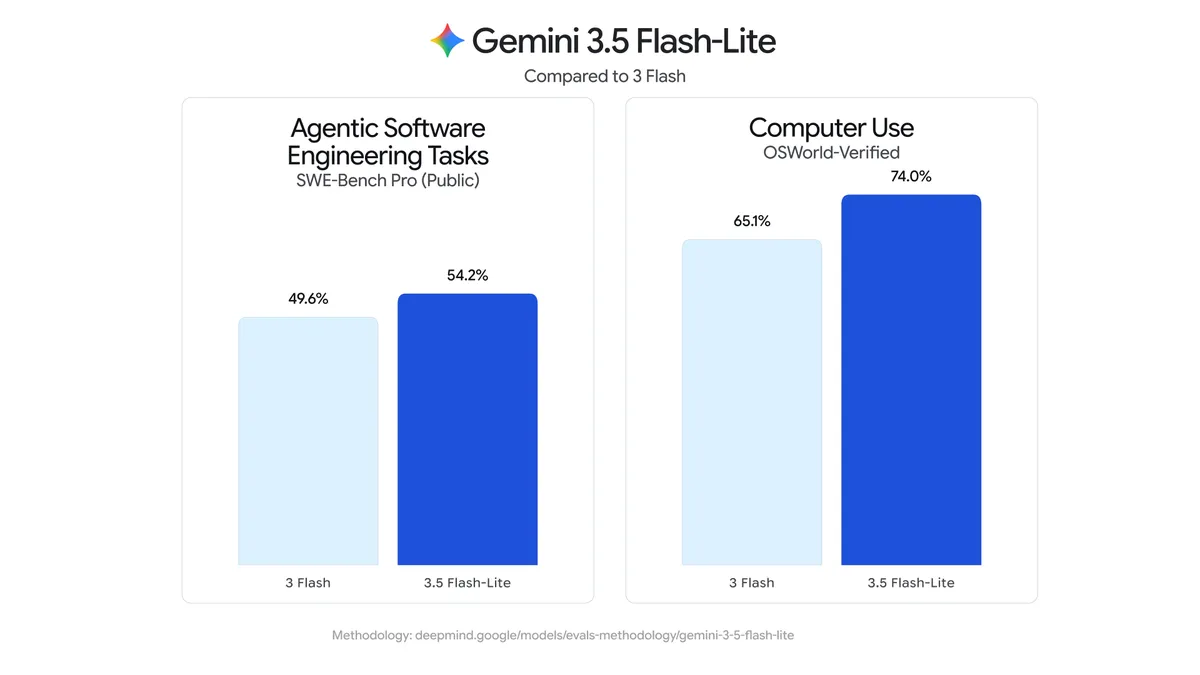
Gemini 3.5 Flash-Lite delivers 350 output tokens per second according to the Artificial Analysis Index, priced at $0.30 per million input tokens and $2.50 per million output tokens. The jump over its predecessor, 3.1 Flash-Lite, is substantial:
- SWE-Bench Pro: 54.2% vs. 38.3%
- Terminal-Bench 2.1: 54.0% vs. 31.0%
- OSWorld-Verified: 74.0% vs. 54.3%
On SWE-Bench Pro and OSWorld-Verified, Flash-Lite even beats the larger 3 Flash. Google is positioning it as a migration path for workloads running on 2.5 and 3 Flash models and is rolling it out inside Google Search.
On pricing, Flash-Lite costs a third of GPT-5.4 mini's input price and less than a third of Claude Haiku 4.5's, while landing within a few points of both on most benchmarks and ahead on several. For workloads running at high volume, such as content moderation, translation, and bulk data processing, that combination tends to matter more than any single benchmark win.
The cybersecurity wildcard
Gemini 3.5 Flash Cyber is built on 3.5 Flash and fine-tuned specifically for finding and fixing security vulnerabilities. The architectural approach centers on search space: deep vulnerability discovery requires exploring millions of code paths, so CodeMender deploys multiple 3.5 Flash Cyber agents in parallel, combining their outputs into a single report rather than routing a single expensive call to a larger model.
The results are concrete. On the V8 JavaScript engine, Flash Cyber found 55 unique confirmed issues versus 47 for 3.5 Flash and 36 for Claude Opus 4.6, including 10 that no other model caught. In internal testing by Google DeepMind's Big Sleep team, it outperformed 3.5 Flash, 3.6 Flash, and Claude Opus 4.6. The model is already running on Google's internal codebases including Chrome, Android, Cloud, and YouTube.
Access is restricted to governments and trusted partners through a limited-access pilot, giving defenders a head start before vulnerabilities can be exploited. Google benchmarked against Claude Opus 4.6 rather than newer competitor models because those more recent releases perform worse at finding vulnerabilities, which Google attributed to their safety guardrails. That framing signals where the industry is heading on AI and offensive security.
Flash while Pro waits
Google had said at I/O that Gemini 3.5 Pro would arrive in June. That deadline passed, with Bloomberg later reporting the delay stems from the model underperforming on coding benchmarks internally. Google confirmed 3.5 Pro is now testing with partners ahead of a broader release, and that its most ambitious pretraining run yet is underway for Gemini 4.
The Flash tier has been carrying the load in the interim. When 3.5 Pro first missed its window, Google shipped 3.5 Flash, which went on to beat Gemini 3.1 Pro on several coding and agentic benchmarks despite being the cheaper, faster tier. The efficiency story behind 3.6 Flash suggests it is running the same play, and the numbers support treating it as a genuine upgrade rather than a stopgap.
Where to start building
Gemini 3.6 Flash and 3.5 Flash-Lite are available today through the Gemini API in Google AI Studio and Android Studio. Gemini 3.6 Flash is also in Google's Antigravity coding tool and the Gemini Enterprise app. Both are live in the Gemini app for end users.
| Model | Input (per 1M tokens) | Output (per 1M tokens) | Speed |
|---|---|---|---|
| Gemini 3.6 Flash | $1.50 | $7.50 | Standard Flash |
| Gemini 3.5 Flash-Lite | $0.30 | $2.50 | 350 tokens/sec |
| Gemini 3.5 Flash (prev.) | $1.50 | $9.00 | Standard Flash |
The routing decision follows from the use case. Use 3.6 Flash for agentic pipelines, complex coding, document analysis, and multimodal tasks where output quality drives the result. Use 3.5 Flash-Lite for high-volume workloads where latency and cost per call are the binding constraints: bulk classification, translation, receipt parsing, or as a fast sub-agent inside a larger orchestration. The two are designed to work together, with Flash-Lite handling volume and 3.6 Flash acting as the orchestrating agent.
Comments
