Google DeepMind's Co-Scientist Cuts Hypothesis Discovery From Years to Days
Google DeepMind's Co-Scientist uses a multi-agent 'tournament of ideas' to generate and rank thousands of scientific hypotheses, now open to individual researchers via Gemini for Science.
- Co-Scientist launched: Google DeepMind released Co-Scientist, a multi-agent Gemini-based system for scientific hypothesis generation, with a Nature paper and public rollout.
- How it works: Specialized agents generate, debate, and evolve thousands of hypotheses using an Elo-style "tournament of ideas" to rank the best ones.
- Lab-validated results: Identified Vorinostat (an FDA-approved drug) that blocked 91% of a liver fibrosis response in lab tests; validated AML drug repurposing candidates in vitro.
- Access: Individual researchers can register interest at labs.google/science; enterprise access available via Google Cloud.
- Limitations: Cannot access paywalled literature, currently bioscience-focused, and requires expert prompting to extract the most valuable hypotheses.
- Broader context: Part of the Gemini for Science suite alongside Literature Insights and Computational Discovery; also deployed to all 17 US National Laboratories.
Scientific discovery has always been bottlenecked by one thing: the ability to connect dots across an ocean of literature and formulate the right hypothesis to test. Google DeepMind is now betting that AI can crack that bottleneck wide open. The lab has formally launched Co-Scientist, a multi-agent AI system built on Gemini that generates, debates, and evolves novel scientific hypotheses at a scale no human team can match. The research was simultaneously published in Nature, and the tool is now rolling out to individual researchers through Gemini for Science.
The announcement moves Co-Scientist from the early-stage research project DeepMind teased in early 2025 into a tool that working scientists can actually request access to, with a growing list of wet-lab validations already in the bag. This is not a chatbot you ask science questions. It is a structured reasoning engine designed to do the kind of iterative, critical thinking that takes human researchers months.
A Coalition of Agents, Not a Single Model
The core insight behind Co-Scientist is that scientific discovery is not a linear process. It is a cycle of ideation, critique, and refinement. The system is made of a collaborative coalition of specialized agents based on the Gemini model. A Generation agent proposes initial focus areas and novel hypotheses grounded in scientific literature and data, while a Proximity agent maps and clusters generated hypotheses to ensure a diverse, comprehensive exploration of the research space.

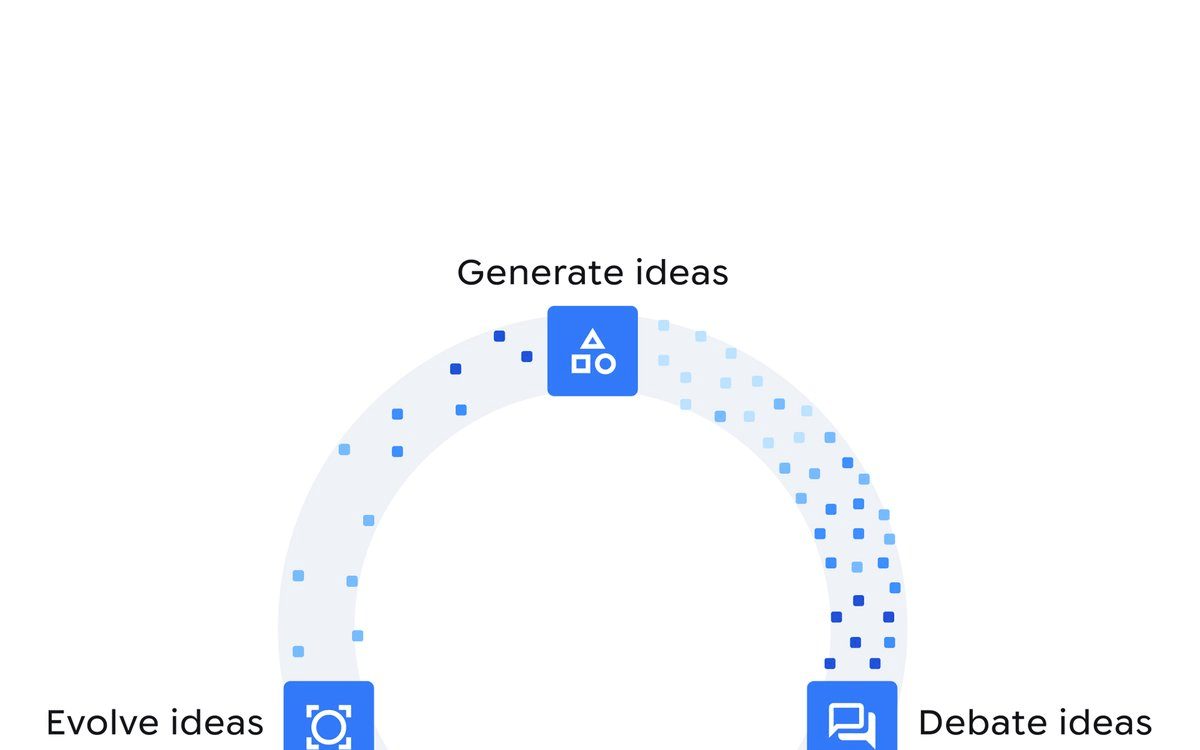
The system works in three phases:
- Generate: A Generation agent proposes hypotheses from literature and data. A Proximity agent clusters them to prevent the system from collapsing into a single line of thinking.
- Debate: A Reflection agent acts as a virtual peer reviewer, critically evaluating hypotheses for correctness, quality, and novelty. A Ranking agent then orchestrates an idea tournament, using pairwise comparisons and simulated scientific debates to prioritize the most promising paths.
- Evolve: An Evolution agent refines, recombines, and builds on top-ranked hypotheses. A Meta-review agent synthesizes insights across all rounds and generates the final research proposal.
Orchestrating everything is a supervisor agent that acts as an adaptive planner. Unlike a model that thinks linearly, it breaks down high-level research goals into executable steps and coordinates agents to run in parallel, exploring multiple avenues simultaneously.
The Tournament of Ideas
The process runs as a competitive loop: an Elo-based Ranking agent scores hypotheses against each other in pairwise debates, the Evolution agent improves the top-ranked hypotheses, and the Meta-review agent adjusts the system's approach across rounds. Performance scales with the computational resources applied during the process. Think of it as the same self-play mechanism that made AlphaGo superhuman at chess, but applied to scientific reasoning instead of board games.
To keep hypotheses grounded, the majority of the system's compute is dedicated to verification, not generation. The system cross-checks claims against scientific literature and integrates specialized databases like ChEMBL and UniProt. It can also call advanced models as tools, including AlphaFold, in select research collaborations.
Lab-Validated Results
The most compelling part of the Co-Scientist story is not the architecture. It is the wet-lab results. In the biomedical applications documented in the Nature paper, Co-Scientist proposed drug repurposing candidates for acute myeloid leukemia that were validated in multiple AML cell lines in vitro, and identified Vorinostat, an FDA-approved anti-cancer drug, as a candidate for liver fibrosis treatment that reduced a key TGFβ-induced cellular response by 91% in hepatic organoid tests.
The system has also been tested across a range of other problems by collaborating researchers:
- ALS: Co-Scientist helped MIT's Ritu Raman quickly digest complex literature, propose testable ideas, and identify where complementary expertise could strengthen the best leads, sparking a collaboration on potential RNA-based approaches to ALS.
- Cellular aging: At the Abudayyeh-Gootenberg Lab, the system synthesized decades of literature to propose novel genetic leads that in lab tests have been shown to rejuvenate cells, slashing dataset analysis time from months to days.
- Antimicrobial resistance: The system independently hypothesized how certain phage-inducible chromosomal islands expand their host range, a discovery later validated by researchers.
- Infectious disease: At Cambridge, Co-Scientist helped narrow the hunt for proteins that cause severe disease when pathogens like flu and COVID-19 leap from animals to humans, down to specific amino acids for lab testing.
Google DeepMind also announced an accelerated access program for all 17 US National Laboratories, beginning with Co-Scientist, which can accelerate hypothesis development from years to days. Enterprise previews are also underway with Daiichi Sankyo and Bayer Crop Science.
Where It Falls Short
The system is not without real limitations. Critical limitations include exclusion of paywalled research and the inability to distinguish low-quality from high-quality research. The system can only reason over what it can access, which means entire bodies of proprietary or paywalled science are invisible to it.
Early users noted that the current focus leans toward bioscience applications, which may require additional fine-tuning for social science or physics workflows. And while the hypotheses it generates are grounded in literature, extracting valuable hypotheses requires careful prompting, iterative feedback, and a willingness to engage in a kind of dialogue with the AI. It rewards expert users who know how to steer it.
While AI can propose hypotheses, it cannot run experiments or make ethical decisions. Scientists remain the ultimate decision-makers, ensuring that AI-driven ideas are rigorously tested before they are accepted. DeepMind is explicit about this: Co-Scientist is a partner in research, not a replacement for scientific or clinical expertise.
The Bigger Picture
Co-Scientist is part of a broader push Google is making under the Gemini for Science umbrella. The suite includes three experimental tools: Literature Insights, built with Google NotebookLM; Hypothesis Generation, built with Co-Scientist; and Computational Discovery, built with AlphaEvolve and Empirical Research Assistance (ERA). Together, they cover the full research pipeline from literature synthesis to hypothesis generation to computational modeling.
The broader industry context matters here. Where previous AI science tools like AlphaFold solved a single, well-defined problem, Co-Scientist is attempting something harder: open-ended scientific reasoning across arbitrary domains. Beyond standard literature review, summarization, and deep research tools, the system is intended to uncover new, original knowledge and to formulate demonstrably novel research hypotheses and proposals, building upon prior evidence and tailored to specific research objectives.
The announcement has sparked diverse reactions within the community. Enthusiasts praise its ability to accelerate research and potentially solve complex problems in days, while skeptics question its novelty and accuracy, suspecting it may just recycle data rather than innovate. The Nature publication and the growing set of lab validations are DeepMind's answer to those skeptics.
How to Get Access
Co-Scientist is being made available to individual researchers through Hypothesis Generation, a new experimental tool jointly developed across Google DeepMind, Google Research, Google Cloud, and Google Labs. The rollout is beginning in the coming weeks and researchers can register their interest at labs.google/science. There is no announced pricing for the individual researcher tier. An enterprise-grade version is available through Google Cloud for organizations that need it at scale.
The question the field is now wrestling with is not whether AI can help generate hypotheses. Co-Scientist has answered that. The real question is whether the hypotheses it generates will hold up when they leave the lab bench and enter the clinic. That answer will take years to arrive, but the early data is hard to dismiss.
Comments