
Google DeepMind's Antigravity Wires 37 Science Databases Into One AI Agent
Google's Science Skills for Antigravity plugs 30+ life science databases into an agentic IDE, compressing hours of bioinformatics work into minutes

Takeaways
- Science Skills launched: Google DeepMind added 30+ life science databases (UniProt, AlphaFold, AlphaGenome, InterPro) to Google Antigravity, its agentic IDE.
- Hours to minutes: Complex structural bioinformatics and genomic workflows that took hours now run in minutes via natural language.
- AK2 proof of concept: Internal teams used Science Skills to surface novel mechanistic insights into reticular dysgenesis, a fatal immunodeficiency, faster than conventional methods.
- Part of Gemini for Science: Three experimental tools also launched -- Literature Insights (NotebookLM), Hypothesis Generation (Co-Scientist), and Computational Discovery (AlphaEvolve) -- via Google Labs.
- Broad validation: Google is collaborating with 100+ institutions including Stanford, Imperial College London, and The Francis Crick Institute; Co-Scientist and ERA papers published in Nature.
- Access: Antigravity is free in public preview; Gemini for Science experiments open gradually via Google Labs; enterprise access via Google Cloud.
Google DeepMind just turned its agentic coding platform into a scientific workbench. At Google I/O, the company launched Science Skills for Google Antigravity -- a specialized toolkit that wires more than 30 major life science databases directly into an AI agent, letting researchers run complex bioinformatics workflows through natural language in minutes rather than hours. It is part of a broader push called Gemini for Science, Google's most coordinated bet yet on AI as a genuine research accelerator.
The announcement was co-authored by Pushmeet Kohli, Vice President at Google DeepMind and Chief Scientist at Google Cloud, and Yossi Matias, VP and General Manager of Google Research. James Manyika, Senior Vice President at Google-Alphabet, also shared the stage for the announcement. Two validation papers -- for Co-Scientist and ERA -- landed in Nature the same day.
What Antigravity Actually Is
Before diving into Science Skills, it helps to understand the platform it lives on. Google Antigravity is an agentic development platform whose core is a familiar AI-powered IDE experience, but it evolves the IDE toward an agent-first future with browser control capabilities, asynchronous interaction patterns, and a product form factor that enables agents to autonomously plan and execute complex, end-to-end tasks.
The underlying editor is a heavily modified fork of VS Code -- familiar enough that any VS Code user can sit down and start working -- but the value proposition is the layer on top: autonomous agents that read, write, and run code, with you supervising rather than driving. Think of it less like Copilot and more like a mission control room where you assign tasks and agents execute them in parallel. Antigravity is available for free in public preview for Mac, Windows, and Linux, with generous rate limits for Gemini 3 Pro usage.
The Science Skills Toolkit
Science Skills is a specialized bundle that integrates insights from over 30 major life science databases and tools including UniProt, AlphaFold Database, AlphaGenome API, and InterPro. The key insight here is unification: previously, a structural bioinformatics workflow meant jumping between a dozen separate databases, copying outputs, reformatting data, and manually stitching together results. Science Skills collapses that into a single agent conversation.
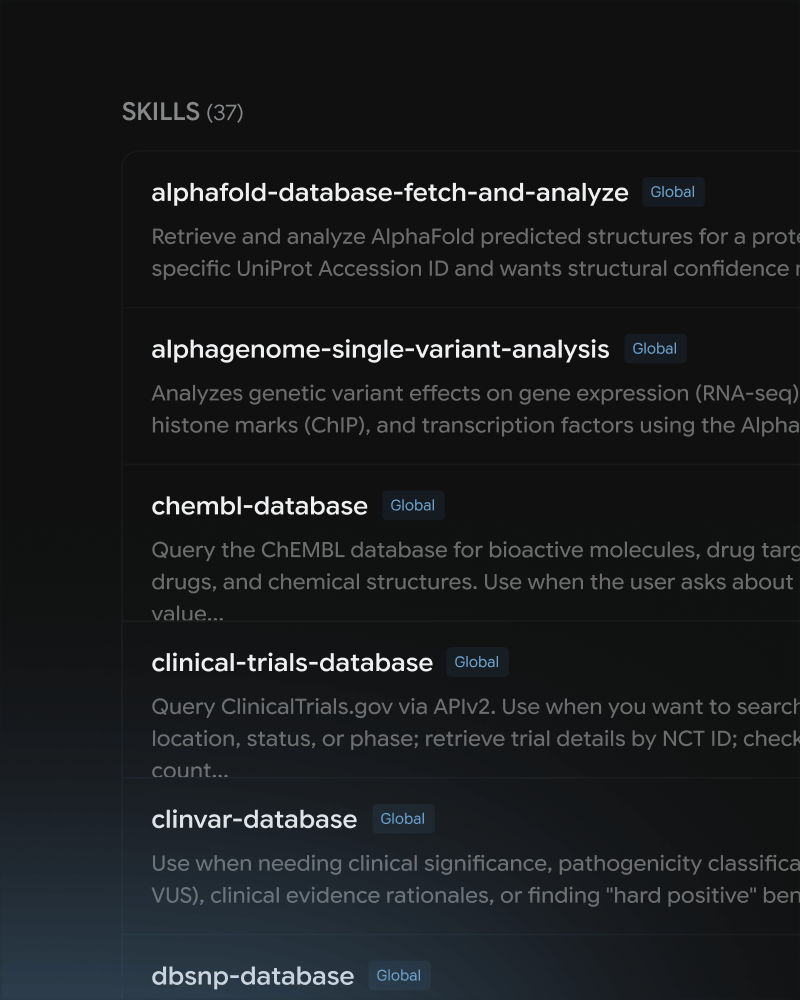
The 37 tools bundled in Science Skills span the core of modern life science research:
- Protein structure: AlphaFold Database fetch and analysis, structural similarity search
- Genomics: AlphaGenome single-variant analysis, dbSNP, ClinVar
- Drug discovery: ChEMBL database, clinical trials database
- Protein annotation: UniProt, InterPro domain analysis
- Literature: PubMed search and retrieval
Using these skills on agentic platforms like Google Antigravity allows researchers to perform complex and often manual workflows like structural bioinformatics and genomic analyses in minutes rather than hours. The entire workflow runs through natural language instructions -- no API wrangling, no format conversion, no database-specific query syntax to remember.
The AK2 Demo: From Observation to Hypothesis in Minutes
Google's internal team used Science Skills to stress-test the platform on a genuinely hard problem. DeepMind teams tested the feature on a rare genetic disease caused by AK2 mutations, which underlie reticular dysgenesis, a severe combined immunodeficiency. Reticular dysgenesis is one of the most severe known primary immunodeficiencies -- the disease is invariably fatal early in life unless hematopoietic and immune reconstitution are achieved by hematopoietic stem cell transplantation.
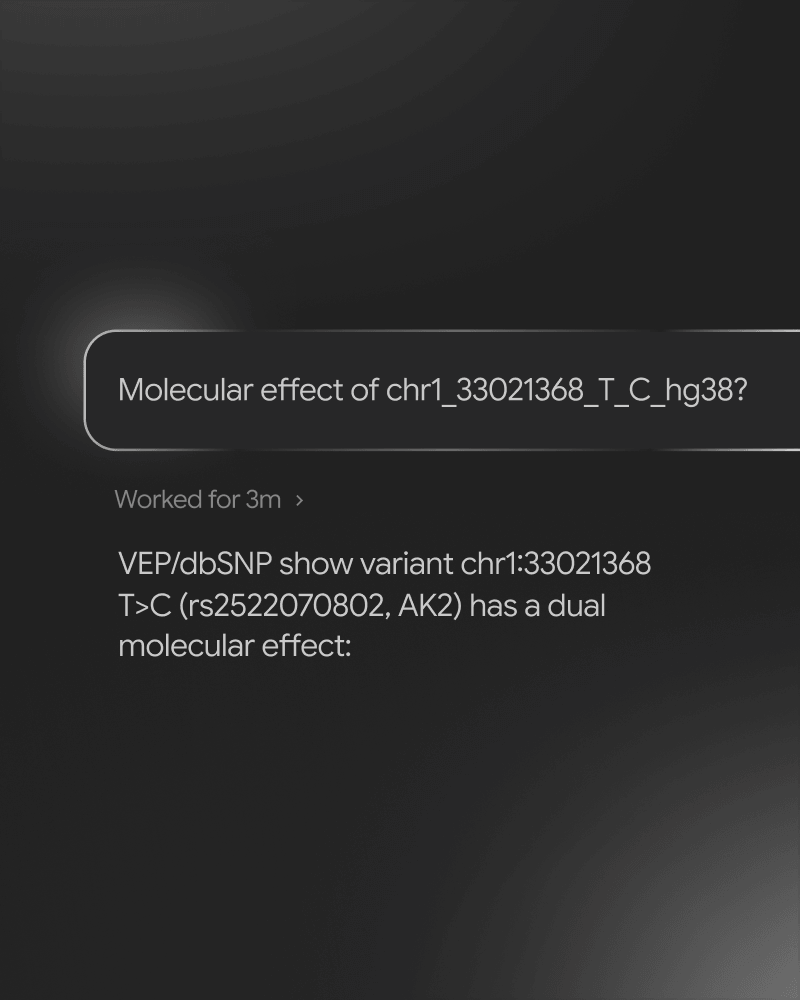
"We have oceans of data and amazing predictive models," says Saz Basu, a Google DeepMind research scientist. "But moving from an initial observation to a physical experiment means navigating fragmented manual and sometimes slow process." Using Science Skills, researchers obtained a complex structural analysis of AK2 and disease-linked variants significantly faster than with conventional methods. The accelerated workflow reportedly supported new mechanistic insights into how AK2 loss-of-function disrupts energy metabolism.
The entire workflow was completed in minutes using natural language instructions. That is the core pitch: not that AI replaces the scientist, but that it eliminates the hours spent navigating fragmented tooling between the moment of observation and the moment of hypothesis.
The Bigger Picture: Gemini for Science
Science Skills is one piece of a larger release. Gemini for Science includes three experimental tools: Literature Insights, built with Google NotebookLM; Hypothesis Generation, built with Co-Scientist; and Computational Discovery, built with AlphaEvolve and Empirical Research Assistance (ERA). Each targets a different bottleneck in the research pipeline:
- Literature Insights: Searches scientific literature and structures results into tables with custom attributes for side-by-side comparison, plus generates reports, slide decks, and audio overviews.
- Hypothesis Generation: Uses a multi-agent "idea tournament" to generate, debate, and evaluate hypotheses -- with every claim backed by clickable citations.
- Computational Discovery: An agentic research engine that generates and scores thousands of code variations in parallel, letting scientists test modeling approaches that would take months manually.
Google said access to the Gemini for Science experiments will begin opening gradually through Google Labs. These advanced AI capabilities are also being brought to enterprise organizations through Google Cloud. Enterprise partners already in private preview include Daiichi Sankyo, Bayer Crop Science, BASF, and Klarna.
Who Wins -- and What Changes
The most direct beneficiaries are wet-lab biologists and computational biologists who spend significant time on database navigation rather than science. Tasks that previously required hours of manual work may now take only minutes. For a PhD student or postdoc, that is not a marginal improvement -- it is a qualitative shift in how many hypotheses can be explored in a week.
The institutional validation effort is substantial. Google said it is collaborating with more than 100 institutions to validate the new systems, including Stanford University, Imperial College London, and The Francis Crick Institute. That breadth matters: it signals Google is not just shipping a demo but building toward peer-reviewed credibility. The Co-Scientist and ERA papers landing in Nature the same day as the announcement reinforces that posture.
For the broader AI-for-science space, this raises the competitive bar significantly. AlphaFold already reached over 3 million researchers. Plugging AlphaFold, AlphaGenome, and 35 other databases into an agentic interface that accepts plain English is a different kind of moat -- one built on ecosystem integration rather than model performance alone. The question now is whether the scientific community adopts Antigravity as a daily driver, or treats it as a powerful but occasional tool. Early signals from the AK2 demo suggest the speed gains are real enough to change habits.