

Google DeepMind and AlphaEvolve Push Math's Hardest Matrix Bound Further
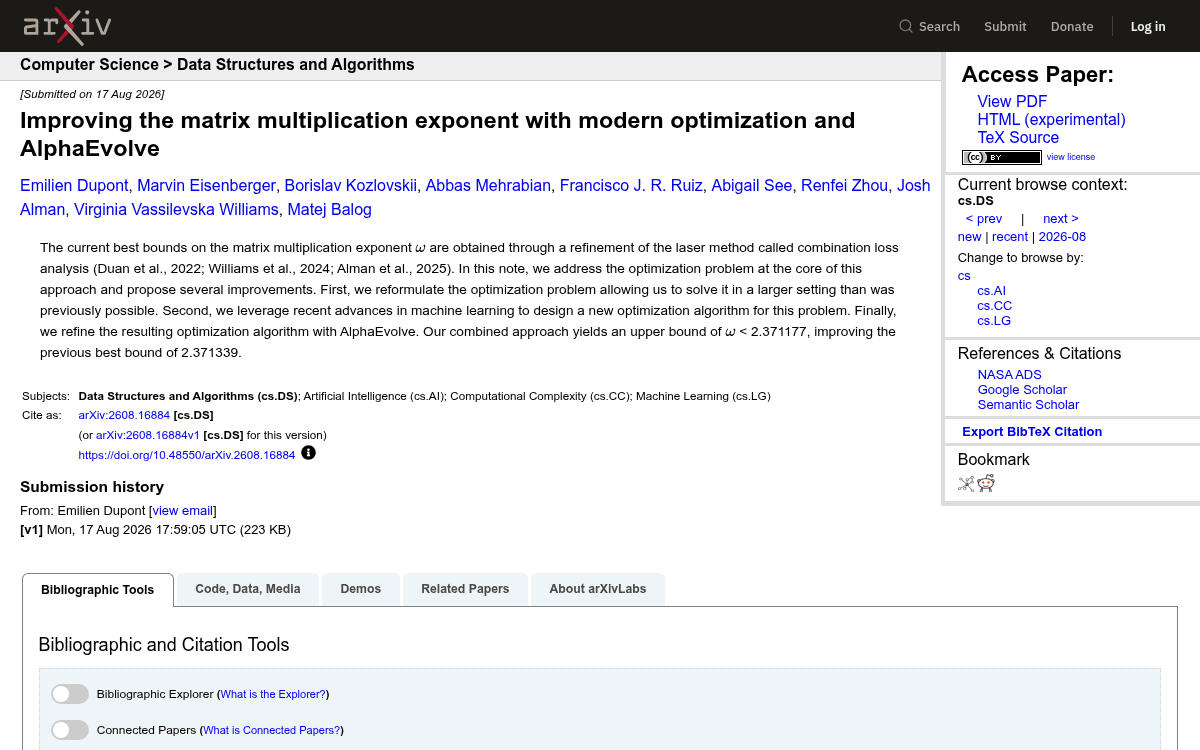
A team from DeepMind, CMU, Columbia, and MIT tightened the theoretical upper bound on matrix multiplication's exponent using gradient-based optimization and AlphaEvolve.
 PRO
- New upper bound on the matrix multiplication exponent: omega less than 2.371177, down from 2.371339.
- Joint work by researchers at Google DeepMind, Carnegie Mellon, Columbia, and MIT, including the authors of the prior record.
- Reformulated the combination-loss optimization problem and scaled from 25k to 7 million parameters.
- Built a Jax-based differentiable solver using softmax logits, Sinkhorn-Knopp, implicit differentiation, and Adam.
- AlphaEvolve evolved the optimizer code, contributing roughly 40 percent of the total gain.
- Final bound is certified in exact rational arithmetic; verification code and solution are being prepared for release.
The exponent that governs how fast matrices can theoretically be multiplied has moved again. A collaboration of researchers from Google DeepMind, Carnegie Mellon, Columbia, and MIT has published a short note pushing the upper bound on the matrix multiplication exponent from 2.371339 down to 2.371177. The improvement looks small, but on this problem, every digit past the decimal has taken decades of theoretical work to earn.
The method behind the number matters as much as the number. The team replaced the classical solver used in prior state-of-the-art work with a differentiable, GPU-friendly optimization pipeline written in Jax, then handed the resulting code to AlphaEvolve to evolve further. Two of the ten authors, Josh Alman and Virginia Vassilevska Williams, are the same theoretical computer scientists who set the previous record.
What omega actually measures
The matrix multiplication exponent, written as omega, is the smallest number such that two n by n matrices can be multiplied in roughly n to the power of omega arithmetic operations. The naive schoolbook algorithm gives omega equal to 3. Strassen's 1969 result showed that two n by n matrices can be multiplied in sub-cubic time, with omega less than 2.81, kicking off a decades-long chase toward the conjectured lower bound of 2.
Progress since then has come almost entirely through one technique. All improvements in the past 40 years rely on the laser method, a mathematical framework for indirectly designing matrix multiplication algorithms. The current best results come from a refinement called combination loss analysis, which reduces the problem to solving a large, non-convex optimization. Any feasible solution to that optimization yields a valid upper bound on omega. Better solutions, tighter bounds.
This story is for Pro members
You've reached the end of the free preview. Upgrade to AlphaSignal Pro to read the full article - and everything else behind the paywall.
Comments
