

Google Builds Nano Banana 2 Into Earth to Reimagine Any Location
Google Earth now lets you generate AI images of any location on Earth using Nano Banana 2, grounded in real satellite and 3D data.
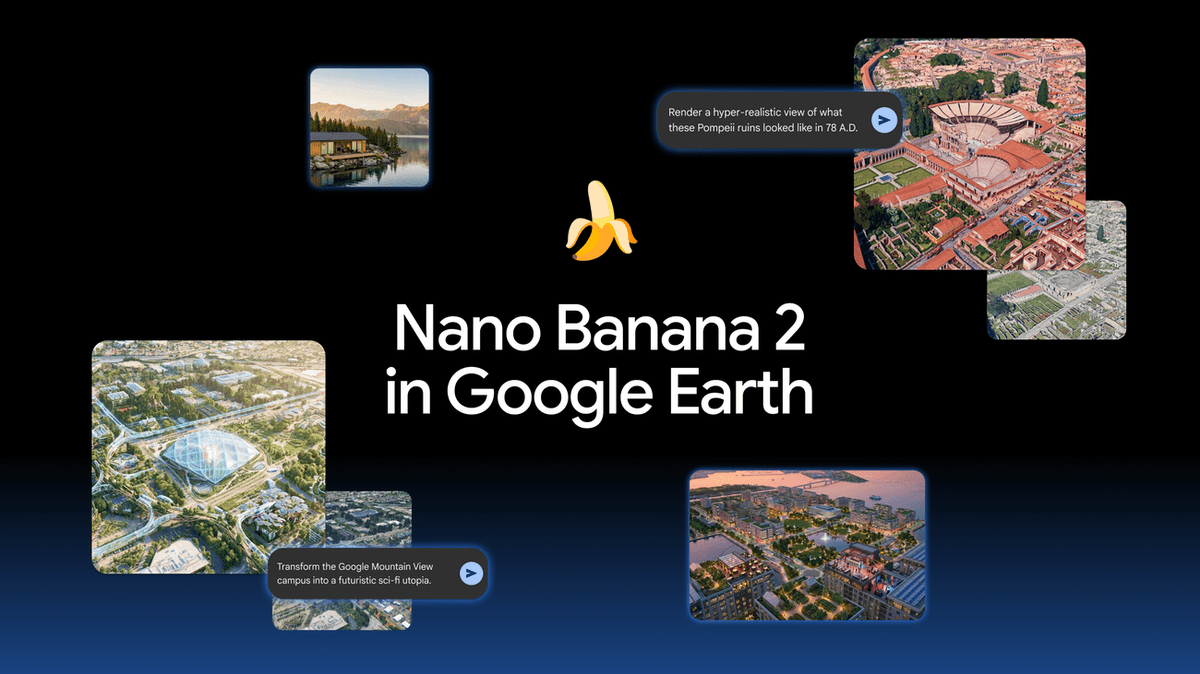
- Google has integrated Nano Banana 2 image generation into Google Earth on the web, live globally and free today.
- Users zoom into any location, tap "create image," and type a prompt; the model generates images grounded in real satellite and 3D data.
- Nano Banana 2 (Gemini 3.1 Flash Image) combines Pro-level quality with Flash speed, supporting up to 4K resolution and 5-character consistency.
- Use cases include historical visualization, real estate rendering, urban planning, location infographics, and creative reimagining.
- The feature is currently web-only, excluding the Google Earth mobile app despite 500M+ Play Store downloads.
- All generated images are watermarked with SynthID and paired with C2PA Content Credentials for AI provenance tracking.
Google has integrated Nano Banana 2 image generation into Google Earth on the web, letting anyone zoom into any spot on the globe, type a prompt, and get a photorealistic AI-generated image grounded in actual satellite, aerial, and 3D map data. It is live globally, for free, right now.
How it works
The workflow is straightforward: open Google Earth on the web, zoom into a location, tap "create image," and type what you want to see. The model uses the real geometry and visual context of that location as a base, then layers your prompt on top. A prompt like "add a modern lakefront cabin" produces a rendering of that specific lot, at that specific angle, with the surrounding landscape intact rather than a generic cabin dropped into a void.
The model behind it
Google DeepMind built Nano Banana 2 on the Gemini 3.1 Flash Image architecture, combining the quality of Nano Banana Pro with the speed of Gemini Flash. The previous Nano Banana models were based on the 3.0 branch.
The architectural difference from traditional diffusion models matters for this use case. Rather than treating a prompt as a bag of weighted keywords, Nano Banana 2 reasons about composition, lighting, and spatial relationships before rendering anything. It reads intent and context the way a language model would. Gemini 3.1's broader world knowledge also feeds the system, giving it enough factual grounding to render objects accurately and generate location-specific infographics rather than plausible-looking fabrications.
What it can do
- Generates images from 512px up to 4K in multiple aspect ratios
- Maintains character consistency across up to five characters and fidelity for up to 14 objects in a single workflow
- Renders text reliably in multiple languages
- Produces location-specific infographics by pulling factual data through Gemini's knowledge base
- Delivers sharper, more dynamic lighting than previous Nano Banana versions
Google also quotes up to 40% lower API cost compared to premium models, which matters for developers building on top of the capability.
Five things you can build or explore
Google's official blog post outlines five concrete use cases:
- Historical visualization: Zoom into Pompeii and prompt a hyper-realistic render of the site as it looked in 78 A.D.
- Location infographics: Ask for a graphic of the Statue of Liberty with key historical facts. Gemini retrieves the data; Nano Banana renders it.
- Real estate and urban planning: Prompt an empty lot to become a retail district, giving clients a photorealistic preview before any permits are filed.
- Pre-construction visualization: Render a future home or studio in the actual landscape of any open lot.
- Creative reimagining: Transform the Google Mountain View campus into a cyberpunk cityscape, or project any city a century forward.
Limitations to know before you start
The feature currently works only on Google Earth for the web. There is no mobile support at launch, which is a significant gap given Google Earth has over 500 million Play Store downloads. Google has not clarified whether image generation is available for every location on Earth or only select areas of interest.
Early reviewers noted that some historical renders fell short of the "hyper-realistic" results the marketing copy promises, so treat complex historical prompts as a starting point rather than a finished product.
On the safety side, every image generated with Nano Banana 2 carries two layers of provenance tracking. SynthID embeds an invisible digital watermark directly into the image file. C2PA Content Credentials attach verifiable metadata to the file so any downstream tool that supports the Coalition for Content Provenance and Authenticity open standard can confirm the image's AI origin.
Why geospatial context changes the output
Earlier attempts at AI-augmented maps produced generic overlays that sat awkwardly on top of real geography. Nano Banana 2 uses the actual geometry of a location as a conditioning signal, which is why renders feel like they belong to the place rather than being composited onto it. Geospatial data is functioning as a first-class input to the generative model, not just a background layer.
For urban planners, educators, and architects, Google Earth is now a visualization tool as much as a navigation one. The web-only restriction will likely not hold for long.
Comments
