

Google Bets Its Entire Cloud on MCP With One Official Open-Source Hub
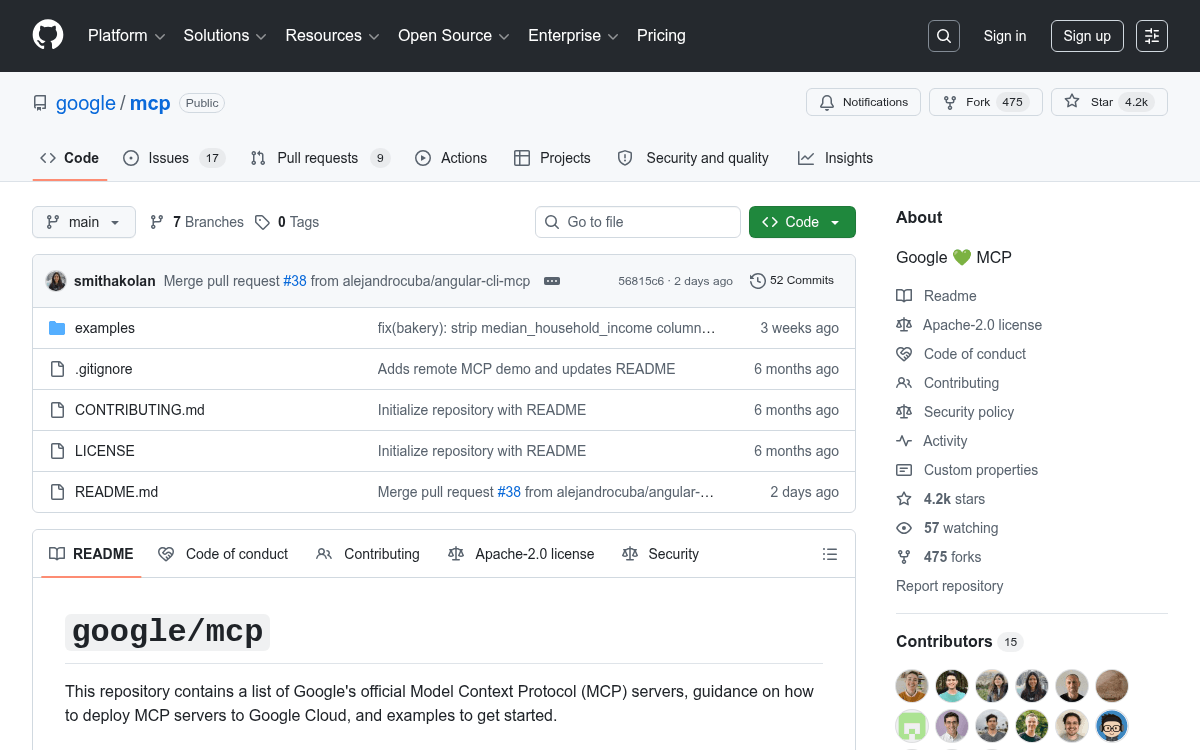
Google's official MCP repo centralizes managed remote servers for BigQuery, GKE, Maps, and 10+ more services, with IAM auth and no local setup required.
 PRO
PRO- Official hub: google/mcp is Google's single repo for all official MCP servers, deployment guides, and examples.
- No local setup: Managed remote servers activate automatically when you enable the corresponding Google Cloud API, accessible via HTTP endpoint.
- Broad coverage: 14+ remote servers including BigQuery, Spanner, AlloyDB, Firestore, GKE, Compute Engine, Maps, Chronicle, and more.
- Enterprise security: IAM-based auth (no shared keys), Model Armor prompt-injection scanning, audit logging, and VPC Service Controls built in.
- Client-agnostic: Works with Gemini CLI, Claude, ChatGPT, Cursor, and any MCP-compatible client.
- Open-source track: Self-hostable servers for Workspace, Firebase, Analytics, Chrome DevTools, Flutter/Dart, and gcloud CLI also included.
If you've been stitching together community-built MCP servers to connect your AI agents to Google Cloud, that era is over. Google has published google/mcp, an official repository that serves as the single source of truth for all of Google's Model Context Protocol integrations: managed remote servers, open-source servers, deployment guides, and working examples. It's the clearest signal yet that Google is treating MCP as a first-class part of its infrastructure strategy.
What MCP actually is (and why the "remote" part matters)
MCP, often likened to a "USB-C for AI", has quickly become a common standard to connect AI models with data and tools. The protocol defines how an AI agent discovers and calls external tools, whether that's running a SQL query, provisioning a VM, or fetching geospatial data. The key distinction in Google's implementation is remote vs. local:
- Local MCP servers run as a subprocess on your machine, communicating over stdin/stdout. They're fragile, hard to scale, and require every developer to manage their own installation.
- Remote MCP servers run on Google's infrastructure and expose a stable HTTP endpoint. Your agent just points to a URL.
Implementing Google's existing community-built servers often required developers to identify, install, and manage individual, local MCP servers or deploy open-source solutions, placing the burden on developers and often leading to fragile implementations. The managed remote approach eliminates all of that.
What's in the repo
The repository contains a list of Google's official MCP servers, guidance on how to deploy MCP servers to Google Cloud, and examples to get started. It's split into two tracks:
Managed remote servers (zero infrastructure to run): Google's existing API infrastructure is now enhanced to support MCP, providing a unified layer across all Google and Google Cloud services. Developers can now simply point their AI agents or standard MCP clients like Gemini CLI to a globally-consistent and enterprise-ready endpoint for Google and Google Cloud services.
This story is for Pro members
You've reached the end of the free preview. Upgrade to AlphaSignal Pro to read the full article - and everything else behind the paywall.
Comments
