



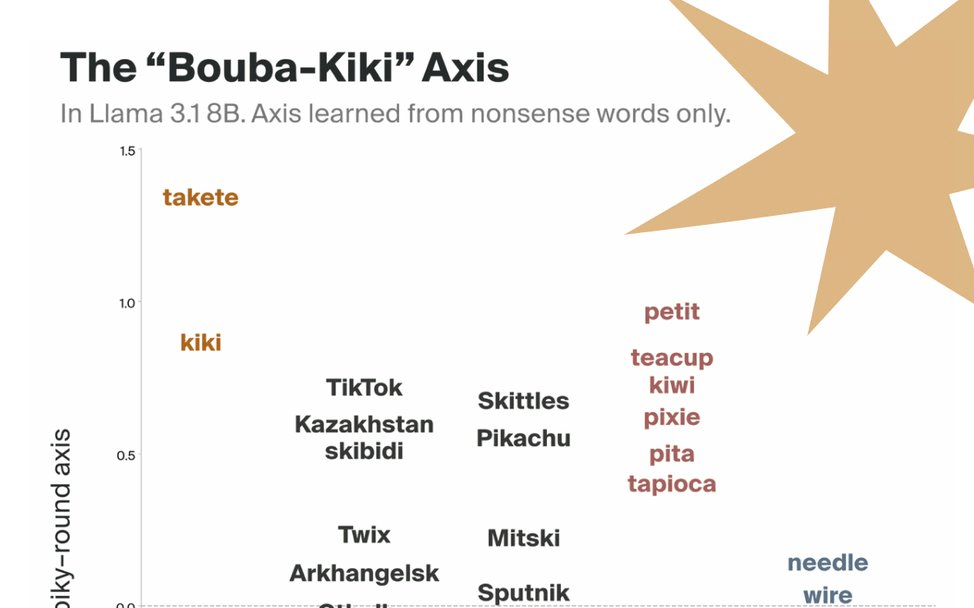
There's a well-known experiment in psycholinguistics: show someone two shapes, one spiky and one round, and ask which is called "kiki" and which is called "bouba." The bouba-kiki effect is a non-arbitrary mental association between certain speech sounds and certain visual shapes, and when presented with nonsense words, people tend to associate "soft" sounds like bouba with a rounded shape and "hard" sounds like kiki with a spiky shape. Now, Goodfire has found the same structure living inside the internal representations of large language models.
A direction in activation space that knows what "spiky" sounds like
Using their interpretability platform Silico, Goodfire's team probed the internal activations of Llama and Gemma and found a specific geometric direction in the models' hidden states that cleanly separates "spiky-sounding" words from "round-sounding" ones, independent of their actual meaning. Words like "kiki," "takete," and "crisp" cluster at one end; words like "bouba," "maluma," and "mellow" cluster at the other. This is mechanistic interpretability in action: instead of asking a model what it thinks, you look directly at the geometry of its internal representations.
The finding matters because it shows the models didn't just learn to answer bouba-kiki quiz questions correctly. They internalized the underlying structure of sound symbolism as a geometric feature of their representation space. The bouba-kiki effect has been robustly confirmed across a majority of cultures and languages, and its discovery dates back to the 1920s. The fact that LLMs replicate it geometrically suggests they absorbed this cross-modal regularity from the statistical patterns in their training text, not from any explicit instruction.


Don't miss what's next in AI
Join 300,000+ engineers and researchers who get the signal, not the noise.
- Full access to in-depth AI research breakdowns
- Be the first to know what's trending before it hits mainstream
- Daily curated papers, repos, and industry moves