

GitNexus Gives AI Coding Agents a Full Dependency Map to Stop Breaking Changes
GitNexus indexes any codebase into a pre-computed knowledge graph and feeds it to AI coding agents via MCP, eliminating blind dependency errors
 PRO
- GitNexus indexes any codebase into a pre-computed knowledge graph using Tree-sitter AST parsing, exposing it to AI agents via MCP — GitHub repo
- One command (
npx gitnexus analyze) indexes a repo, installs agent skills, registers Claude Code hooks, and creates context files automatically - 16 MCP tools give agents blast radius analysis, 360-degree symbol context, pre-commit change detection, and coordinated multi-file renames in a single query
- Graph RAG with Leiden community detection and hybrid BM25 + semantic + RRF search catches 2.7x more dependencies than grep-based approaches in tests
- Supports Claude Code, Cursor, Codex, Windsurf, Google Antigravity, and OpenCode; web UI available at gitnexus.vercel.app with no install
- Free for non-commercial use (PolyForm NC license); enterprise SaaS and self-hosted options via akonlabs.com; 40k+ GitHub stars
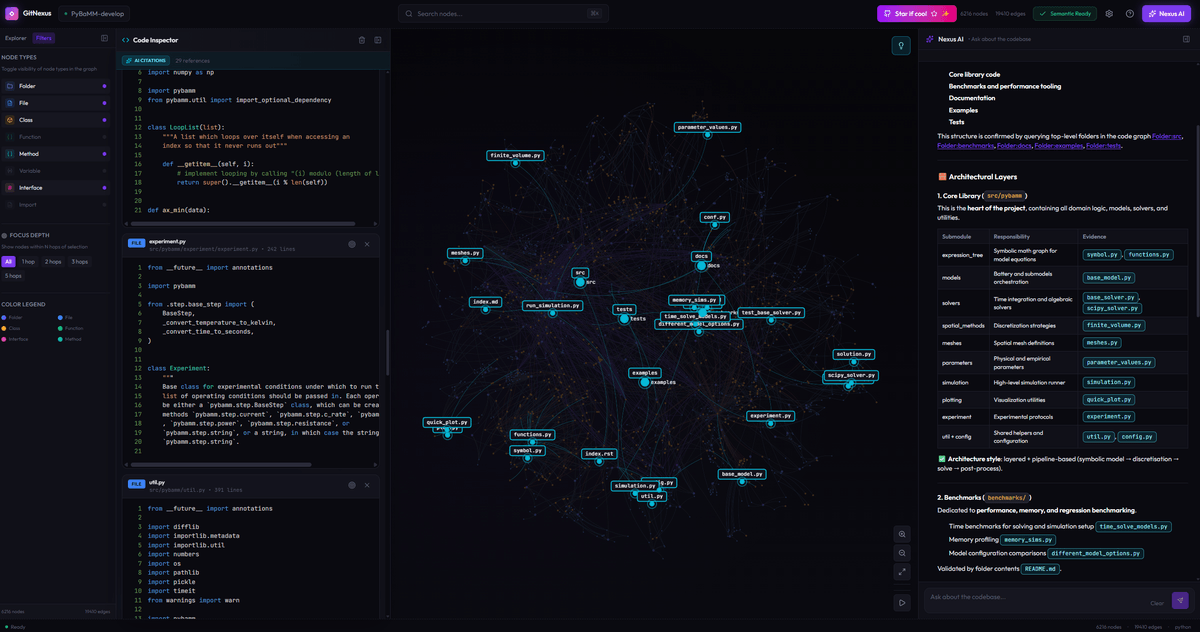
GitNexus is an open-source code intelligence engine that converts any repository into a structured knowledge graph , mapping every function call, import, class inheritance, and execution flow , then pipes that graph directly into AI coding agents like Claude Code, Cursor, and Codex via the Model Context Protocol (MCP). It has crossed 40,000 GitHub stars with over 4,600 forks, and the problem it solves is one most teams using AI-assisted coding have already hit: the agent edits a function, doesn't know 47 other functions depend on its return type, and breaking changes ship.
The blind spot in every AI coding agent
Traditional AI coding agents operate on file-based context windows or inefficient RAG prompts, frequently causing breaking changes because they lack visibility into distant dependencies. The standard fix , giving the agent more files , doesn't scale. Context quality beats model quality. AI agents can write impressive code but struggle with architectural decisions because they can't see relationships.
The deeper issue is how retrieval works. GitNexus uses Graph RAG (relationship-based retrieval) instead of vector-based RAG. When you ask "where do we handle payment failures?", Graph RAG combines BM25 text search, semantic embeddings, and graph context , prioritizing functions in payment execution flows , via Reciprocal Rank Fusion (RRF). The result: architecturally relevant answers, not just keyword matches. RRF is a technique that merges rankings from multiple search methods into a single, better-ranked list. Vector RAG finds semantically similar code but ignores relationships. It might return every function with "payment" and "error" in the name, ranked by embedding similarity. Graph RAG understands "this function is called by these 10 files in this execution flow" , structural awareness that's critical for impact analysis and refactoring.
How the graph gets built
Multi-phase indexing uses Tree-sitter ASTs to extract symbols with precision higher than regex or text search. Tree-sitter is the same incremental parsing library used by editors like Neovim and Zed , it produces a concrete syntax tree for each file, not just a text scan. The pipeline runs in six phases:
- Structure , walks the file tree and maps folder/file relationships
This story is for Pro members
You've reached the end of the free preview. Upgrade to AlphaSignal Pro to read the full article - and everything else behind the paywall.
Comments
