

GenCluster Crashes the Gold Medal Club at Coding's Hardest AI Benchmark
A research team demonstrates that open-weight models can hit IOI gold with a reproducible test-time compute pipeline built on generation, clustering, and tournament ranking.
 PRO
- Researchers at NVIDIA introduce GenCluster, a test-time compute pipeline for competitive programming.
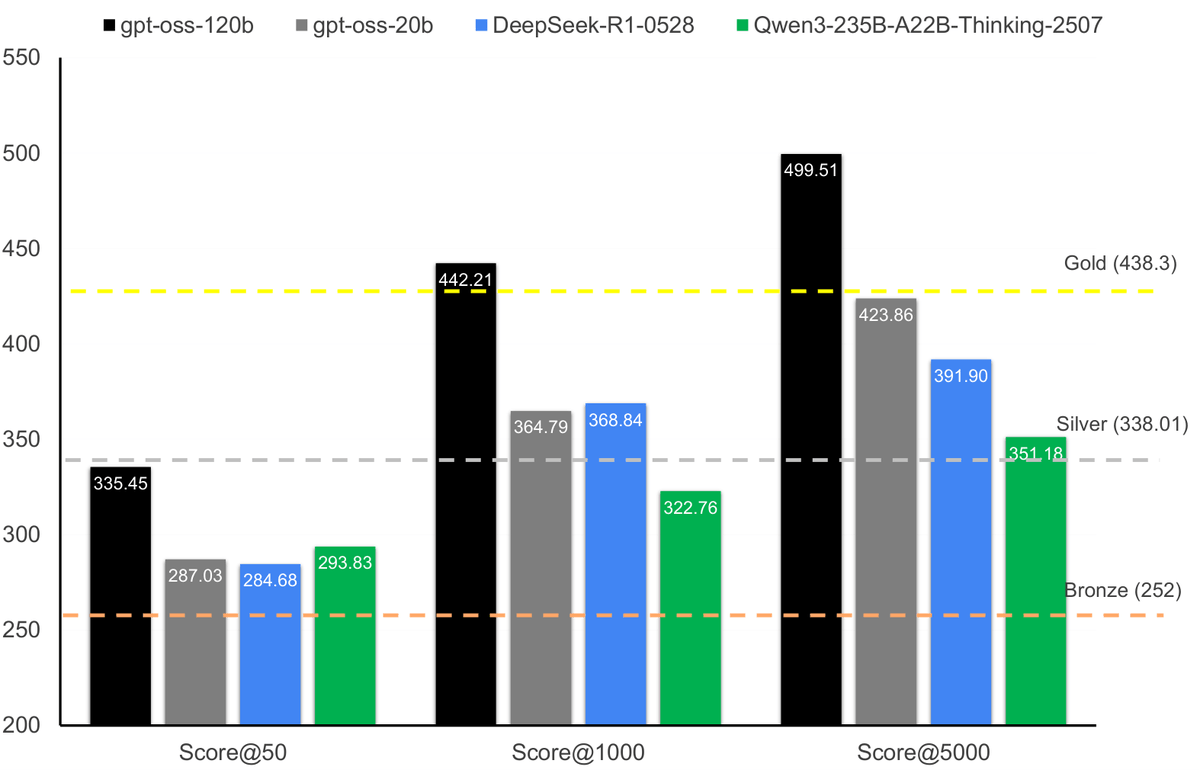
- Using gpt-oss-120b, it scores 446.75 at IOI 2025, above the gold medal threshold.
- First reported open-weight gold at IOI, with a fully documented and reproducible method.
- Pipeline: parallel generation, behavioral clustering via LLM-generated tests, tournament ranking, round-robin submission.
- Tournament ranking beats majority voting by 130+ points on the 50-submission constrained score.
- Cost is steep: about 15 billion tokens per full benchmark run across generation and ranking.
A group of researchers has published a paper showing that an open-weight language model can reach gold medal territory at the International Olympiad in Informatics (IOI), the annual competition long treated as the ceiling for algorithmic reasoning in AI. Their framework, GenCluster, wraps gpt-oss-120b in a four-stage test-time compute pipeline and reaches a score high enough for gold at IOI 2025, which they claim is a first for open-weight systems.
Until now, every publicly announced gold-medal IOI performance came from proprietary systems whose methodology was largely undisclosed. OpenAI reported gold at IOI 2024 with its o1-ioi and o3 models using specialized test-time compute approaches, and later claimed gold at IOI 2025, but the recipe was never published. This paper releases a fully specified approach that anyone with sufficient compute can reproduce.
The gap the paper is trying to close
IOI is not a leaderboard you win by prompting harder. At IOI 2025, contestants face six problems, each divided into 2–12 subtasks, with strict time and memory constraints. Each problem allows a maximum of 50 submissions, making submission strategy an essential factor in performance. That cap is the crux of the challenge: a model can generate thousands of candidate solutions, but only a tiny fraction can be submitted for grading.
Prior large-scale test-time compute work like AlphaCode 2, which surpassed 85% of Codeforces participants by scaling up to 1M solutions and refining the selection mechanism, established the generate-then-select pattern. Those systems used proprietary models, and existing selection strategies designed for math problems (where majority voting usually finds the right answer) fall apart on IOI-difficulty tasks where correct solutions are rare.
This story is for Pro members
You've reached the end of the free preview. Upgrade to AlphaSignal Pro to read the full article - and everything else behind the paywall.
Comments
