

GenAutoML Lets an LLM Invent Custom Neural Nets With 0.01ms Latency
GenAutoML uses LLMs as neural architects to auto-generate PyTorch time-series models from scratch, producing ultra-lightweight networks that run in under 0.01ms per sample
 PRO
- GenAutoML is an agentic framework that uses LLMs as neural architects to generate custom PyTorch time-series models from natural-language task descriptions.
- A Sandboxed Reflection Loop lets the system autonomously fix its own code errors by feeding runtime failures back to the LLM for rewriting.
- A Signature-Aware Runtime enforces input/output shape contracts, preventing the common failure mode of syntactically valid but unrunnable generated code.
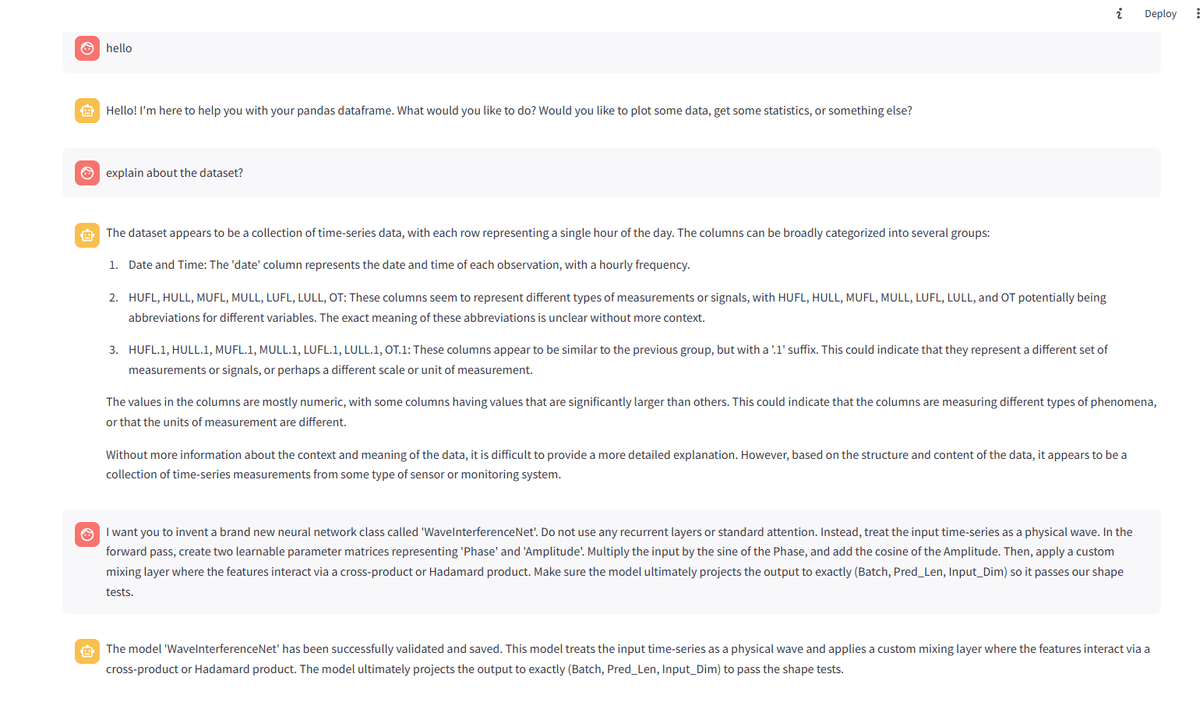
- WaveInterferenceNet, one of the generated architectures, achieves under 0.01ms inference latency per sample, making it viable for edge AI deployments.
- Tested on the standard ETTh1, ETTm1, and Weather benchmarks, the same datasets used to evaluate Informer, Autoformer, and PatchTST.
- No public code is released yet; the paper is available on arXiv but reproduction requires re-implementing the full pipeline.
Building a neural network for time-series forecasting has always been a hand-crafted affair. You pick an architecture, tune it to your data's quirks, and repeat. GenAutoML proposes a different approach: hand the job to an LLM and let it write the PyTorch code for you, end-to-end, with no predefined architecture template to constrain it.
The result is a fully agentic AutoML system that reads a description of your task, generates a custom neural network, tests it, fixes its own bugs, and delivers a working model. One of its generated architectures, WaveInterferenceNet, clocks in at under 0.01 ms inference latency per sample, making it a serious candidate for edge deployments where every microsecond counts.
The wall that traditional AutoML hits
Traditional AutoML systems primarily focus on model selection, hyperparameter tuning, and pipeline configuration, employing various optimization and meta-learning techniques to achieve automation. The catch is that all of this happens inside a fixed menu of pre-approved architectures. Neural architecture search (NAS) aims to systematically explore the complex architecture space to discover optimal neural architecture configurations without intensive manual interventions, but even NAS is bounded by whatever operations the researcher decides to include in the search space upfront.
For time-series data specifically, this rigidity is painful. Statistical properties such as mean and variance often change over time in time series, meaning time-series data suffer from a distribution shift problem, and this change in temporal distribution is one of the main challenges that prevent accurate forecasting. A static search space cannot adapt to the wildly different characteristics of, say, hourly electricity transformer readings versus 10-minute weather station data.
An LLM that writes its own architectures
GenAutoML's core idea is to replace the search space entirely with an LLM acting as a neural architect. Instead of choosing from a catalog of known blocks, the LLM generates novel PyTorch
This story is for Pro members
You've reached the end of the free preview. Upgrade to AlphaSignal Pro to read the full article - and everything else behind the paywall.
Comments
