

Free Open-Source Curriculum Teaches Engineers to Ship Real AI Agent Systems
A free, framework-free Colab curriculum walks backend engineers through the applied LLM stack, from raw API calls to serving, evals, agents, and red-team benchmarks.

 PRO
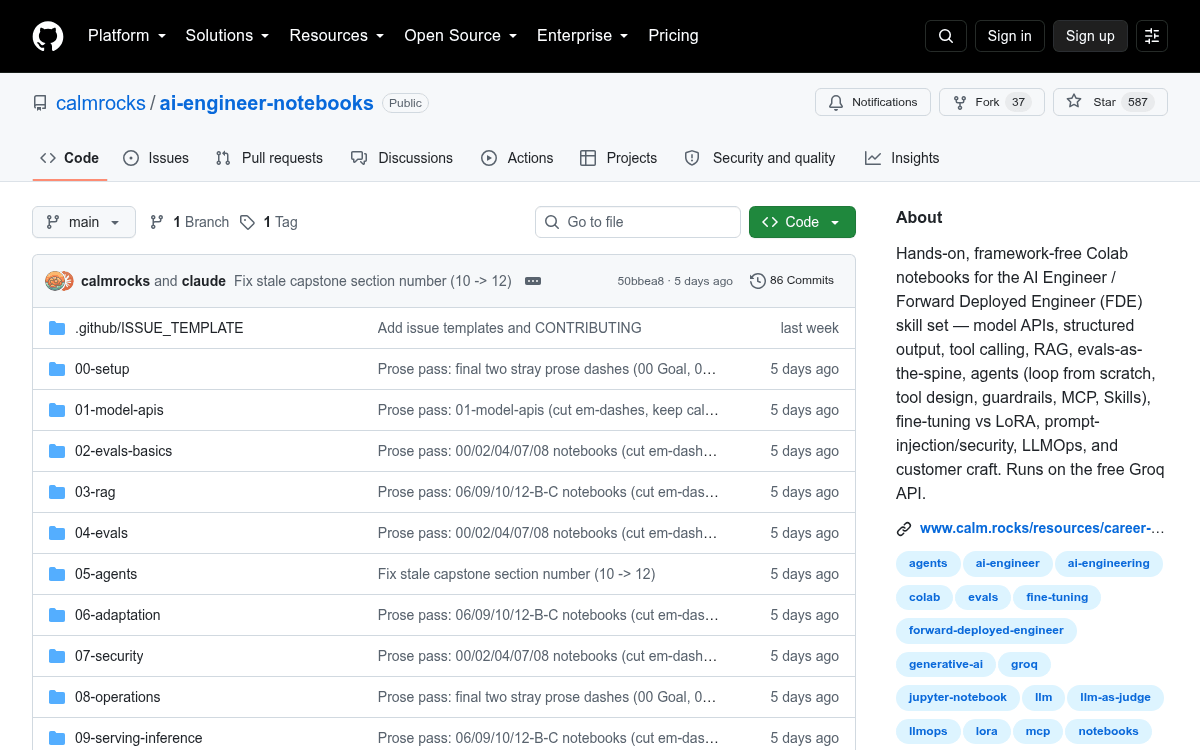
PRO- New MIT-licensed Colab curriculum ai-engineer-notebooks hits 587 stars teaching the applied LLM stack.
- Framework-free by design: build RAG, agent loops, and evals from raw API calls before touching LangChain.
- Runs entirely on the free Groq API with no credit card required.
- Covers evals-as-CI, MCP, Skills, LoRA vs RAG, OWASP LLM Top 10, vLLM/TGI serving trade-offs.
- Three end-to-end case studies including a PAIR-style red-team robustness benchmark.
- Includes a capstone brief designed to produce a resume-ready deployed repo.
Engineers who can call an LLM API are common. Engineers who can ship an evaluated, observable, agent-driven system in production are not. A new open-source curriculum called ai-engineer-notebooks targets that gap by teaching the applied-LLM stack from raw API calls up, with no LangChain, no LlamaIndex, and no credit card required.
The repo has crossed 587 stars in a few weeks and is aimed at backend or full-stack engineers moving into AI Engineer, Forward Deployed Engineer (FDE), Applied AI, or Solutions Engineer roles. Every notebook runs on the free Groq API and opens directly in Colab.
Framework-free by design
You write the agent loop, RAG pipeline, and evals from raw API calls first, so you understand what LangChain and LlamaIndex actually do before reaching for them. Patterns are durable; wrappers churn. The RAG section makes you build retrieval before chunking. The agents section has you implement the tool-calling loop by hand before introducing MCP or Anthropic-style Skills. Everything is OpenAI-compatible throughout, so every pattern transfers directly to OpenAI and, with small changes, Anthropic.
Evals as the spine
Rather than treating evals as a late chapter, the curriculum treats them as load-bearing infrastructure. Section 02 forces you to build a golden set on the prompting task from section 01 before you touch RAG. Section 04 goes deeper into LLM-as-judge, judge failure modes, and regression evals wired up like CI. By section 08, that eval harness gets promoted into MLflow with run tracking, model registry, and stage promotion. The habit of measuring before tuning is installed early and returns throughout.
This story is for Pro members
You've reached the end of the free preview. Upgrade to AlphaSignal Pro to read the full article - and everything else behind the paywall.
Comments
