

Fish Audio's S2 Pro Beats GPT-4o TTS With 15,000 Free-Form Voice Tags
Fish Audio open-sourced a 5B-parameter TTS model with free-form emotion tags, 80+ languages, and sub-100ms streaming on a single H200.
 PRO
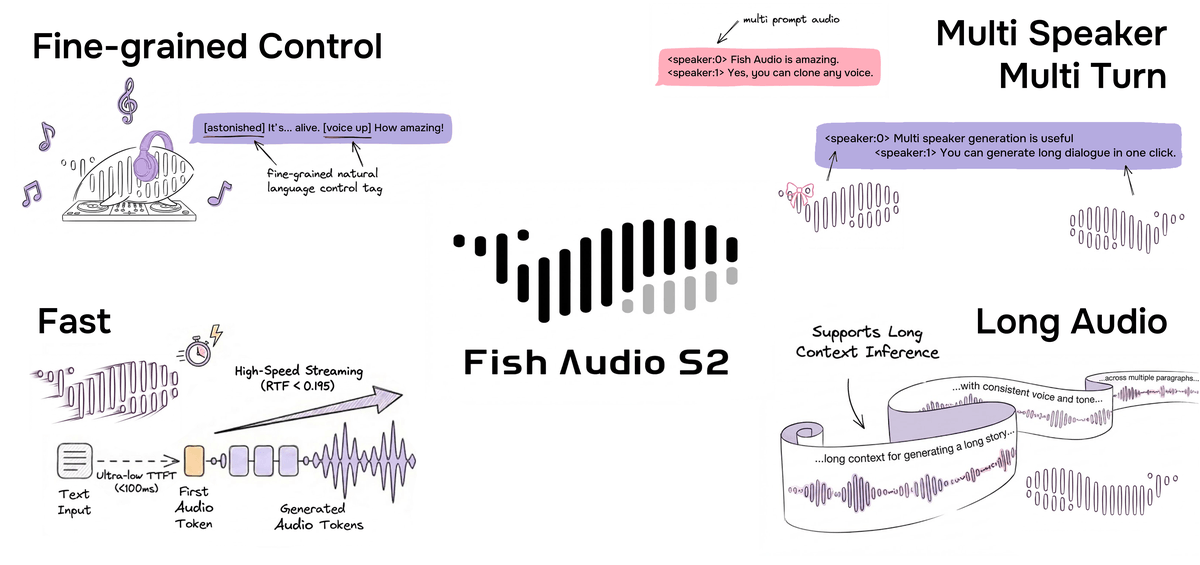
PRO- Fish Audio S2 Pro open-sourced: 5B-param TTS with free-form inline emotion tags across 80+ languages.
- Dual-AR architecture: 4B Slow AR for semantics, 400M Fast AR for acoustic detail via RVQ codec.
- Achieves 0.54% WER on Seed-TTS Chinese, 81.88% win rate on EmergentTTS-Eval versus gpt-4o-mini-tts.
- Runs at 0.195 RTF with ~100 ms time-to-first-audio on a single H200 via SGLang.
- Supports 15,000+ expressive tags like
[whisper],[professional broadcast tone],[chuckle]at word level. - Fish Audio Research License: free for research, commercial use requires separate agreement.
Fish Audio has released S2 Pro, an open-weights text-to-speech model that lets you steer voice delivery by writing bracketed instructions in plain English inside the script itself. Trained on more than 10M hours of audio across 80+ languages, it combines reinforcement learning alignment with a dual-autoregressive architecture. The release ships as a full stack rather than bare weights, and has already pulled nearly 400k downloads on the Hub.
Stage directions, inline
Instead of setting emotion through a fixed enum or a separate style embedding, you drop natural-language tags directly into the text where you want them to fire. S2 Pro accepts free-form descriptions such as [whisper in small voice], [professional broadcast tone], or [pitch up], giving open-ended expression control at the word level.
There is no closed vocabulary. Fish Audio reports support for more than 15,000 unique expressive tags covering whispering, broadcast tone, pitch changes, and beyond. A snippet looks like this:
[professional broadcast tone] Welcome back to the show.
[chuckle] I know, I know. [whisper] But listen carefully.
[excited] The results were unbelievable!
Because the tags are just text, novel phrases the model never saw during training tend to work anyway. That is a real departure from most controllable TTS systems, which expose a fixed set of style tokens or require a reference clip per emotion.
Two transformers instead of one
Under the hood, S2 Pro uses what Fish calls a Dual-Autoregressive (Dual-AR) design. Built on a decoder-only transformer with an RVQ-based audio codec (10 codebooks, ~21 Hz frame rate), the Slow AR (4B parameters) operates along the time axis and predicts the primary semantic codebook, while the Fast AR (400M parameters) generates the remaining 9 residual codebooks at each time step to reconstruct fine-grained acoustic detail. This asymmetric split keeps inference efficient while preserving fidelity.
This story is for Pro members
You've reached the end of the free preview. Upgrade to AlphaSignal Pro to read the full article - and everything else behind the paywall.
Comments
