

Fish Audio's S2 Pro Beats Closed-Source TTS Giants With 4B Open Model
Fish Audio open-sources S2 Pro, a 4B-parameter dual-autoregressive TTS system trained on 10M hours that beats closed-source rivals on Seed-TTS eval.
 PRO
PRO- Fish Audio open-sourced S2 Pro, a 4B parameter TTS model trained on 10M hours of audio.
- Beats Seed-TTS, MiniMax Speech-02, and Qwen3-TTS on Seed-TTS Eval WER for Chinese and English.
- Dual-Autoregressive architecture: 4B Slow AR handles semantics, 400M Fast AR handles acoustic residuals.
- Streams at 0.195 RTF with ~100ms time-to-first-audio on a single H200 via SGLang.
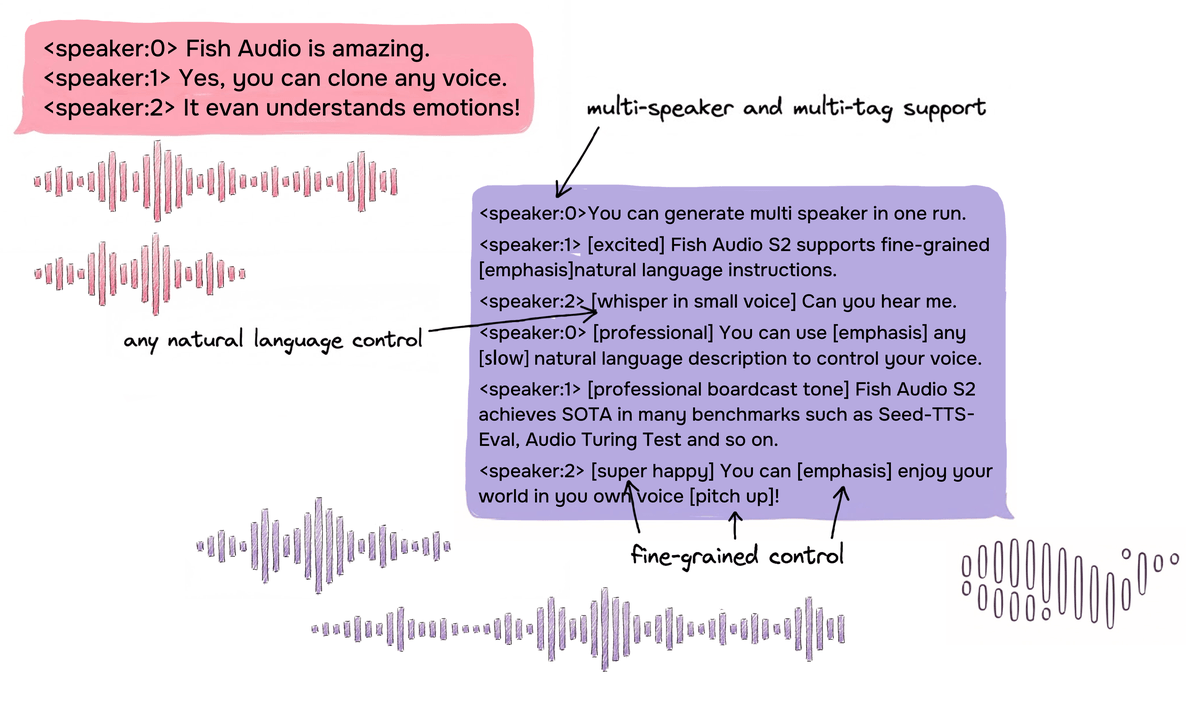
- 15,000+ inline emotion tags, native multi-speaker generation, and 10-30 second voice cloning.
- Weights on Hugging Face under a research license, not standard open source.
The open source TTS ecosystem just got a serious upgrade. Fish Audio has released Fish Speech S2 Pro, a 4-billion-parameter text-to-speech model that outperforms closed-source systems like Seed-TTS and MiniMax Speech-02 on standard benchmarks, while running fast enough for real-time streaming on a single GPU. The repo has crossed 31,000 stars and the weights are live on Hugging Face.
What makes this release interesting is not just the quality bump. It is the architecture choice: S2 Pro adopts a master-slave Dual-AR architecture consisting of a decoder-only transformer and an RVQ audio codec with 10 codebooks running at roughly 21 Hz. A Slow AR of 4B parameters operates along the time axis, predicting the primary semantic codebook. A smaller Fast AR handles the acoustic detail. The result is a system that treats speech generation like an LLM problem and inherits the entire modern LLM inference stack for free.
How it stacks up against the closed models
The benchmark numbers are the headline. On Seed-TTS Eval, S2 achieves the lowest WER among all evaluated models including closed-source systems: Qwen3-TTS at 0.77/1.24, MiniMax Speech-02 at 0.99/1.90, and Seed-TTS at 1.12/2.25. Fish S2 lands at 0.54% WER on Chinese and 0.99% on English.
On subjective quality, the gap is larger than you would expect from an open-source challenger. On the Audio Turing Test, 0.515 surpasses Seed-TTS at 0.417 by 24% and MiniMax-Speech at 0.387 by 33%. On EmergentTTS-Eval, S2 achieves particularly strong results in paralinguistics with a 91.61% win rate, questions at 84.41%, and syntactic complexity at 83.39%. Paralinguistics matters here because it is where most TTS systems fall apart, laughter, sighs, whispers, breathing.

The Dual-AR trick
The core idea behind Dual-AR is to split the two hard problems in neural codec TTS. Residual vector quantization codecs use multiple codebooks per audio frame, one for coarse semantics and several more for acoustic residuals. Predicting all of them with a single big transformer is expensive; predicting them separately with two right-sized transformers is much cheaper.
This story is for Pro members
You've reached the end of the free preview. Upgrade to AlphaSignal Pro to read the full article - and everything else behind the paywall.
Comments
