

Fish Audio Retires Bert-VITS2 and Points 8,800 Stars to Fish-Speech
Fish Audio officially retires Bert-VITS2, pointing its 8,800-star community to Fish-Speech, a new autoregressive TTS that outperforms closed-source rivals.
 PRO
PRO- Bert-VITS2 deprecated: Fish Audio officially retired Bert-VITS2 (8,800 stars), marking it as no longer actively maintained.
- Successor named: Users are directed to migrate to Fish-Speech, Fish Audio's new autoregressive TTS system.
- Architecture shift: Fish-Speech replaces BERT+VITS2 with a dual-AR transformer trained on 720,000 hours of multilingual audio.
- Benchmark-topping results: Fish Audio S2 achieves the lowest WER on Seed-TTS Eval, beating Qwen3-TTS, MiniMax, and Seed-TTS.
- Zero-shot cloning: Fish-Speech clones voices from short reference clips without fine-tuning, unlike Bert-VITS2 which required training data.
- Community forks survive: Style-BERT-VITS2 and other derivatives remain active but will no longer receive upstream improvements from Fish Audio.
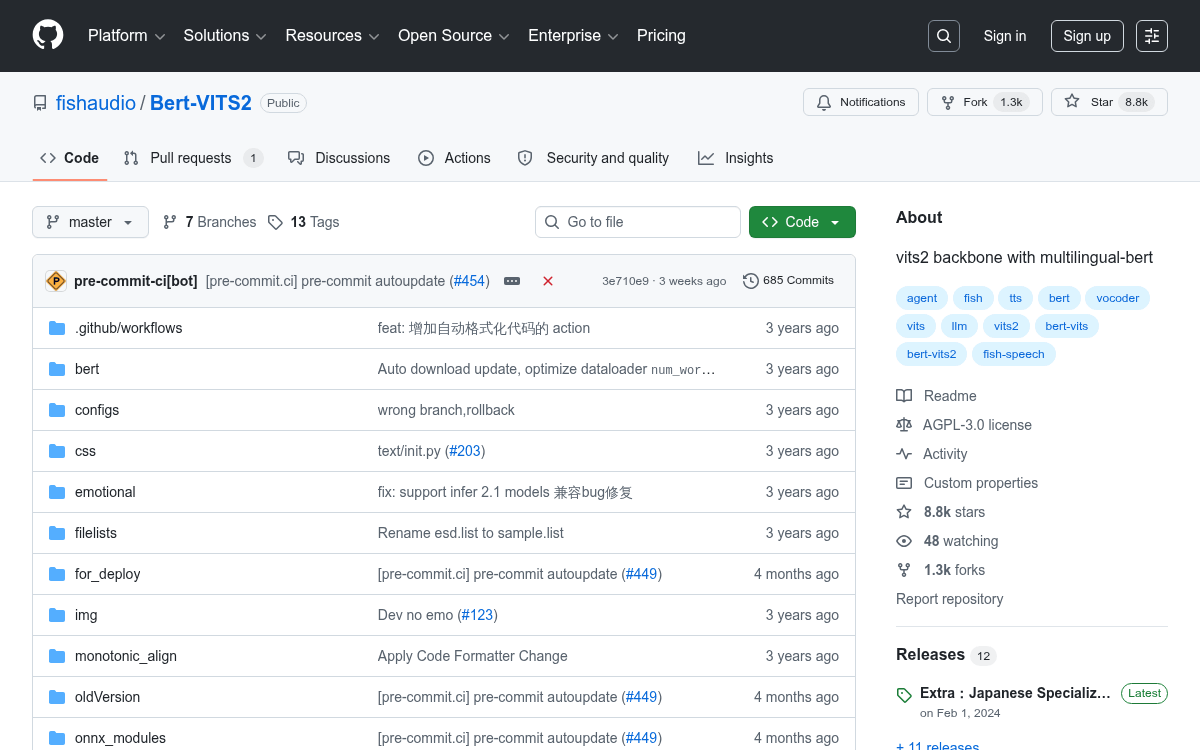
Bert-VITS2 is not getting a new release. It is getting a retirement notice. Fish Audio has updated the repository's README to tell users plainly: the project is no longer under active maintenance, and they should migrate to Fish-Speech instead. For a repo with 8,800 stars and 1,300 forks, that is a meaningful signal about where the open-source TTS landscape is heading.
What Bert-VITS2 was built to do
Bert-VITS2 is a neural TTS project that combines a VITS2 backbone with a multilingual BERT front-end to produce high-quality speech in multiple languages. The core idea is to use BERT-style contextual embeddings for text encoding while relying on a refined VITS2 architecture for acoustic generation and vocoding. In plain terms: instead of feeding raw phonemes into a speech synthesizer, Bert-VITS2 first runs the text through a BERT model to get rich, context-aware representations, then hands those off to VITS2 to generate audio.
BERT-VITS2 extended VITS2 by integrating a multilingual BERT encoder for text processing, enabling richer contextual understanding and improved text-to-semantic mapping. This addition allowed the model to handle diverse linguistic contexts effectively, resulting in more expressive and natural speech synthesis.
The repo shipped a full self-contained toolkit. It included support for emotional embeddings to control voice emotion and style during synthesis, a training pipeline with scripts for preprocessing, dataset filelists, spectrogram generation, and multi-GPU/multi-node runs, a web UI and inference scripts to test and use models interactively, and ONNX export for lighter-weight deployment environments.
This story is for Pro members
You've reached the end of the free preview. Upgrade to AlphaSignal Pro to read the full article - and everything else behind the paywall.
Comments
