

Firefox Partners With Exa.ai to Fight Google's AI Browser Monopoly
Mozilla is wiring Exa's AI-native search into Firefox Smart Window and iOS Quick Answers, pitching source-cited responses as an open alternative to closed browser stacks.
- Firefox is partnering with Exa.ai to power AI answers in Smart Window on desktop and Quick Answers on iOS.
- Responses show inline cited sources, backed by a zero-data-retention commitment.
- Mozilla positions the deal as an alternative to closed browser-plus-search-plus-model stacks from Google and OpenAI.
- Smart Window is opt-in, in beta, available in English in the US and Canada only.
- Exa runs its own index of 500B+ URLs, serves 5,000+ companies including Cursor and Cognition.
- Exa recently raised $250M Series C at a $2.2B valuation led by Andreessen Horowitz.
Firefox just picked a side in the AI browser wars, and it isn't the vertically integrated one. Mozilla announced a partnership with Exa.ai, the AI-native search company, to power live web answers inside Firefox's new Smart Window on desktop and Quick Answers on iOS. The deal is less about a single feature and more about a bet: that users would rather assemble their browser from independent parts than accept an all-in-one experience owned by one company.
What Exa actually plugs into
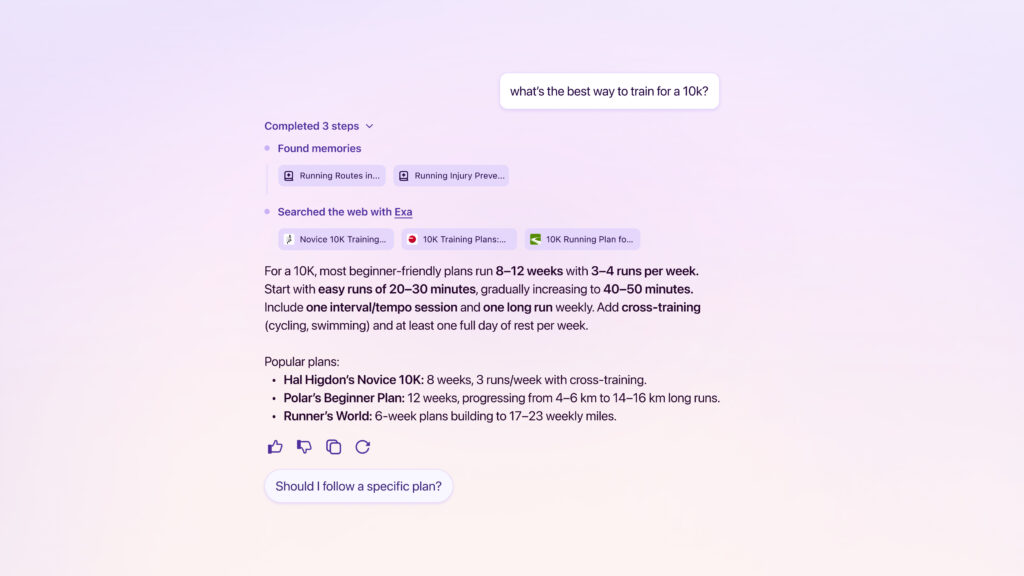
According to Mozilla's announcement, Exa's retrieval sits behind Firefox's AI answers so that when you get a response, you can see the source it came from, sitting inline rather than buried in a citations menu . The design goal is that a two-second glance tells you whether to trust an answer or click through to read more.
The retrieval layer lives inside Smart Window, Firefox's opt-in AI browsing mode. Through the Exa partnership, Smart Window can retrieve current web information and show the sources behind its response without taking you to a separate search results page. The same launch also brought automatic tab grouping, duplicate tab detection, and natural-language search over browsing history with visual page previews.
The anti-monolith pitch
Mozilla is being unusually blunt about the strategic framing. The blog post calls out how the industry is consolidating: one company builds the browser, the search engine, the model, and everything on top. Firefox's counter-position is to stay a browser and partner out the specialized pieces. Instead of building its own closed AI stack, Firefox is investing in partnerships with companies like Exa.ai that share its commitment to user choice, privacy, and transparency.
Exa's CEO Will Bryk hit the same note. Search built for the AI era doesn't work if it's locked inside one company's stack, and Firefox is one of the last browsers not trying to own the model, the search, and the browser all at once . That framing is aimed squarely at Google, Microsoft, and the wave of AI-first browsers from OpenAI, Perplexity, and The Browser Company.
Head of Firefox Ajit Varma has been direct about the economics behind the choice. In press interviews around the launch, he noted that Mozilla doesn't have billions of dollars spent on building an LLM that it needs to force upon users , arguing that Firefox users should pick the AI they want rather than take whatever the browser maker built.
Why Exa
Exa isn't a wrapper around Bing or Google. The company runs its own index and its own neural search stack, which is what makes it usable inside an AI product without leaking traffic to a third-party search engine. Founded around 2021 by Will Bryk, Dan McArdle, and Jeffrey Wang in San Francisco, Exa has built a proprietary search engine that indexes over 500 billion URLs using models trained from scratch rather than reselling Google or Bing results.
The company has become something of a default retrieval backend for AI products. Since launching its AI-focused API in early 2023, Exa's customer base has grown to more than 5,000 companies, including Cursor, Cognition, HubSpot, OpenRouter, and Monday.com. Its business case rests on the idea that agents will need search built for machines, not humans:
- A $250 million Series C announced in May 2026 to train the next generation of models and scale to hundreds of thousands of searches per second
- Led by Andreessen Horowitz at a $2.2 billion post-money valuation
- $361M in total funding across four rounds
- 400,000+ developers and 5,000+ businesses on the platform
Availability and the fine print
Smart Window remains a beta and stays firmly optional. The feature is only shown to users who opt in, and they can opt out at any time or toggle it off temporarily. It is currently available in English in the US and Canada only, with Mozilla taking sign-ups at firefox.com/smart-window to notify users when it reaches more regions. Mozilla is also pairing the rollout with a zero-data-retention commitment on the retrieval side.
What this changes for the rest of the stack
For anyone building on top of browsers or shipping AI products, the interesting signal is that a mainstream browser is treating the retrieval layer as a swappable component rather than a moat. That has a few knock-on effects worth watching:
- It gives Exa distribution into a browser that still handles a meaningful share of desktop web traffic, validating the pitch that neural search can be productized as infrastructure.
- It pressures competitors like Perplexity, Arc/Dia, and ChatGPT's Atlas to justify why their models, search index, and browser all need to come from the same vendor.
- It sets up a testable claim about grounding quality. If Smart Window's cited answers actually match the sources they show, that becomes a benchmark the closed stacks have to meet on their own turf.
Mozilla is hinting there will be more deals like this one, positioning Firefox as the neutral surface where independent AI pieces get stitched together. Whether that model can compete on speed and polish with a fully integrated stack from Google or OpenAI is the open question. But for now, Firefox has a credible AI answer engine that doesn't route its users through a competitor's index.
Comments
