

Fine-Tuned LLaMA 3.1 8B Beats Frontier APIs on Call Center Compliance
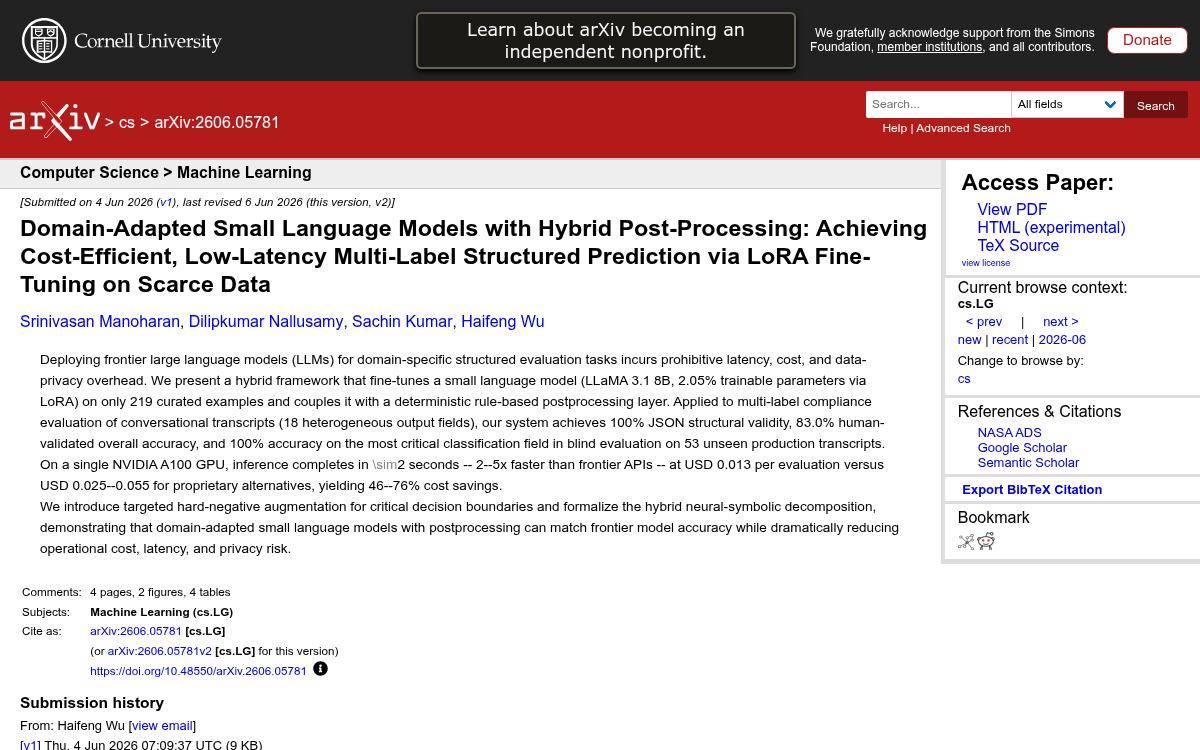
A fine-tuned LLaMA 3.1 8B model trained on just 219 examples matches frontier API accuracy on compliance tasks at a fraction of the cost and latency
 PRO
- Tiny training set, production results: A LLaMA 3.1 8B model fine-tuned on just 219 examples matches frontier API accuracy on compliance evaluation tasks.
- Hybrid architecture: The system pairs a LoRA-fine-tuned small model with a deterministic rule-based post-processing layer for 100% JSON structural validity.
- Cost savings of 46-76%: $0.013 per evaluation versus $0.025-$0.055 for proprietary API alternatives like GPT or Claude.
- 2-5x faster inference: ~2 seconds on a single A100 GPU, compared to frontier model API latency.
- Privacy-first deployment: Fully local inference means sensitive transcripts never leave the organization's infrastructure.
- Hard-negative augmentation: A targeted data augmentation strategy for critical decision boundaries compensates for the extremely small training dataset.
Every time a call center conversation gets routed through a frontier model API for compliance scoring, three things happen: money leaves the building, milliseconds stack up, and sensitive customer data crosses a third-party boundary. A new paper from Srinivasan Manoharan and colleagues proposes a tighter alternative: fine-tune a small model on your own data, bolt on a deterministic rule layer, and skip the API entirely.
The Problem with Using GPT for Everything
Compliance evaluation of conversational transcripts is a perfect example of a task that looks like it needs a frontier model but actually does not. The inputs are structured, the output schema is fixed, and the decision logic is domain-specific enough that a general-purpose model is bringing a lot of unnecessary capability to the table.
This story is for Pro members
You've reached the end of the free preview. Upgrade to AlphaSignal Pro to read the full article - and everything else behind the paywall.
Comments
