

Fake Ultrasound Images Help Hospitals Train Cancer AI Without Sharing Patient Data
A new study shows synthetic ultrasound images from diffusion models can lift federated breast cancer classifiers past centralized training baselines.
 PRO
- Federated breast ultrasound framework uses synthetic images from DCGANs and a class-conditioned DDPM to augment local training
- Average AUC rises from 0.9206 to 0.9362 with FedAvg, 0.9429 to 0.9574 with FedProx on three public datasets
- Diffusion-augmented FedProx (0.9574 AUC) beats centralized pooled-data baseline (0.9391 AUC)
- Class-conditioned DDPM outperforms two class-specific DCGANs across nearly all metrics
- Ablation shows excessive synthetic data hurts: 2000 extra images drop AUC from 0.9237 to 0.9203
- Sweet spot is around 12% synthetic samples per batch with a 10x smaller learning rate than real data
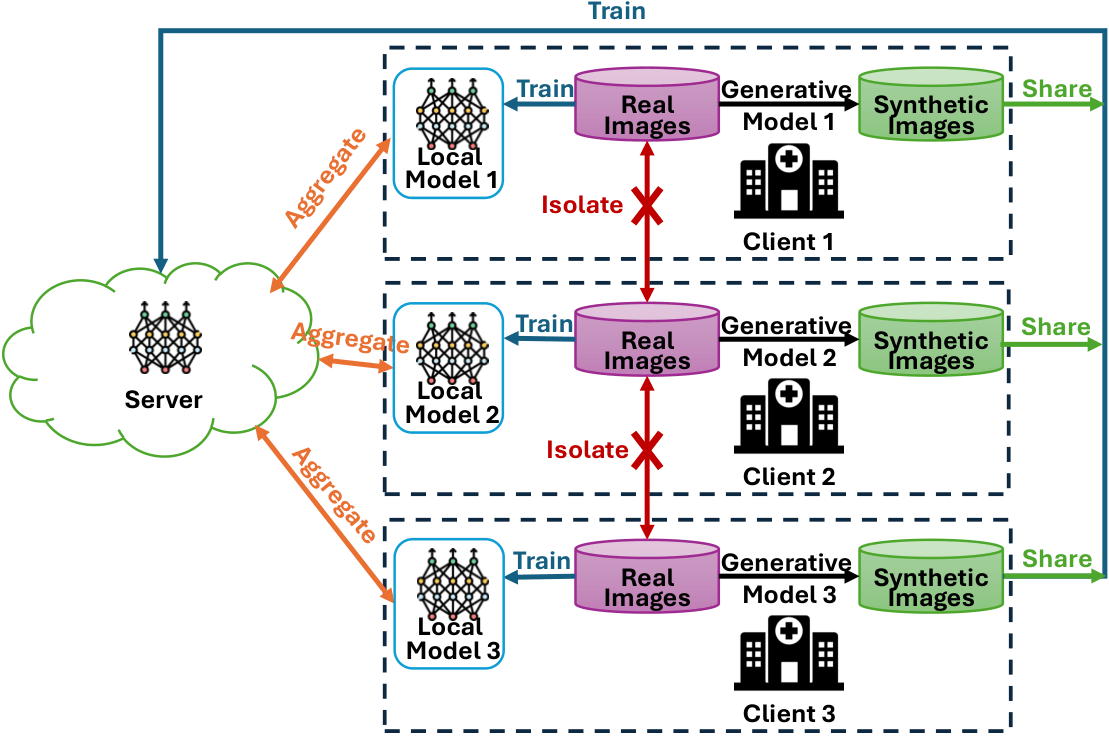
Training medical imaging models across hospitals is a tug-of-war between privacy and performance. Federated learning solves the privacy half by keeping patient data local, but each site's slice is usually too small and too skewed to train a strong classifier. A new paper from a team of radiology researchers proposes a fix: have each hospital train a generator, share only the fake images, and use those synthetic samples as a shared augmentation layer across the federation.
The authors test the idea on breast ultrasound classification and report that adding a suitable number of synthetic images lifted average AUC from 0.9206 to 0.9362 for FedAvg and from 0.9429 to 0.9574 for FedProx. The federated setup with diffusion-based augmentation even edges past a centralized model trained on the pooled real data, which is the usual ceiling for this kind of work.
Why federated ultrasound is hard
Breast ultrasound datasets are small, noisy, and heterogeneous. The three public datasets used here, BUS-BRA, BUSI, and UDIAT, together hold fewer than 2,700 images, and the class split leans heavily benign. In a federated setup each hospital only sees its own local distribution, which the paper flags as the classic problem: non-IID data, domain shifts, and limited local samples all hamper federated learning performance. Malignant cases in particular are so rare per client that a naive FedAvg run overfits to whatever local quirks exist.
This story is for Pro members
You've reached the end of the free preview. Upgrade to AlphaSignal Pro to read the full article - and everything else behind the paywall.
Comments
