

Factory's Droid Now Runs GPT-5.6 Sol Beating Claude by 13 Points
Factory's Droid platform now routes GPT-5.6 Sol, Terra, and Luna to the right engineering task automatically — no model-switching required.
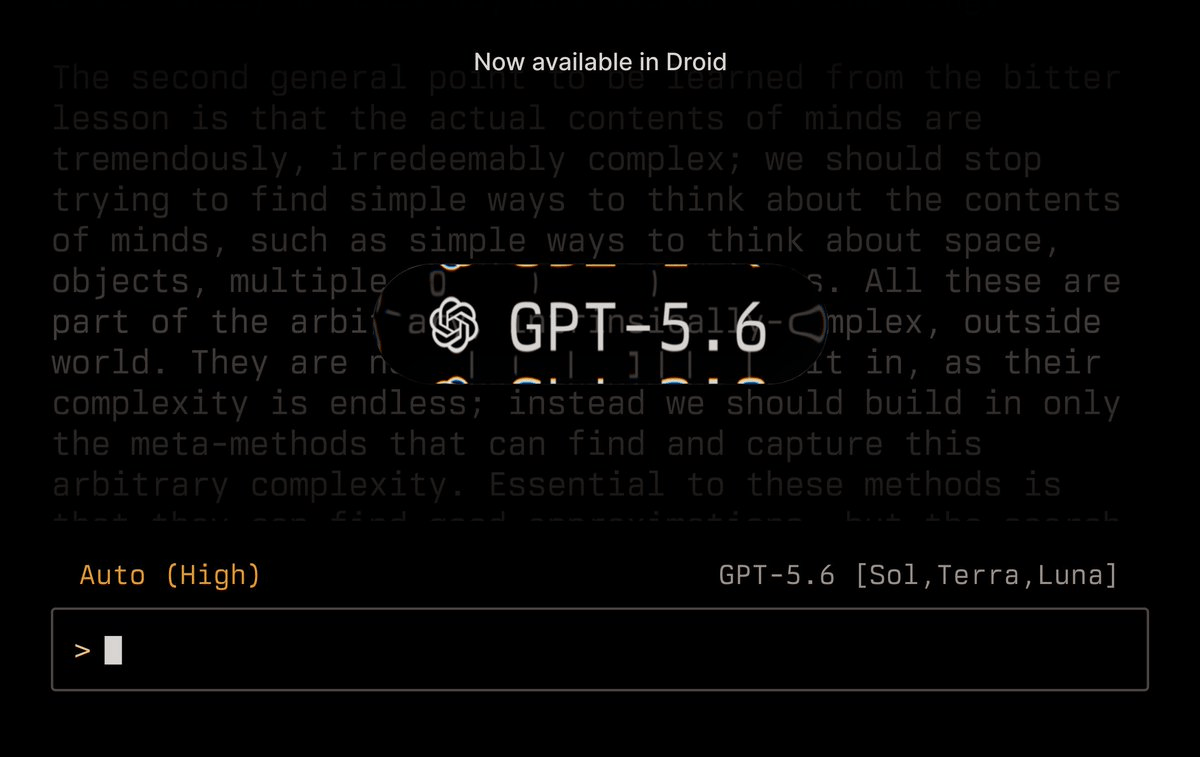
- GPT-5.6 Sol, Terra, and Luna are now live in Factory's Droid platform, routed automatically by task type.
- Sol handles broad terminal engineering work; Terra targets the edit-test-iterate loop; Luna excels at codebase research and document synthesis.
- GPT-5.6 Sol scores 53.6 on Agents' Last Exam, beating Claude Fable 5 by 13.1 points on long-horizon professional workflows.
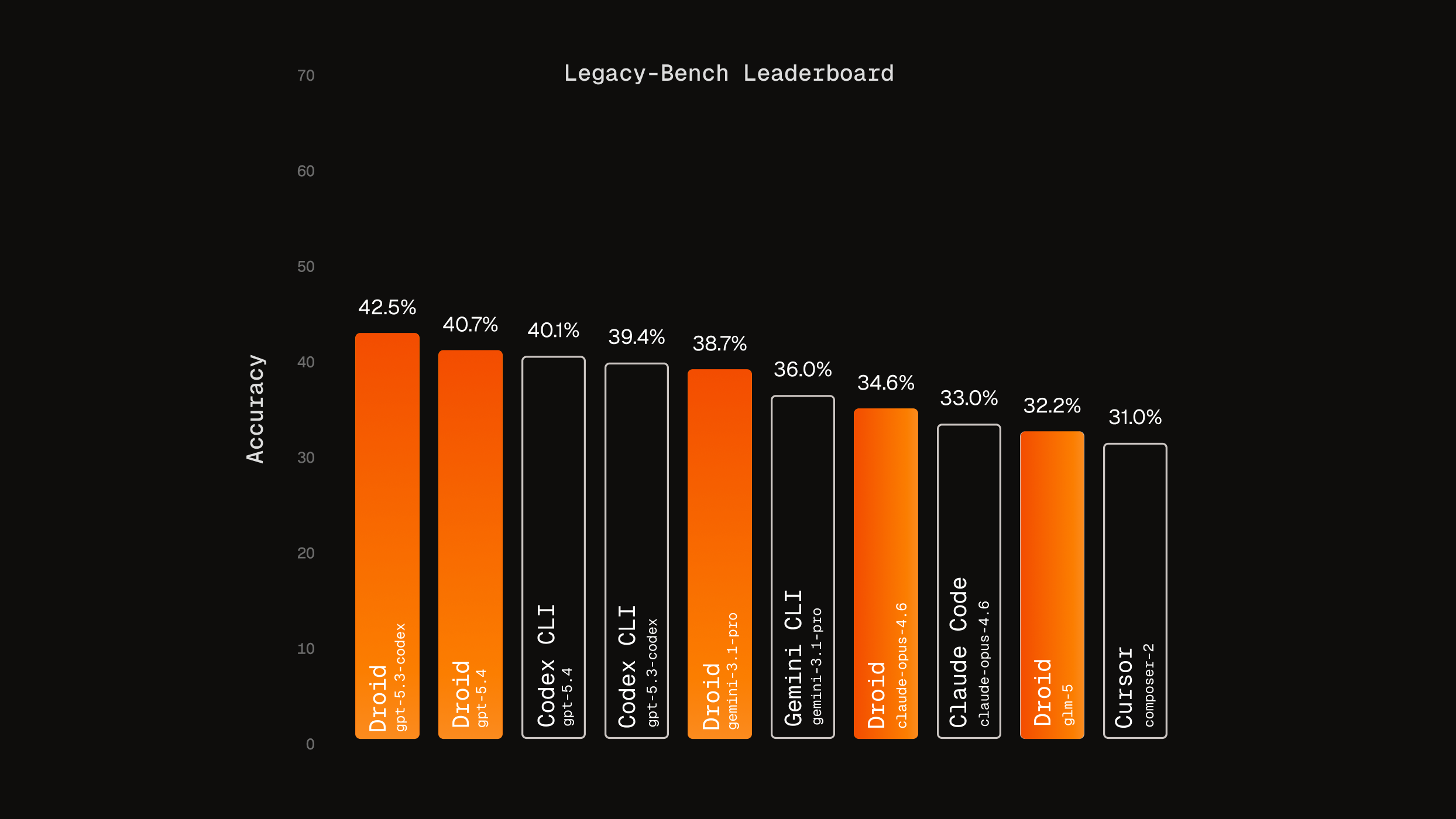
- Factory's agent harness outperforms labs' own agents: Droid with GPT-5 (52.5%) beats Codex CLI (42.8%) on Terminal-Bench.
- Pricing: Sol $5/$30 per 1M tokens, Terra $2.50/$15, Luna $1/$6; Factory plans start at $20/month.
- Factory is model-agnostic and interface-agnostic — works across CLI, VS Code, JetBrains, Slack, and Linear without lock-in.
OpenAI's GPT-5.6 model family , Sol, Terra, and Luna , just landed inside Factory's Droid platform. For teams already using Droid as their autonomous engineering agent, this means access to OpenAI's newest generation of models on day one, routed automatically to the task at hand. No config changes, no model-switching, no tradeoffs.
The timing matters. GPT-5.6 hit general availability as a three-model family: Luna, Terra, and Sol, from smallest to largest. In OpenAI's new naming system, the number identifies a model's generation, while Sol, Terra, and Luna identify durable capability tiers that can advance on their own cadence. Factory is one of the first platforms to surface all three in a single, unified agent harness.
Three models, three jobs
The GPT-5.6 family is not just a single model with different price tags. Each tier has a distinct performance profile, and Factory has mapped each one to a specific engineering role inside Droid:
- Sol is the broad engineering generalist. It handles multi-step terminal work across code, data, security, and environment setup, and tends to inspect surrounding code before changing behavior. Sol is the flagship model, built for complex reasoning, coding, scientific work, cybersecurity, and long-running agentic tasks.
- Terra is the high-reasoning implementation model. It shines inside the edit-test-iterate loop, holds up well on long sessions, and supports cache reuse for efficiency. Terra has competitive performance to GPT-5.5 while being 2x cheaper.
- Luna is the standout for codebase research and document synthesis. It starts with the right moves: reading relevant files, fetching source material, and searching the repo with focused patterns. Luna is the smallest and most cost-efficient model in the series, aimed at faster, lower-cost workloads.
What GPT-5.6 actually brings
The raw benchmark numbers for GPT-5.6 Sol are hard to ignore. OpenAI's biggest benchmark claim concerns long-running agentic performance , on Agents' Last Exam, an evaluation of long-running professional workflows across 55 fields, GPT-5.6 Sol sets a new high of 53.6, eclipsing Claude Fable 5 by 13.1 points. Even at medium reasoning, it beats Fable 5 by 11.4 points at roughly one-quarter the estimated cost.
Cybersecurity is a notable standout. On ExploitBench 1, GPT-5.6 Sol scored 73.5%, compared with 47.9% for GPT-5.5 at a comparable output-token budget. In BrowseComp, GPT-5.6 Sol achieved 92.2%, a new state-of-the-art result for agentic browsing tasks. These are the kinds of tasks , long-horizon, multi-tool, ambiguous , that Droid is specifically designed to run.
There are also new API-level features baked into GPT-5.6 that matter for agentic use. OpenAI introduced a new "max reasoning effort" setting for Sol, and a new "ultra mode" that goes beyond a single agent by utilizing subagents to accelerate complex reasoning workflows. GPT-5.6 also introduces more predictable prompt caching, including support for explicit cache breakpoints and a 30-minute minimum cache life , cache writes are billed at 1.25x the uncached input rate, while cache reads receive a 90% discount. Terra's role in Droid specifically takes advantage of this cache reuse for long iterative sessions.
Why the harness matters as much as the model
Factory's core thesis is that the agent framework around a model is just as important as the model itself. Their Terminal-Bench results back this up: the combination of prompting and tool design, systematic environment exploration, and speed optimizations enables cheaper models to outperform more expensive ones , Droid with Sonnet outperforms all other agents using Opus, and Droid with GPT-5 (52.5%) tops Codex CLI (42.8%).
The technical reasons are specific. Droid uses a three-tier prompting hierarchy , tool descriptions, system prompts, and contextually-injected system notifications , to fight the recency bias that causes long-running agents to forget their own instructions. It also bootstraps every new session with broad environment context (running processes, git state, environment variables) so the agent doesn't waste early turns figuring out where it is. And it uses minimalist tool design: fewer tools, simpler schemas, model-specific scaffolding , because complex tool schemas compound error rates multiplicatively across long task chains.
Model-agnostic by design
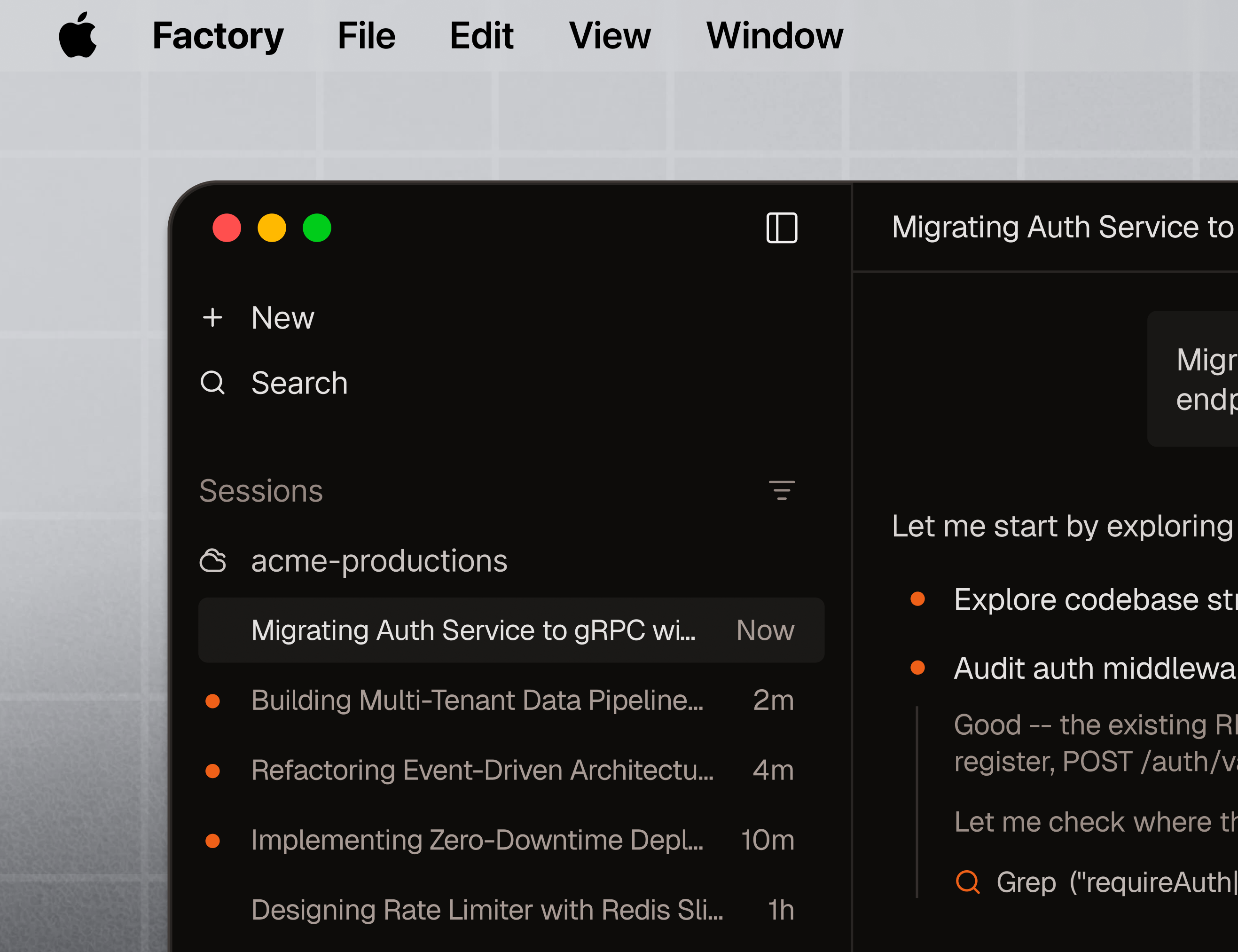
Droids are model-agnostic and interface-agnostic , they work in any IDE, CLI, Slack, or web. This is a deliberate architectural choice. A company that depends on any one model provider is not sovereign , its roadmap, costs, reliability, capabilities, and even product philosophy become downstream of another company. Being model-agnostic is finding independence.
In practice, this means Factory can integrate new frontier models on launch day without requiring users to change anything. Droids route tasks between Claude, DeepSeek, and other frontier models depending on the workload. GPT-5.6 Sol, Terra, and Luna are the latest additions to that roster. The platform also supports Factory Router for automatic model routing , picking the right model for the right task without manual selection.
Pricing and access
GPT-5.6 is now broadly available. GPT-5.6 is priced per 1M tokens: Sol is $5 input / $30 output; Terra is $2.50 input / $15 output; and Luna is $1 input / $6 output. Inside Factory, the lowest available plan is Pro at $20/month, with higher tiers at $100/month (Pro Plus) and $200/month (Max).
For teams evaluating where GPT-5.6 fits into their stack, Factory's model-agnostic approach means you can run Sol for deep architectural work, Terra for the daily edit-test loop, and Luna for fast codebase Q&A , all inside the same platform, with the same context, without switching tools. If you're part of a larger engineering team with an existing codebase, Factory is a much different experience, especially if you plug in all your tools and set up automations where Droids can run in the background and get tasks done.
Factory is available at app.factory.ai. The official docs cover model selection, session configuration, and integration setup for CLI, IDE, and Slack workflows.
Comments
