

Factory's AutoWiki Turns Outdated Code Docs Into Auto-Refreshing Build Artifacts
Factory's AutoWiki turns any repo into living, structured engineering docs that auto-refresh on every push — no manual writing required.

- AutoWiki launched: Factory's new tool auto-generates structured, browsable engineering docs from any repo, refreshing on every push.
- Multi-agent pipeline: Uses specialized agents across 6 stages — survey, plan, generate, visual capture, video rendering, and upload.
- Four output surfaces: Web viewer, GitHub wiki tab, Droid sessions, and committed directly to the repo under
droid-wiki/. - Incremental updates: After the first full run, only pages affected by new commits are regenerated, keeping costs low.
- Available now on all plans starting at $20/month; trigger with
/wikiin any Droid CLI session. - 100 open-source examples: Factory pre-generated wikis for React, Kubernetes, Rust, Grafana, and more at factory.ai/open-source-wikis.
Documentation is the part of software development everyone agrees matters and almost nobody keeps up to date. Factory's AutoWiki is a direct attack on that problem: it analyzes your repository and generates structured, browsable engineering documentation that automatically refreshes every time you push code. The pitch is simple but pointed , documentation should be a build artifact, not a side project.
The Problem It's Actually Solving
Every engineering team knows the pain. A codebase starts clean, then six months later you're staring at files that reference modules nobody remembers writing, and the wiki was last updated when the previous tech lead was still around. One of the most persistent challenges in software development is dealing with legacy code: as projects evolve, the underlying knowledge of the codebase inevitably decays, leading to significant challenges in understanding, maintaining, and modernizing it.
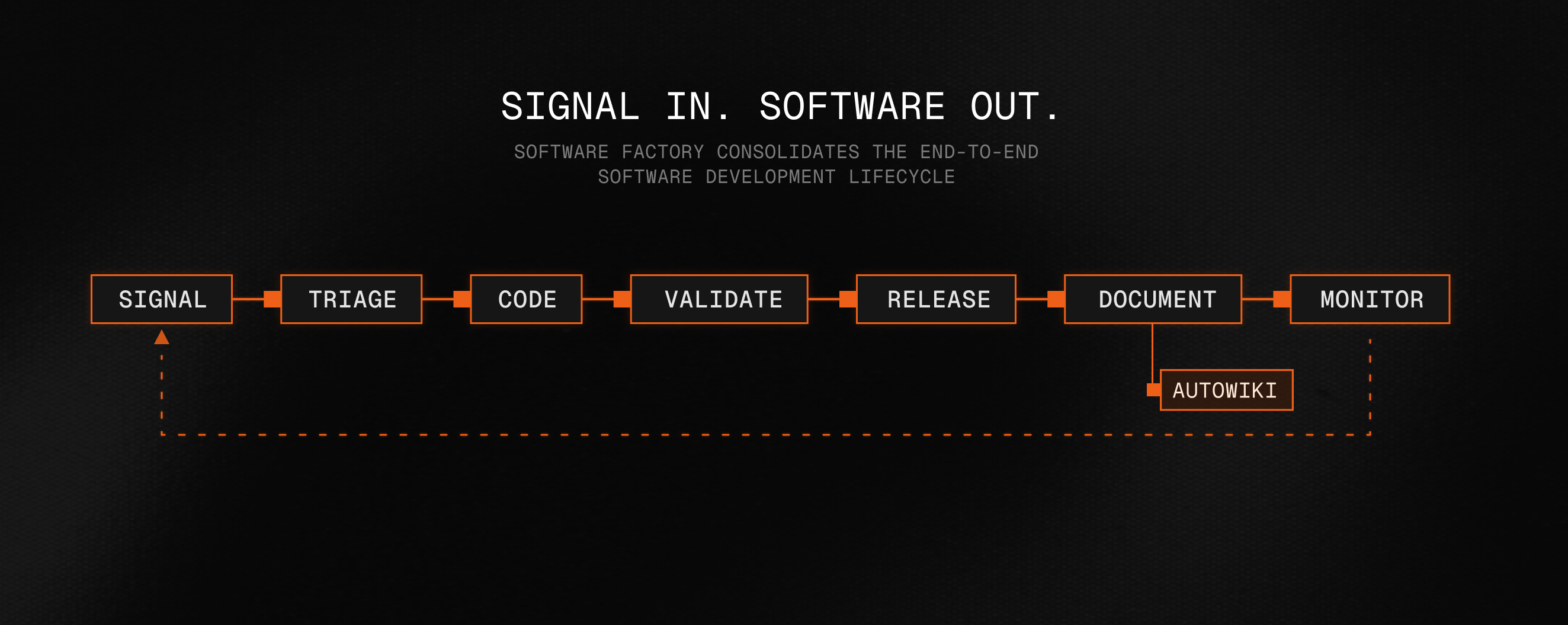
AutoWiki's answer is to treat documentation the same way CI/CD treats builds: automated, versioned, and tied to the actual state of the code. AutoWiki analyzes your codebase and generates structured, browsable documentation that stays current on every push. It's built by Factory, the agent-native software development company focused on autonomous software agents that handle full tasks in the development lifecycle, allowing human engineers to focus on high-level decisions.
What Gets Generated
AutoWiki analyzes your repository and generates structured documentation organized into sections that cover different facets of the codebase. The output isn't just a flat README dump. A generated wiki is organized into navigable sections:
- Architecture , a high-level map of major components, how they compose, and how data flows between them, including request-path diagrams
- Systems and Features , per-system and per-feature breakdowns
- Tech Stack and Project Structure , entry points, dependencies, and configuration
- How to Contribute , onboarding-focused guidance derived from the actual repo
- Reference and Lore , API references and institutional knowledge surfaced from the codebase history
Every codebase has a learning curve. AutoWiki accelerates onboarding by giving engineers up-to-date documentation from day one. New teammates can understand the architecture, key flows, how components fit together, and where to make their first change. Importantly, Droid can also use that same documentation to find the right context faster , meaning the wiki feeds back into the AI agents doing the actual coding work.
A Multi-Agent Pipeline Under the Hood
AutoWiki generation is a multi-phase, multi-agent process. Large codebases are hard to document well with a single linear pass: the important context is spread across entry points, APIs, services, configuration, and history. AutoWiki splits the work across specialized agents, each scoped to one facet of the repository with just enough context to produce a good page.
The generation pipeline runs through six stages:
- Survey , a two-pass analysis: first a structural scan of READMEs, package manifests, CI config, and entry points, then a deeper semantic scan of routes, API endpoints, service classes, database schemas, and feature flags
- Plan , the wiki structure is determined based on what was found
- Generate , pages are produced in dependency order by specialized agents
- Visual capture , screenshots and diagrams are captured from the live codebase
- Video rendering , a narrated MP4 walkthrough of the system is produced automatically
- Upload , finished artifacts are published across all surfaces
The incremental generation is worth highlighting. The first run analyzes the entire codebase; subsequent runs diff against the commit hash stored in the previous wiki's metadata and only regenerate affected pages. Unchanged pages are carried forward verbatim. This keeps refresh costs low on large repos.
Where the Wiki Lives
One of the more practical design decisions is that AutoWiki doesn't lock the output into a single surface. Every Factory-generated wiki ships to four surfaces automatically.
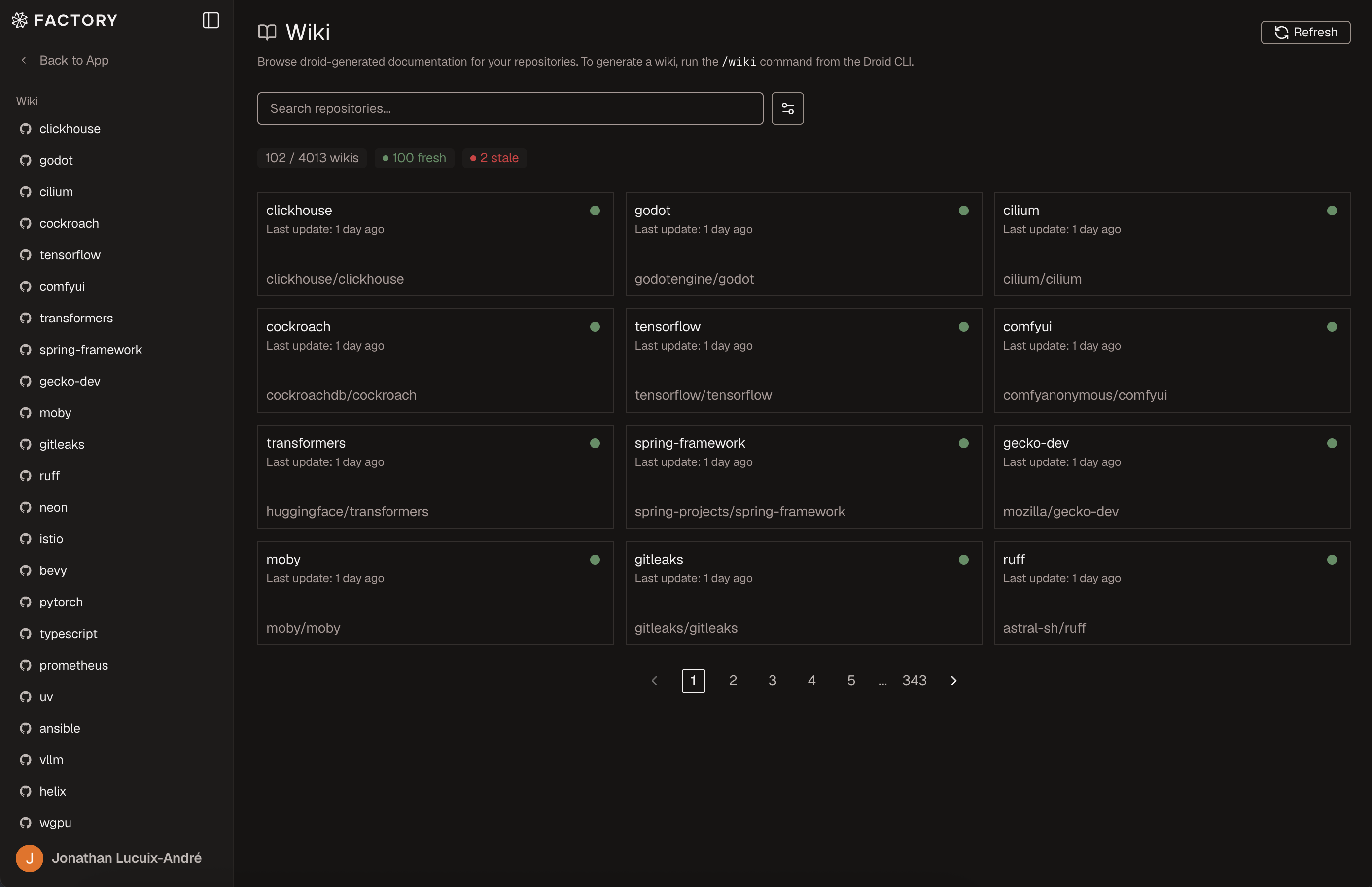
- Web viewer at
app.factory.ai/wiki, full-text search, version history by commit, and side-by-side comparisons - GitHub wiki tab , for GitHub-hosted repositories, AutoWiki automatically syncs the generated content to the repository's built-in wiki tab, so your team can browse documentation directly from the repo page
- Droid sessions , because every wiki version is preserved and indexed, Droid sessions can browse and search across all your wikis natively. Whatever your team reads to navigate the codebase, Droid reads too.
- In the repo itself , every wiki is committed under
droid-wiki/, versioned alongside the code, so doc changes show up in PR diffs and blame works on every page
The Bigger Picture: Documentation as a Build Artifact
AutoWiki fits into Factory's broader vision of a "Software Factory" , instead of one generalist agent that tries to plan, code, review, and document, Factory ships a coordinator agent that dispatches to a fleet of role-scoped droids. AutoWiki is the documentation layer of that system. Droids go beyond autocomplete to perform complex tasks such as feature development, refactoring, code review, documentation, incident response, and codebase Q&A.
The key shift in framing here is that documentation becomes a first-class output of the development process rather than an afterthought. When Droid agents are doing the coding, they need the same shared map of the system that human engineers use. AutoWiki ensures both parties are working from the same source of truth. Internally at Factory, AutoWiki saves engineers critical hours during codebase onboarding by turning each repository into a navigable system map.
How to Use It
AutoWiki is available on all Factory plans today, starting at $20/month for the Pro tier. To get started:
- Run
/wikiinside any Droid CLI session to generate a wiki for the current repo on demand - Run
/install-wikito set up a CI workflow , the command creates a CI workflow that automatically regenerates a wiki every time code is pushed to the default branch, detecting your CI framework , GitHub Actions or GitLab CI , and generating the appropriate configuration - Browse all generated wikis at
app.factory.ai/wiki
Factory also generated example wikis for 100 popular open-source repos , including React, Kubernetes, Rust, Django, and Grafana , so you can see the output quality before connecting your own codebase. You can browse them at factory.ai/open-source-wikis. The full AutoWiki documentation covers advanced configuration like custom trigger branches and path filters.
The competitive landscape for AI doc generation is getting crowded , tools like DeepWiki, DocuWriter, and CodeWiki all operate in adjacent territory. What differentiates AutoWiki is its tight integration with Factory's agentic coding platform: the wiki isn't just for humans to read, it's the shared context layer that makes the AI agents more effective. When your coding agent and your engineers are both navigating the same up-to-date system map, the feedback loop between documentation and development closes in a way that standalone doc tools can't replicate.
Comments
