

Factory's AutoWiki Turns Any Codebase Into Self-Updating Docs on Every Push
Factory's AutoWiki generates living, narrated documentation for any codebase and keeps it in sync with every push

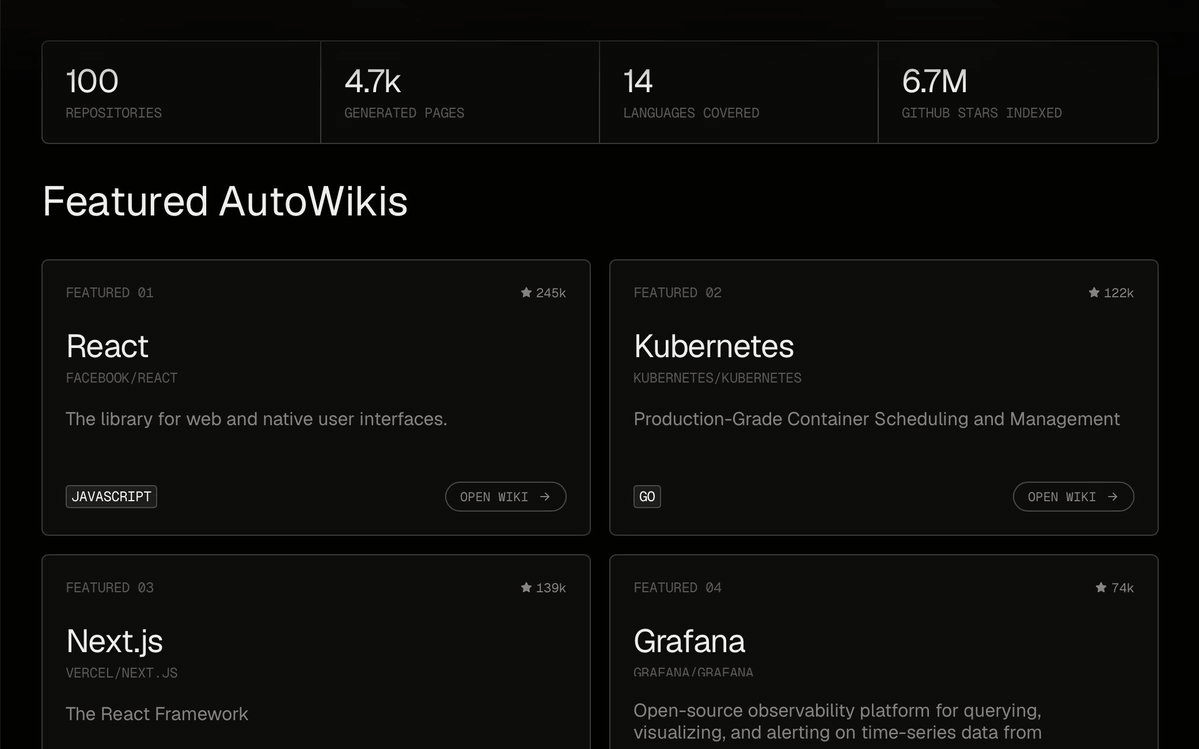
- AutoWiki is live: Factory launched AutoWiki, which auto-generates structured, browsable documentation for any GitHub or GitLab repo. Read the announcement
- 100 open-source examples: Factory published wikis for 100 popular repos (React, Kubernetes, Linux kernel, llama.cpp, etc.) covering 4,700 pages across 14 languages. Browse them here
- Multi-agent pipeline: Generation runs through six stages -- survey, plan, generate, visual capture, video rendering, and upload -- using specialized agents per facet of the codebase.
- Always current:
/install-wikiinstalls a GitHub Actions or GitLab CI workflow that regenerates docs on every push, with incremental diffing to keep costs low. - Feeds AI agents too: Droid (Factory's coding agent) reads the same wikis, giving it a pre-computed system map to retrieve context from during coding sessions.
- Pricing: Available on all plans starting at $20/month; enterprise controls allow disabling cloud sync for sensitive codebases.
Documentation is the part of software development everyone agrees matters and almost no one actually does. Factory is betting that the right fix is to make it automatic. Their new AutoWiki product generates structured, browsable documentation from a codebase and refreshes it on every push to your default branch, treating docs as a build artifact rather than a backlog item.
To show what it can do on real code, Factory has published a gallery of 100 open-source wikis spanning everything from React and Kubernetes to the Linux kernel and llama.cpp. The collection covers 14 programming languages, 4,700 generated pages, and over 6.7 million GitHub stars worth of indexed code.
What the pipeline actually does
AutoWiki is not a single prompt sent to a language model. It is a multi-phase, multi-agent process designed to handle the fact that important context in large codebases is spread across entry points, APIs, services, configuration, and history. The pipeline runs in six stages:
- Survey -- a two-pass analysis: a structural scan of READMEs, package manifests, CI config, and entry points, followed by a deeper semantic scan of routes, API endpoints, service classes, database schemas, and feature flags.
- Plan -- the system decides the wiki structure based on what it found.
- Generate -- specialized agents, each scoped to one facet of the repo, produce pages in dependency order.
- Visual capture -- screenshots and diagrams are captured from the codebase.
- Video rendering -- a narrated MP4 walkthrough is produced from the collected evidence.
- Upload -- everything is published to the Factory app, GitHub Wiki tab, and committed to
droid-wiki/in the repo itself.
The video step is worth pausing on. AutoWiki turns the repository evidence it collected into a narrated codebase walkthrough -- a video about the system itself, not a recap of the docs. That is a meaningful difference from a screen recording of someone reading documentation.
Eight types of pages, four places they land
Each generated wiki includes up to eight page types:
- Architecture -- high-level component map with data and control flow diagrams
- Systems -- deep dives into services, APIs, data, deployment, and infrastructure
- Packages -- module-level breakdowns
- How to contribute -- setup, testing, workflows, and conventions
- Lore -- historical context and design decisions baked into the codebase
- Diagrams -- visual representations of architecture
- Video walkthrough -- the narrated MP4
- API map -- endpoint and interface reference
Once generated, the wiki lands in four places automatically: the Factory web viewer at app.factory.ai/wiki (with full-text search and version history), the GitHub or GitLab wiki tab, inside Droid agent sessions, and committed directly into the repo under droid-wiki/ so it travels with forks, mirrors, and offline clones.
Staying current without manual effort
The harder problem with auto-generated docs is staleness. Factory addresses this with two mechanisms.
On-demand generation lets you run /wiki in a Droid session to regenerate from the current state of the repository.
Automated refresh uses /install-wiki to create a CI workflow (GitHub Actions or GitLab CI) that refreshes the wiki on every push to the default branch.
Both paths use incremental generation. The first run analyzes the entire codebase; subsequent runs diff against the commit hash stored in the previous wiki's metadata and only regenerate affected pages. Unchanged pages are carried forward verbatim. This keeps refresh costs low even on large repos.
Here is what the basic workflow looks like from the CLI:
# Generate a wiki for the current repo
/wiki
# Install a CI workflow that auto-refreshes on every push
/install-wiki
The agent angle
AutoWiki is not just for human readers. Because every wiki version is preserved and indexed, Droid sessions can browse and search across all your wikis natively -- whatever your team reads to navigate the codebase, Droid reads too. This matters because the quality of an AI coding agent's output is directly tied to how much relevant context it can retrieve. A well-structured wiki gives the agent a pre-computed map of the system, so it spends less time exploring and more time doing.
Factory says this is already paying off internally: AutoWiki saves engineers critical hours during codebase onboarding by turning each repository into a navigable system map.
Pricing and availability
AutoWiki is available to all plans today. Factory's pricing starts at $20/month for the Pro plan, $100/month for Plus (roughly 5x the usage limits), and $200/month for Max (10x, plus early access to new features). Teams and Enterprise tiers are available for larger organizations that need SSO, SCIM, zero data retention, and dedicated compute.
Enterprise customers who need to prevent wiki content from leaving their environment can disable AutoWiki Cloud Sync at the org level.
When disabled, all AutoWiki API endpoints return 403, the /wiki command will not store content in the Factory App, and GitHub Wiki sync is also skipped.
Where this fits in a crowded space
AI-generated documentation is not a new idea. Tools like DeepWiki (from Cognition, the team behind Devin) and open-source clones like deepwiki-open have been generating repo wikis for a while. What Factory is doing differently is treating the wiki as a first-class artifact inside a broader software development platform, where the same documentation feeds both human engineers and AI agents, stays versioned alongside the code, and refreshes automatically as part of CI. The 100 open-source examples are effectively a live demo -- a way to let teams evaluate the output quality on codebases they already know before committing to running it on their own.
Comments
