

ETH Zurich's Two-Sensor AI Catches Stroke Patients Cheating Their Rehab
A two-sensor wearable setup catches compensatory trunk movements in stroke rehab in real time, matching pricey lab motion capture on healthy subjects.
 PRO
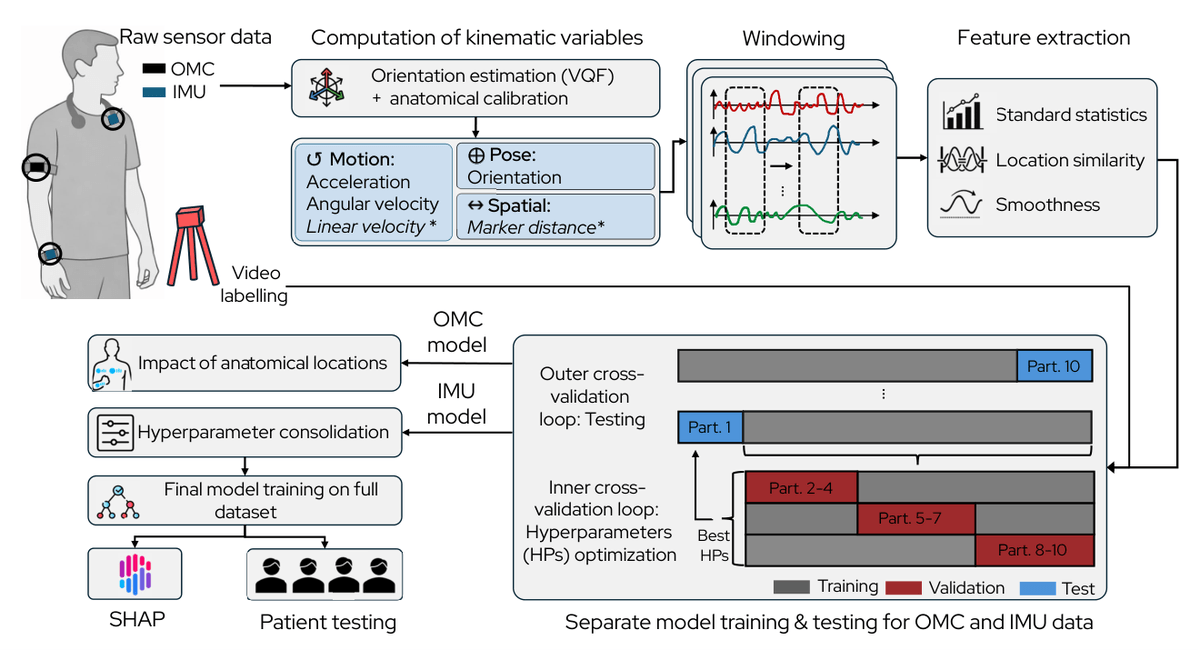
- Two-IMU setup (wrist + trunk) detects compensatory trunk movements in stroke rehab in real time.
- XGBoost model hit macro-F1 of 0.80 and ROC-AUC above 0.93 on able-bodied data.
- End-to-end latency around 120 ms makes closed-loop feedback during therapy feasible.
- SHAP analysis shows trunk dynamics contribute 64% of discriminative power, wrist-trunk coordination 30%.
- Generalization to four real patients dropped macro-F1 to 0.43 despite strong AUC of 0.78.
- Paper from ETH Zurich; no public code, commercial ties to Skaaltec AG.
Stroke survivors often cheat. Not on purpose, but because their arm has stopped cooperating. When asked to reach for a cup, they lean their whole torso forward to close the distance their elbow can no longer cover. Physiotherapists call these compensatory trunk movements (CTMs), and while they help patients get through daily tasks, they also bake in bad habits that stall real motor recovery.
A team from ETH Zurich's Rehabilitation Engineering Laboratory has shown that two small inertial sensors and an XGBoost classifier are enough to detect these movements continuously and in real time, with performance comparable to a 14-camera optical motion capture rig.
Harder than it sounds
The problem isn't detecting that the trunk moved. It's deciding whether that motion was appropriate or compensatory. Large trunk excursions can be legitimate when the task requires them, while small movements can be compensatory when they substitute for insufficient elbow extension. A person reaching for a far object is supposed to lean. A person leaning because their elbow won't extend is not.
Existing tech has trade-offs. Camera-based skeletal tracking is susceptible to occlusions and requires precise positioning or extensive calibration, limiting its use in unsupervised settings. Multi-IMU rigs cover more joints but demand careful calibration and are uncomfortable to wear all day. Single trunk-only sensors are simple but can't distinguish compensation from legitimate reaching.
This story is for Pro members
You've reached the end of the free preview. Upgrade to AlphaSignal Pro to read the full article - and everything else behind the paywall.
Comments
