



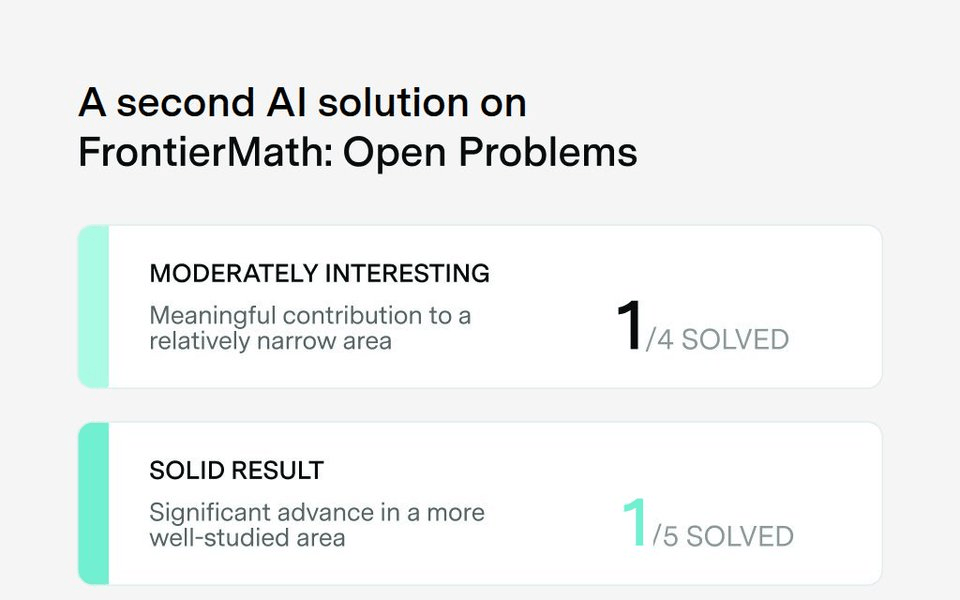
Epoch AI has announced that AI has found a presentation for the absolute Galois group of the field of 2-adic numbers , a problem that has resisted mathematicians since the early 1980s. It is the second problem to be solved on FrontierMath: Open Problems, Epoch's benchmark of genuinely unsolved research mathematics, and the first in the "Solid Result" category, meaning it carries real weight in its subfield.
What was actually solved
To understand why this matters, a little context helps. The absolute Galois group of a field is a single algebraic object that encodes all of that field's extension theory at once , every way you can adjoin roots and build larger number systems. For p-adic fields (number systems built around a prime p that capture modular arithmetic in a continuous way), explicit presentations of this group were known for all odd primes since the early 1980s, thanks to work by Jannsen and Wingberg. The prime 2 was the stubborn exception.
No explicit presentation of the absolute Galois group of Q₂ , concrete generators and concrete relations , was known. The new result fills that gap. The paper closes it, giving an explicit presentation in an enriched, "marked" sense that goes back to Jannsen and Wingberg's description for odd p.
The absolute Galois group of Q₂ is the profinite group generated by four marked elements σ, τ, x₀, x₁, subject to the tame relation τ^σ = τ², one explicit wild word relation, and the requirement that the closed normal subgroup generated by the wild generators x₀, x₁ be pro-2. A profinite group, for context, is a group built as a limit of finite groups , it's the natural algebraic structure for capturing symmetries of infinite field extensions.


Don't miss what's next in AI
Join 300,000+ engineers and researchers who get the signal, not the noise.
- Full access to in-depth AI research breakdowns
- Be the first to know what's trending before it hits mainstream
- Daily curated papers, repos, and industry moves