

Epoch Reveals OpenAI's Computing Power Grew 17x in Two Years
Epoch AI's new explorer estimates compute capacity for OpenAI, Google DeepMind, Anthropic, Meta, and xAI, revealing a 17x surge at OpenAI.
- Epoch AI launched an AI Chip Users explorer tracking compute at five frontier labs
- OpenAI grew roughly 17x in two years, reaching ~1.7M H100-equivalents by end of 2025
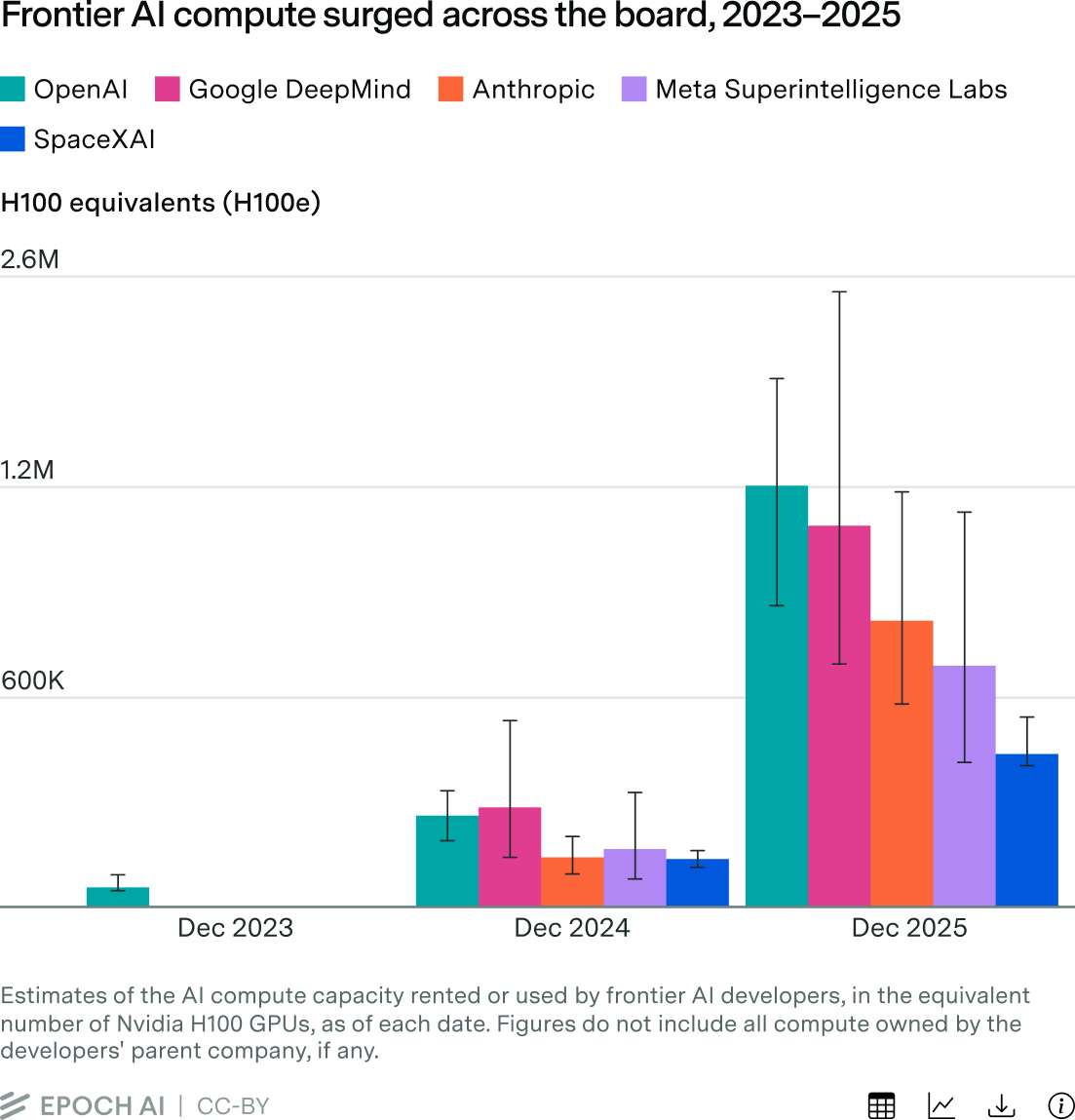
- OpenAI narrowly leads Google DeepMind on median estimates, though uncertainty ranges overlap heavily
- Anthropic (~1.19M H100e), Meta Superintelligence Labs (~996K), and SpaceXAI (~615K) round out the top five
- OpenAI and Anthropic mostly rent capacity; DeepMind and Meta share parent-company fleets
- OpenAI plans ~$50B on compute in 2026, roughly triple its 2025 budget
Tracking who actually runs the world's largest AI workloads has always been guesswork, since most frontier labs treat their GPU counts as trade secrets. Epoch AI just released a public dataset that tries to close that gap, and the headline number is striking: OpenAI's compute capacity has grown roughly 17x in two years.
The new AI Chip Users explorer covers five frontier developers: OpenAI, Google DeepMind, Anthropic, Meta Superintelligence Labs, and SpaceXAI. Estimated use includes all compute used for AI research, training, and inference by these developers, measured in the equivalent number of Nvidia H100 GPUs (H100e). The estimates blend power capacity disclosures, financial filings, third-party analyst numbers, and Epoch's own data center analysis.
The OpenAI curve
OpenAI is the only lab that has publicly disclosed its compute footprint in electrical power terms, which makes it the cleanest data point. Its reports show a tripling of the fleet annually, from approximately 0.2 GW of power at the end of 2023, to 0.6 GW at the end of 2024, and 1.9 GW at the end of 2025. For scale, 1.9 GW is enough to simultaneously power roughly 1.5 million average American homes.
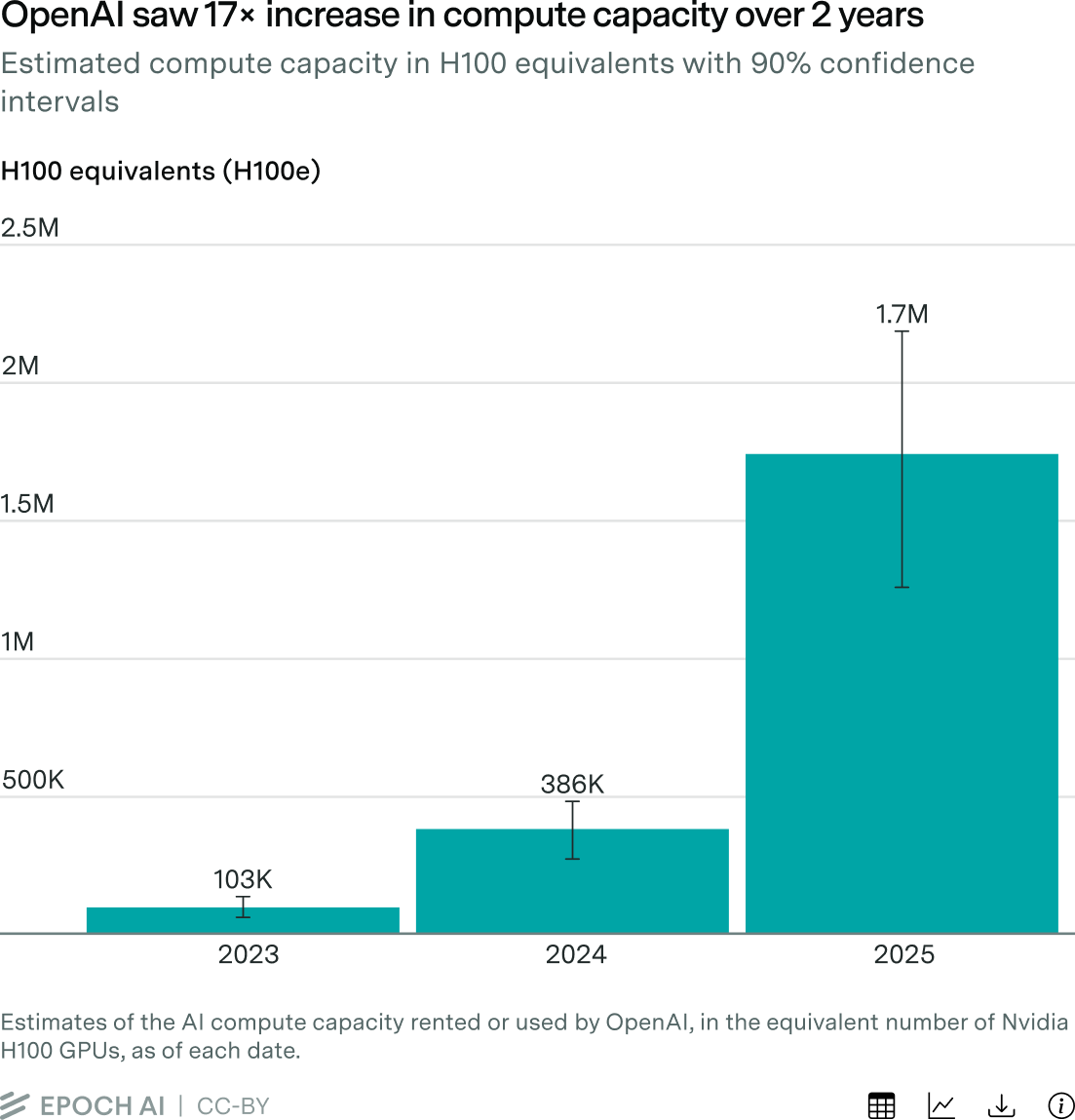
Converted into H100-equivalents, OpenAI quadrupled its computing power in both 2024 and 2025, for a roughly 17x increase over two years. With 1 million H100e a lab could run dozens of large training runs on the scale of GPT-4 simultaneously. Epoch estimates the workload split is now roughly 50/50 between R&D and inference, whereas in 2024 more of the capacity was still going to research and training runs.
Who is actually ahead
The explorer's median estimates for end of 2025 put the frontier much closer than the marketing narratives suggest:
| Lab | Median H100e | 90% CI |
|---|---|---|
| OpenAI | 1,743,000 | 1.25M-2.19M |
| Google DeepMind | 1,583,000 | 1.01M-2.55M |
| Anthropic | 1,190,000 | 842K-1.72M |
| Meta Superintelligence Labs | 996,000 | 606K-1.64M |
| SpaceXAI | 615,000 | 551K-700K |
OpenAI may have had a narrow lead over Google DeepMind at the end of last year, though the uncertainty intervals for both substantially overlap, with DeepMind's true figure potentially ranging from around 1 million to 2.5 million H100-equivalents. Anthropic was almost certainly well behind OpenAI in compute in 2025, and SpaceXAI was probably fifth.
Rented cycles versus owned racks
One of the more useful distinctions the dataset draws is between chips a lab owns and chips a lab uses. OpenAI and Anthropic own very little of the hardware they run on, instead renting from cloud providers like Microsoft, Amazon, Google, Oracle, and CoreWeave. Google DeepMind and Meta Superintelligence Labs sit inside parent companies that own enormous compute fleets, though only a fraction of that capacity is allocated to their frontier AI work.
That is why the confidence intervals on DeepMind and Meta are so wide. Nobody outside those companies knows exactly how many TPUs or internal GPUs are pointed at Gemini training versus ranking ads or serving Search.
Where the wider project fits
The users explorer slots into a larger supply chain map Epoch has been building. The full stack now covers:
- Chip components: HBM stacks, wafers, and packaging capacity consumed in manufacturing
- Chip sales: which vendors are shipping the most AI silicon
- Chip owners: the hyperscalers and neoclouds holding the inventory
- Chip users: the frontier labs actually burning cycles on it
- Data centers: the physical sites where the chips end up
Why builders should care
For anyone building models or planning infrastructure, this is a rare grounded baseline for competitive analysis that does not rely on press releases. It helps with sanity-checking claims about training run scale, estimating how much inference capacity a competitor could plausibly serve, and modelling the cost curves behind subscription pricing. The data is free to browse and downloadable under a Creative Commons license.
The forward-looking numbers suggest the gap will get harder to close. OpenAI has committed to spending approximately $50 billion on compute in 2026, roughly triple its 2025 compute budget. Anthropic has locked in massive multi-year cloud deals, and SpaceX has pivoted Colossus into a hybrid model where it rents spare capacity to outside customers including Anthropic and Google. Compute concentration among a handful of labs is accelerating.
Comments
