

Epoch Finds AI Detectors Miss 26% of Scientific Writing Disguised as Human
Epoch AI finds that style-mimicking AI fools leading detectors up to 29% of the time, with scientific writing as the biggest blind spot
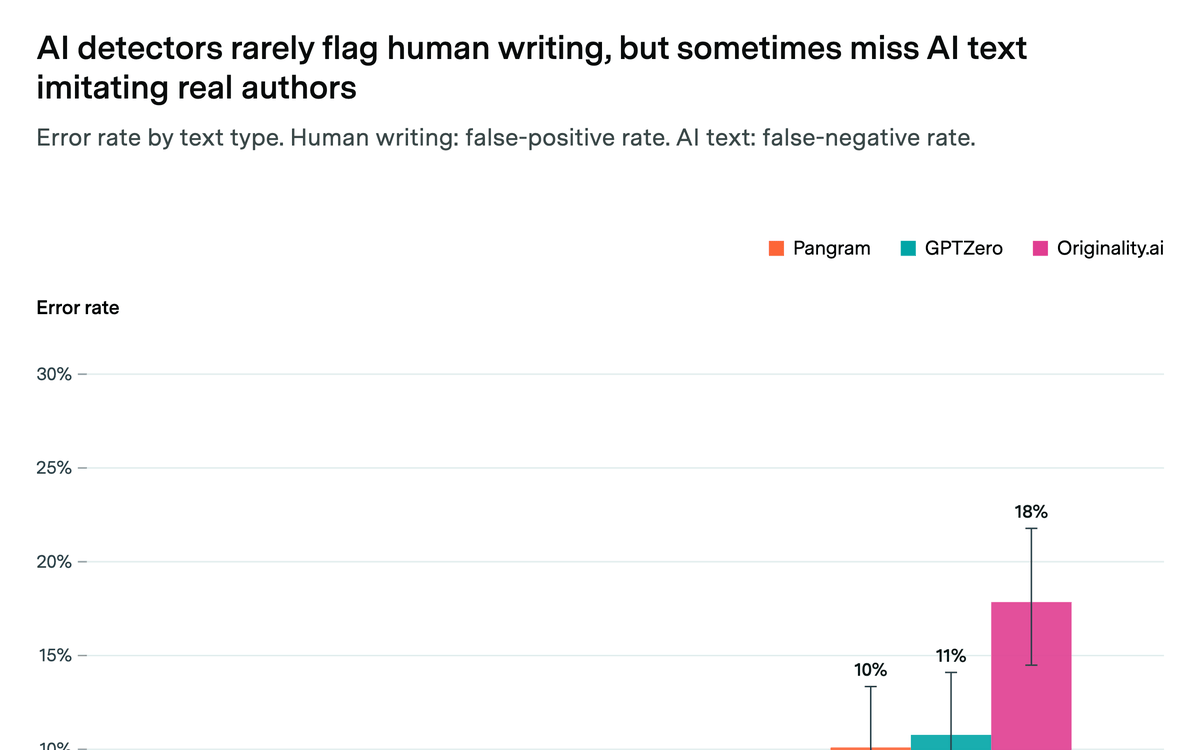
- Epoch AI tested Pangram, GPTZero, and Originality.ai on human text, basic AI prompts, and style-mimicking AI across 99 authors.
- Basic AI prompts are reliably caught: all three detectors had near-zero false negative rates (under 1%) on plainly-prompted AI text.
- Style imitation breaks detection: ~13% of author-mimicking passages went undetected on average across all genres and detectors.
- Scientific writing is the biggest blind spot: false negatives hit 24–29% across detectors, with Gemini scientific passages reaching 48% on Pangram.
- Human text is safe from false positives: Pangram and GPTZero flagged zero human passages as AI; Originality.ai had a 3.8% false positive rate.
- The full dataset and code are open-source; full methodology at Epoch AI.
AI text detectors have a well-known false positive problem: they occasionally flag real human writing as machine-generated. But a new study from Epoch AI flips the question around and asks: what happens when someone actually tries to slip AI past these tools? The answer is uncomfortable for anyone relying on detectors to police academic or scientific integrity.
The Setup: A Rigorous Stress Test
Researcher Jaeho Lee tested three of the most widely deployed AI detectors -- Pangram, GPTZero, and Originality.ai -- under three distinct conditions designed to isolate exactly where detection breaks down.
- Human writing: 495 verbatim ~500-word passages from 99 well-known authors (bloggers, fiction writers, scientists), all published strictly before ChatGPT's launch in November 2022, guaranteeing clean human-only text.
- Basic AI prompts: 297 passages generated by Claude Opus 4.8, GPT-5.5, and Gemini 3.1 Pro from bare one-line prompts like "Write a short story about a lost dog."
- Style imitation: 297 passages where each model was given five real samples of a specific author's work and asked to write a new piece in that author's style -- the most realistic evasion scenario.
All three detectors caught nearly every passage written from a simple prompt, but missed roughly one in five passages imitating a specific author's style. The full dataset and code are publicly available in the project repository on GitHub.
The Numbers That Matter
On AI text generated from basic prompts, false negative rates were near zero -- at most 0.7% across detectors. That's the good news. The bad news is what happens when you add author context.
When models were given five samples of a specific author's work and asked to mimic it, an average of 38 of 297 (~13%) of the resulting passages went undetected. Detectors performed particularly poorly on mimicked scientific writing, failing to detect ~26% of AI-generated passages.
Breaking it down by detector on scientific writing specifically:
- GPTZero missed 24% of author-mimicking scientific passages
- Pangram missed 25%
- Originality.ai missed 29%
The worst single cell in the entire study: Gemini scientific passages for Pangram hit a 48% miss rate, and 36% for GPTZero. Nearly half of Gemini-generated scientific text mimicking a real researcher's style sailed right through Pangram undetected.
Why Scientific Writing Is the Blind Spot
This is the real finding buried in the headline number. The detectors didn't fail uniformly -- they failed in a very specific place. Formal academic style, thesis-evidence-conclusion structure, and discipline-specific writing conventions mirror AI training data closely. Technical and scientific writing -- with its formal prose, standardized terminology, and objective tone -- closely resembles AI-generated technical content.
The detectors work by looking for signals that distinguish human from machine text. AI detectors score two signals from text: perplexity (how predictable each word is to a reference language model) and burstiness (how much sentence-level predictability varies). AI writing scores low on both because it picks high-probability words and keeps sentences uniform. Scientific writing, by its nature, also uses predictable vocabulary and uniform sentence structure -- which means a model imitating a scientist's style produces text that looks, to a detector, a lot like the scientist wrote it.
Pangram takes a different approach: it is a trained neural classifier that does not use perplexity, and reports that repeated "hard-negative mining" pushes its false-positive rate toward zero. Yet even Pangram struggled with scientific style imitation, suggesting the problem runs deeper than any single detection method.
Where Detectors Actually Hold Up
To be fair, the study also shows what detectors are genuinely good at. When judging genuine human text, detectors tended to be reliable -- Pangram and GPTZero correctly flagged no human writing as AI, while Originality.ai incorrectly flagged 19 of 495 passages (3.8%).
Fiction was the easiest genre for all three detectors to catch when AI-generated. Across the style-imitation condition, fiction false negatives stayed at 1-5% -- far better than the 24-29% seen in scientific writing. Blogging sat in the middle. The pattern is consistent: the more formulaic and domain-constrained the writing style, the harder it is to detect AI mimicry of it.
The Methodology Is Unusually Rigorous
One thing that sets this study apart from most AI detector evaluations is how carefully the human corpus was constructed. Every passage was published strictly before 2022-11-30 -- the launch of ChatGPT -- so they cannot contain LLM output. Passages were extracted from Wayback Machine snapshots and arXiv sources, then independently verified by 8-gram shingle coverage to confirm verbatim reproduction.
The AI generation pipeline was equally careful. For each author and model, a style-imitation piece was generated first, then a bare one-line prompt was derived from that piece's topic and used to generate the basic-prompt control. This means both conditions are matched on topic and model, isolating the effect of style imitation specifically. The study tested a single evasion method -- few-shot style imitation with five reference passages -- and did not test the effectiveness of paraphrasing tools, manual editing, or other approaches. Those would likely produce even higher evasion rates.
What This Means in Practice
The implications split cleanly by use case:
- Academic integrity tools: Detectors are reasonably reliable for catching naive AI use (basic prompts, no style guidance). But a student or researcher who provides the model with a few samples of their own past writing -- or mimics a known author's style -- has a meaningful chance of evading detection, especially in STEM fields.
- Peer review and journal screening: Scientific writing is exactly where these tools fail most. A 26% average false negative rate means roughly one in four style-mimicked scientific passages gets through. For journals using detectors as a first-pass filter, this is a significant gap.
- Content moderation at scale: For blog or fiction content generated from generic prompts, detectors remain highly effective. The evasion problem is specific to targeted style mimicry, not bulk AI content generation.
AI detection is not a "truth machine." Most tools are designed to flag risk so an instructor can look more closely, and major providers warn that results can be inaccurate and should not be used as the sole basis for penalties. The Epoch AI study makes that limitation concrete and quantifiable for the first time under a realistic evasion scenario.
The broader takeaway is structural: as frontier models get better at capturing individual writing styles -- and they clearly already can -- the gap between what detectors are designed to catch and what they actually encounter in the wild will keep widening. The detectors tested here were pinned to versions from June 2026, and the models used to generate the evasive text are among the most capable available. This is not a theoretical future problem. It's happening now.
Comments
