

Edinburgh's XpertXAI Beats Every AI X-ray Explainability Tool With Radiology Vocabulary
A concept bottleneck model built with radiologist input beats LIME, SHAP, Grad-CAM, and CXR-LLaVA on both accuracy and clinical relevance.
 PRO
- XpertXAI is a concept bottleneck model using radiologist-curated clinical concepts for chest X-ray pathology detection.
- Achieves F1 of 0.861 on multiclass MIMIC-CXR, beating InceptionV3 (0.631) and unsupervised XCBs (0.792).
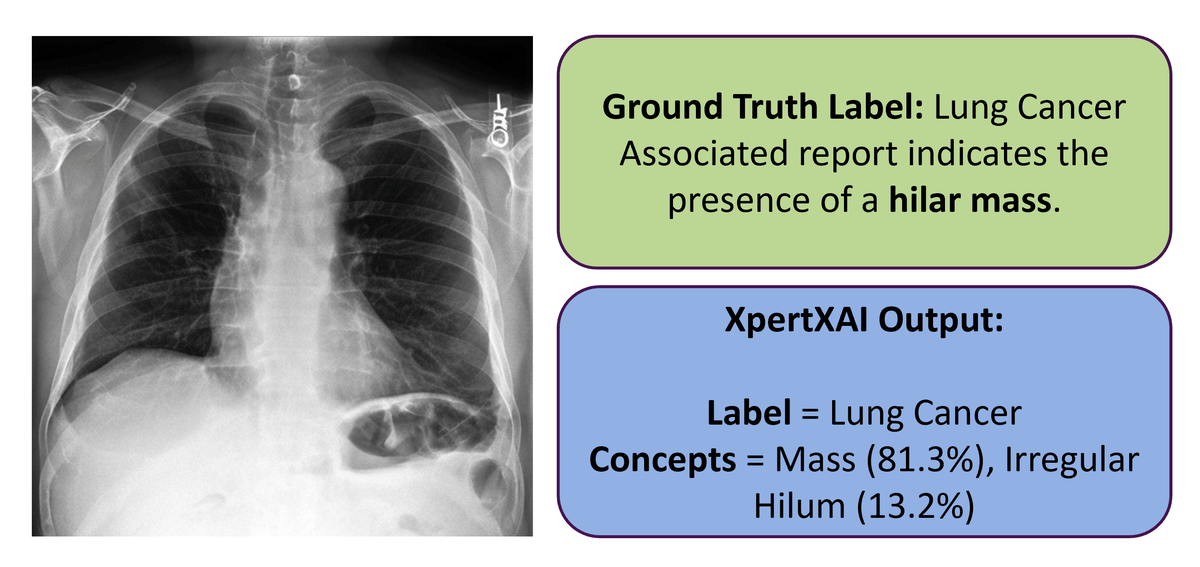
- Radiologist rated its explanations fully clinically relevant on nearly all 60 evaluated X-rays.
- LIME, SHAP, and Grad-CAM mostly scored 0 (irrelevant), often highlighting clear lung fields or non-lung regions.
- CXR-LLaVA hallucinates pathologies when prompts imply disease presence, missing cancer findings frequently.
- Code, concept lists, and extraction phrases available at github.com/AmyRaff/concept-explanations.
Deep learning classifiers can spot lung cancer on chest X-rays with impressive numbers, but the explanations they produce often point at the wrong things. A team from the University of Edinburgh and NHS Lothian put the most popular explainability techniques through a clinical stress test, and the results are damning for the current generation of post-hoc tools. Their fix, called XpertXAI, swaps saliency maps for a small vocabulary of radiologist-defined concepts, and beats every baseline they threw at it.
The trust gap in medical XAI
Explainable AI techniques generally fall into two camps. Post-hoc methods are applied after model training; ante-hoc methods are designed to make models intrinsically interpretable. The post-hoc family (LIME, SHAP, Grad-CAM) has become the default in medical AI papers, yet prior studies show these techniques often underperform in medical imaging compared to general computer vision, frequently missing clinically significant features that human experts spot easily.
Concept Bottleneck Models (CBMs) are the leading ante-hoc alternative. A CBM splits prediction into two stages: first, concepts (either pre-defined or learned unsupervised) are predicted from the input image, then those concepts determine the final label. The intermediary step is fully transparent and can be examined by an expert. The problem is that most recent CBM variants learn their concepts without any clinician in the loop, so you end up with an interpretable model whose interpretations are not necessarily clinical.
How badly do existing tools fail?
The authors ran a systematic audit on MIMIC-CXR, a large-scale public dataset of chest X-rays and associated radiological reports. Under radiologist guidance they narrowed the label set to six clinically meaningful classes (Healthy, Lung Cancer, Pneumonia, Pneumothorax, Pleural Effusion, Cardiomegaly) and trained an InceptionV3 classifier that reached a macro-average F1 score of 0.74 across the six classes.
This story is for Pro members
You've reached the end of the free preview. Upgrade to AlphaSignal Pro to read the full article - and everything else behind the paywall.
Comments
