

ECC Turns Claude Code Into a 68-Agent Engineering Workflow With 240k Stars
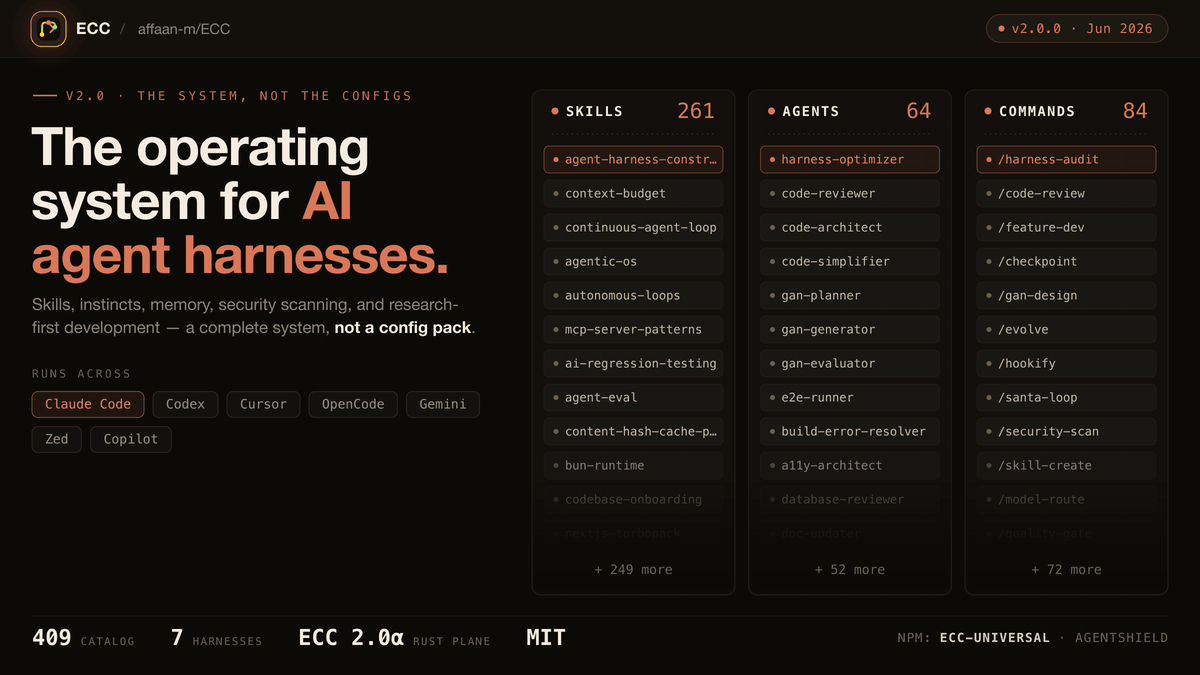
ECC gives Claude Code, Codex, and Cursor a full engineering operating system: 68 agents, 285 skills, hooks, memory, and a built-in security scanner
 PRO
- ECC is an open-source agent harness for Claude Code and 10+ other AI coding tools, now at 240k GitHub stars with 68 agents, 285 skills, and a built-in security scanner.
- The system enforces a structured plan → test → implement → review → verify → remember loop, with each phase handled by a dedicated specialized agent in its own isolated context.
- AgentShield scans your agent configs, MCP servers, hooks, and CLAUDE.md for vulnerabilities using 102 rules and a red-team/blue-team Opus pipeline.
- An instinct system automatically extracts patterns from real sessions, scores them by confidence, and injects relevant ones into future sessions -- the config gets smarter over time.
- v2.1 adds Plan Canvas: a local browser UI where you click, annotate, and approve agent-generated plans before implementation starts, plus Kimi Code support and self-hosted GPU compute.
- The core repo is MIT-licensed and free; ECC Pro (private-repo GitHub App) starts at $19/seat/month.
Most developers using Claude Code start the same way: a long CLAUDE.md file, a handful of custom prompts, and a growing pile of instructions the model occasionally ignores. Everything Claude Code (ECC) is a direct answer to that problem. Built by Affaan Mustafa over 10+ months of daily production use, it has grown from a personal config pack into what the project now calls an "agent harness performance optimization system" -- a full engineering workflow layer that sits on top of Claude Code, Codex, Cursor, OpenCode, and a dozen other AI coding tools.
From hackathon win to 240k stars
Built by Affaan Mustafa over 10+ months of daily use, ECC has evolved from a personal config pack into what its maintainer now calls an "agent harness performance optimization system" spanning Claude Code, OpenAI Codex, Cursor, and OpenCode. The origin story matters here: Mustafa and his teammate won the Anthropic x Forum Ventures hackathon in NYC, building zenith.chat entirely with Claude Code in eight hours, and the config system they used during that build became ECC's foundation. After the hackathon, Affaan published "The Shorthand Guide to Everything Claude Code" on X. The thread hit 900,000 views in a matter of days, with over 10,000 bookmarks. He then open-sourced the entire configuration system. The repo now sits at over 240,000 stars.
What you actually get
ECC provides access to 68 agents, 285 skills, and 94 legacy command shims, plus hooks, rules, memory, continuous learning, and AgentShield security scanning. The agents are specialized for planning, review, build repair, security, architecture, and domain work. That's a lot of surface area, so here's how it breaks down:
- Agents -- 68 specialized subagents that handle delegated tasks in their own isolated context. There are language-specific reviewers for TypeScript, Python, Go, Java, Kotlin, Rust, C++, F#, and more, plus dedicated agents for planning, architecture, TDD, build repair, E2E testing, and security.
- Skills -- 285 reusable workflow definitions loaded on demand. Think TDD cycles, security reviews, multi-agent orchestration, deployment patterns, and even business workflows like investor materials and article writing.
- Hooks -- Scripts that fire on harness events (session start/end, file edits, tool calls) to enforce standards outside the model's context. Auto-format on edit, secret detection before a prompt is submitted, dev-server guards -- all without touching the model's context window.
- Rules -- Always-loaded guidelines organized into a
common/base plus language-specific packs (TypeScript, Python, Go, Swift, PHP, ArkTS). They enforce things like 80% test coverage, commit format, and immutability patterns.
This story is for Pro members
You've reached the end of the free preview. Upgrade to AlphaSignal Pro to read the full article - and everything else behind the paywall.
Comments
