

Durham Team's Bayesian-ARGOS Discovers Chaos Equations 100x Faster With Uncertainty
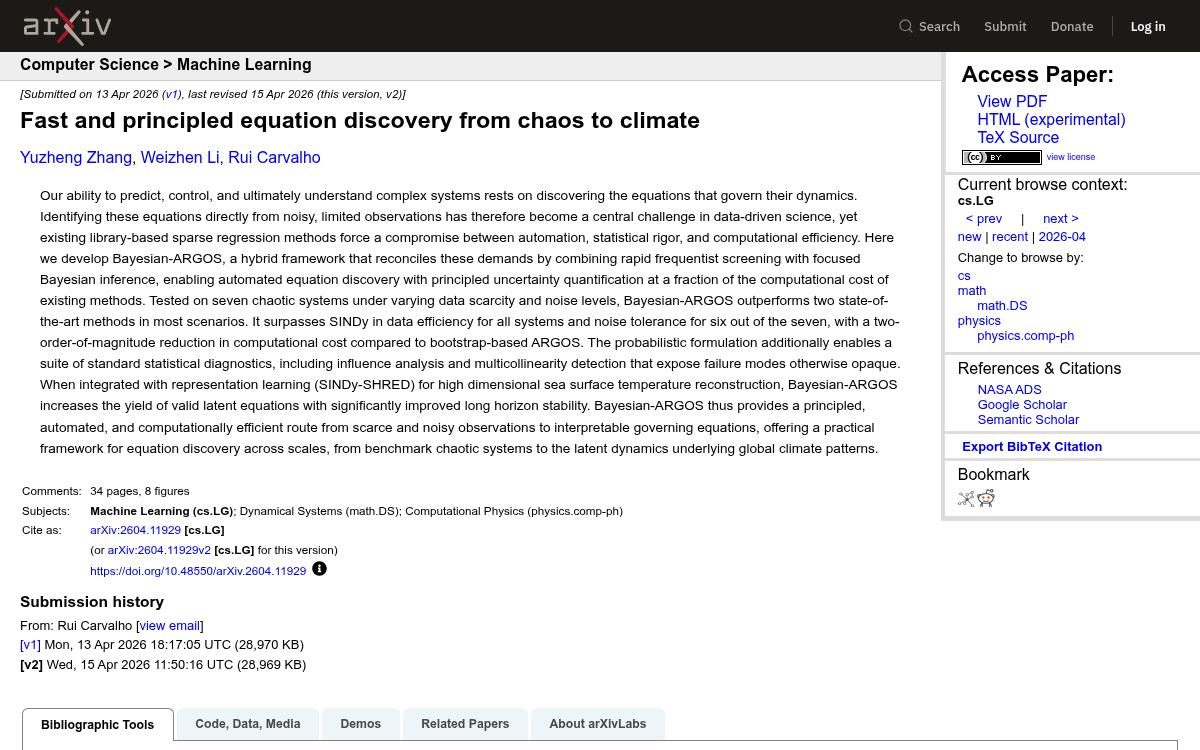
Bayesian-ARGOS combines frequentist screening with Bayesian inference to recover governing equations from noisy data 100x faster than existing methods.
 PRO
- Bayesian-ARGOS combines frequentist screening with focused Bayesian MCMC for fast, principled equation discovery. Paper
- Delivers a 100x speedup over bootstrap ARGOS while beating SINDy on data efficiency across all seven benchmark chaotic systems.
- Ships PSIS-LOO, VIF, and residual diagnostics that expose multicollinearity, influential points, and heteroscedasticity failures.
- Integrated with SINDy-SHRED, it recovered valid latent equations in 77% of NOAA sea surface temperature runs versus 60% for SINDy.
- Discovered latent SST dynamics show a 1.01-year oscillation matching the annual seasonal cycle, plus a 1.25-year transient.
- Open source in both R and Python with SINDy-SHRED integration.
Discovering the equations that govern a chaotic system from noisy observations has been stuck in a three-way tradeoff: you can have automation, statistical rigor, or computational efficiency, but rarely all three. A team from Durham University and Zhejiang University just released Bayesian-ARGOS, a hybrid framework that recovers all three at once and scales up to real climate data.
The method pairs rapid frequentist screening with focused Bayesian inference, enabling automated equation discovery with principled uncertainty quantification at a fraction of the computational cost of existing approaches. Code is available in both R and Python implementations, with the Python version including integration with SINDy-SHRED for high-dimensional problems.
The library-based sparse regression trilemma
Modern equation discovery typically follows a recipe popularized by SINDy: approximate the unknown dynamics as a linear combination of candidate basis functions (polynomials, trig terms, and so on) and use sparsity-promoting regression to pick out the terms that actually matter. What comes next is where the trouble starts.
Deterministic thresholding methods run fast, yet lack principled selection criteria and depend heavily on manually chosen hyperparameters. Bootstrap-based extensions like ARGOS add statistical rigor and confidence intervals but pay a steep price in compute. Fully Bayesian methods using MCMC give you principled uncertainty but scale poorly to the large candidate libraries typical of system identification.
Divide the labor
Bayesian-ARGOS threads the needle by splitting the work across two modules that each do what they are best at:
This story is for Pro members
You've reached the end of the free preview. Upgrade to AlphaSignal Pro to read the full article - and everything else behind the paywall.
Comments
