

Duke's AbdomenGen Builds Realistic Virtual Patients With a Single Size Dial
A new diffusion framework generates 11 abdominal organs one at a time with a single knob that scales organ size independently of body habitus.
 PRO
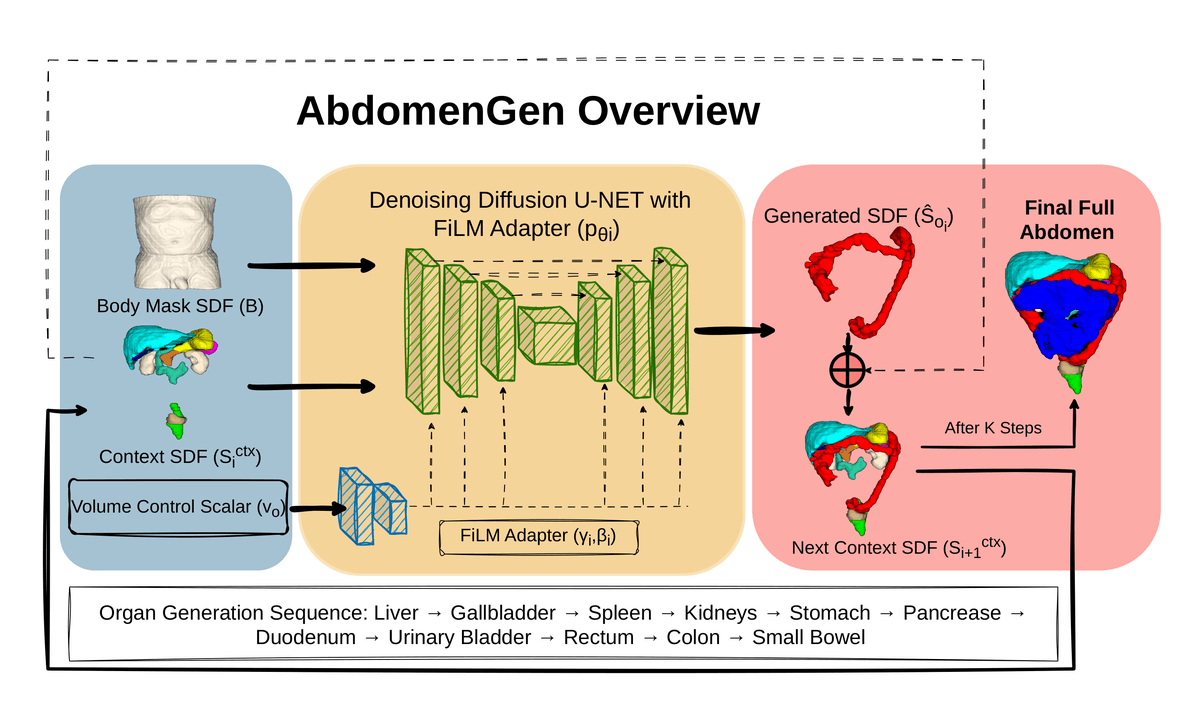
- AbdomenGen generates 11 abdominal organs sequentially using a diffusion U-Net with FiLM conditioning on signed distance fields.
- The Volume Control Scalar decouples organ size from body habitus, fixing raw-volume conditioning's contradictory-signal problem.
- Each organ conditions on the body mask and previously generated organs for global anatomical coherence.
- Liver Dice hits 0.83 plus or minus 0.05 with stable calibration across the -3 to +3 VCS range.
- Wasserstein-optimal VCS selection cut distributional distance to a MERLIN hepatomegaly cohort by 73.6% without retraining.
- Paper on arXiv from the Duke group behind XCAT 3.0 and MAISI-adjacent phantom work.
Building realistic virtual patients for medical imaging research usually means choosing between two bad options: hand-crafting anatomy that looks correct but lacks diversity, or generating diverse anatomy that violates basic biology like organs overlapping or floating outside the body. A team from Duke University proposes a middle path with AbdomenGen, a diffusion framework that generates abdominal organs one at a time with a single interpretable dial for controlling each organ's size.
The paper introduces two ideas that matter for anyone working on synthetic medical data: a sequential generation process that keeps organs spatially coherent, and a standardized size-control variable that finally makes volume conditioning behave predictably.
Why controllable phantoms are hard
Computational phantoms, essentially digital twins of human anatomy, are the workhorse of imaging research. Researchers use them to test scanners, train segmentation models, and simulate radiation exposure. Current systems for generating controlled, clinically meaningful anatomical variations remain limited. If you want to study how a CT reconstruction algorithm behaves on patients with enlarged livers, you cannot just ask most generative models to give you that population.
The naive fix is to condition a diffusion model directly on organ volume in milliliters. That breaks down quickly: a 2000 mL liver is normal in a large adult and pathological in a small child. The model gets contradictory training signals and learns nothing useful about size control. AbdomenGen's Volume Control Scalar (VCS) resolves this by providing a calibrated, interpretable axis for modulating organ size while remaining grounded in body-scale statistics.
This story is for Pro members
You've reached the end of the free preview. Upgrade to AlphaSignal Pro to read the full article - and everything else behind the paywall.
Comments
